




The significance of FLT-3L protein in the study of FLT3 mutations in acute myeloid leukemia


Acute myeloid leukemia is a highly heterogeneous group of hematologic malignancies, and its prognosis assessment involves multiple factors. Traditionally, age, history of hematologic disorders, karyotype, and gene mutation profiles have been important bases for evaluating patient prognosis, and these factors collectively determine the selection of treatment strategies.
- Recent Advances
- Product Information
I. Evolution of Prognostic Factors in Acute Myeloid Leukemia
Acute myeloid leukemia (AML) is a highly heterogeneous group of hematologic malignancies, with prognosis determined by multiple factors. Traditionally, age, hematologic history, karyotype, and mutational profiles have served as important criteria for assessing patient prognosis, collectively guiding treatment strategy selection. AML with normal karyotype was once considered intermediate-risk, but widespread application of mutation analysis has revealed various clonal mutations that continuously deepen our understanding of disease pathogenesis and prognostic evaluation. Certain mutations may reduce patient risk, such as NPM1 and CEBPA gene mutations, while others increase risk, including alterations in FLT3, RUNX1, DNMT3A, and TP53 genes. Among these, FLT3 mutations have attracted significant attention due to their high frequency and substantial prognostic impact.
II. Biological Characteristics of FLT3 Gene and Its Encoded Protein
The FLT3 gene encodes a class III receptor tyrosine kinase, normally expressed in CD34-positive hematopoietic stem cells. Upon binding with its ligand, the FLT3 receptor induces different downstream signaling pathways depending on the coexisting signaling environment. FLT-3L protein, as the natural ligand of this receptor, plays a crucial role in regulating the fate of hematopoietic progenitor cells. In the absence of other growth factors, FLT-3L binding to FLT3 receptors induces differentiation of hematopoietic progenitors into monocytes. However, when interleukin-3, stem cell factor, and FLT-3L coexist, FLT3 receptor activation promotes progenitor cell proliferation and self-renewal. This signal integration mechanism demonstrates the complexity of hematopoietic regulation and reveals the precise control of FLT3 signaling in normal hematopoiesis.
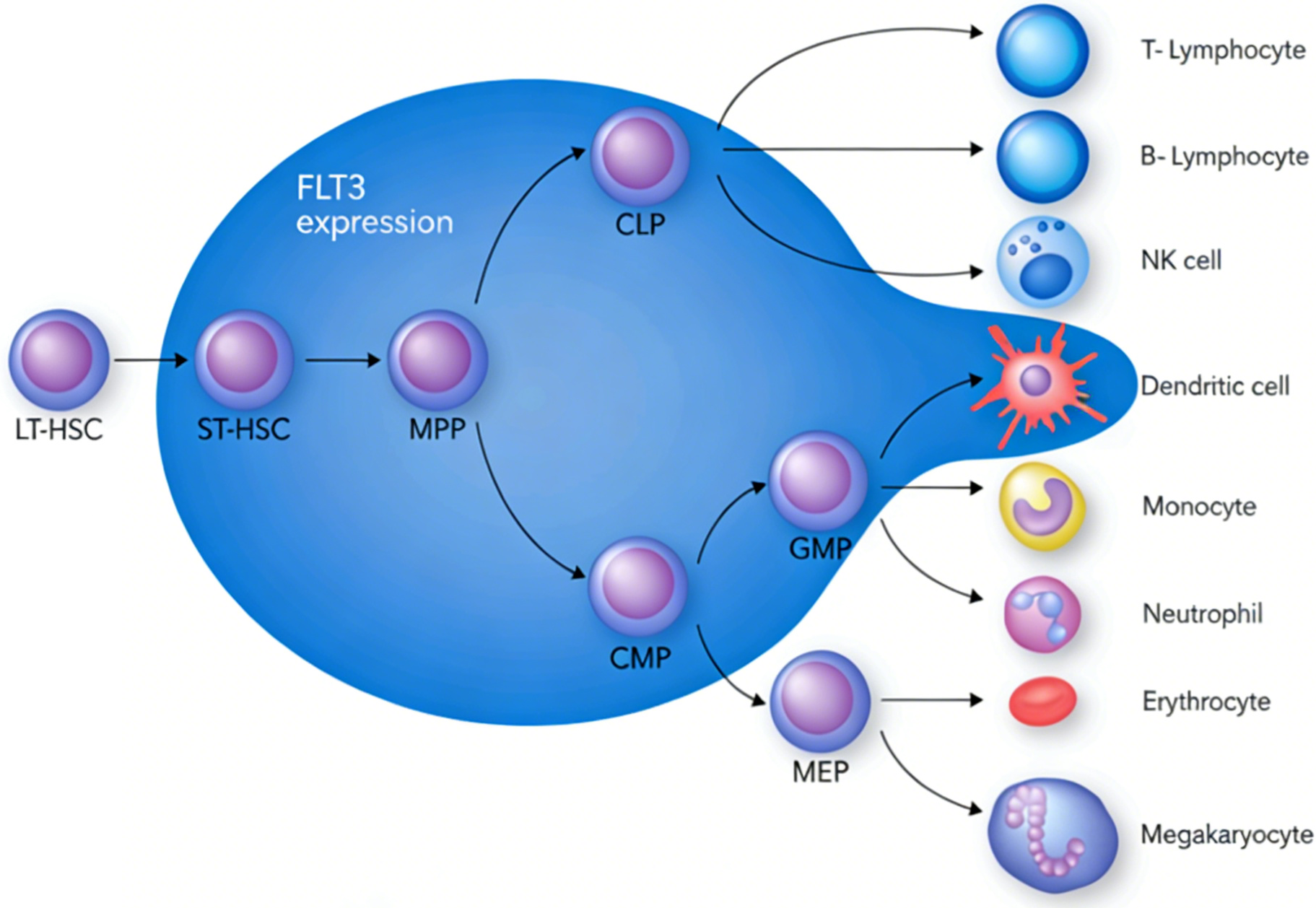
III. Major Types and Molecular Features of FLT3 Mutations
AML patients with diploid cytogenetics frequently carry FLT3 mutations, indicating these mutations serve as important leukemogenic drivers. Two classes of FLT3-activating mutations have been identified in AML patients. The first involves internal tandem duplications (ITD), consisting of in-frame repeats of 3 to 400 base pairs, detectable in 20-25% of patients. FLT3-ITD mutations cause ligand-independent constitutive activation of the receptor, persistently stimulating downstream pathways including STAT5, PI3K, and AKT. The second class comprises point mutations, most commonly aspartate-tyrosine mutations in the tyrosine kinase domain, found in 5-10% of patients. FLT3-TKD mutations similarly activate proliferative pathways but demonstrate different clinical significance compared to ITD mutations.
IV. Prognostic Impact of FLT3 Mutations in AML
FLT3 mutation types correlate closely with clinical outcomes. FLT3-ITD mutations show positive association with higher white blood cell counts, explaining the molecular basis of elevated WBC as an adverse prognostic factor. Patients with FLT3-ITD mutations are typically younger than classical AML patients. Although most achieve remission through conventional induction chemotherapy, their complete remission duration is significantly shorter than age-matched controls without this mutation, with markedly higher relapse rates, rapid progression post-relapse, and poorer overall survival. This high relapse propensity and rapid progression establish FLT3-ITD as a critical adverse prognostic marker in AML. In contrast, FLT3-TKD mutations exhibit neutral effects on overall survival, suggesting mechanistic and clinical differences between mutation classes.
V. Mechanisms of FLT3 Signaling in Leukemogenesis
FLT3 mutations cause constitutive activation of receptor tyrosine kinases, subsequently stimulating multiple proliferative and anti-apoptotic pathways. Under normal physiological conditions, FLT3 signaling is tightly controlled, requiring FLT-3L interaction for activation. However, ITD mutations maintain receptor activation without ligand binding, disrupting signaling homeostasis. Mutant FLT3 persistently activates STAT5 pathways to promote anti-apoptotic gene expression while enhancing cell survival signals through PI3K-AKT pathways. These aberrantly activated pathways synergistically promote leukemic cell proliferation and survival, driving malignant clonal expansion. Cooperative effects between FLT3 mutations and other genetic alterations further increase disease heterogeneity and influence treatment response.
VI. Significance of FLT-3L Protein in Research
As the natural ligand of FLT3 receptor, FLT-3L protein plays important roles in both normal hematopoietic regulation and leukemogenesis. Through receptor binding, this protein participates in regulating hematopoietic stem cell proliferation, differentiation, and survival. In the context of FLT3 mutations, FLT-3L's functional patterns change as mutant receptors become partially ligand-independent. Studying FLT-3L interactions with mutant receptors helps elucidate molecular mechanisms of FLT3 signaling dysregulation. Furthermore, FLT-3L levels may reflect hematopoietic microenvironment status, with potential correlations to disease progression and treatment response warranting further exploration. In-depth investigation of FLT-3L biology will provide crucial insights into FLT3 mutation roles in AML.
VII. Suppliers of FLT-3L Protein
Nanjing UA-Biotech Co., Ltd (UA-Bio) has independently developed "FLT-3L Protein, Mouse", a premium recombinant protein reagent specifically designed for hematopoietic stem cell expansion, dendritic cell differentiation, and immunocyte therapy research. This murine Fms-like tyrosine kinase 3 ligand (FLT-3L) efficiently activates FLT-3 receptor signaling to promote proliferation and differentiation of hematopoietic stem cells, progenitor cells, and dendritic cells, providing researchers in hematopoietic development, cancer immunotherapy, and vaccine development with stable, reliable standardized tools.
| Core Product Advantages |
|---|
| High Purity & Full Bioactivity: Utilizing advanced recombinant expression systems and standardized purification processes with multi-dimensional QC validation, the product achieves >95% purity, correct native conformation, and complete biological function. It effectively binds murine FLT-3 receptor, faithfully replicating FLT-3L-mediated hematopoietic stem cell expansion, progenitor survival, and dendritic cell differentiation signals under physiological conditions. |
| Excellent Batch Consistency & Stability: Rigorous management from gene construction to protein expression and purification QC, combined with comprehensive release testing, ensures stable bioactivity, consistent purity, and superior long-term stability across batches, providing solid reliability for continuous hematopoietic and immune cell research. |
| Versatile Research Tool: The protein performs exceptionally in hematopoietic stem cell (HSC) expansion, dendritic cell (DC) differentiation, primary cell culture, immunocyte therapy, and vaccine development systems, broadly applicable for HSC maintenance, DC vaccine preparation, signaling research, and drug activity evaluation. |
| Low Endotoxin & High Batch Uniformity: Multi-step chromatography purification and endotoxin removal processes yield ultra-low endotoxin levels (<0.1 EU/μg), meeting stringent requirements for cell culture and animal studies. Strict QC ensures high inter-batch consistency in activity and purity. |
| Complete Solutions & Professional Support: We provide thoroughly validated protocols, representative bioactivity data, and detailed certificates of analysis to facilitate rapid establishment of stable, reproducible workflows. Nanjing UA-Bio's expert team offers comprehensive technical consultation and support for experimental design, optimization, and data analysis. |
Nanjing UA-Biotech Co., Ltd remains committed to providing cutting-edge, high-quality core reagents and tools for immunology, cell therapy, and innovative drug development. For detailed technical parameters (Catalog#: UA040159), validation data, or application inquiries regarding "FLT-3L Protein, Mouse", please feel free to contact us.
This article is reviewed and published by the technical expert team of UA
Disclaimer: This article partially utilizes artificial intelligence assistance in its creation. If any content involves copyright or intellectual property issues, please let us know and we promise to verify and remove it as soon as possible.
Purchase recombinant protein, choose Nanjing UA-Bio
UA protein focuses on providing various protein reagents, raw materials, and services required for drug research and development, cell therapy, gene therapy, and basic scientific research, including drug target proteins, immune checkpoint proteins, cytokines, tool enzymes, customized protein expression, and full-length transmembrane protein development. Youai is committed to providing customers with high-quality products and professional services, and building a High-tech Biological Enterprise with International Competitiveness.







 Business license (three certificates in one)