




The mechanism and research progress of GM-CSF protein in cytokine storm


SARS-CoV-2 infection typically causes lymphocytopenia and the release of inflammatory cytokines, with cytokine storms considered one of the critical factors leading to disease progression in patients.
- Recent Advances
- Product Information
1. Mechanisms and Research Background of Cytokine Storm
SARS-CoV-2 infection typically causes lymphopenia and inflammatory cytokine release, with cytokine storm being considered one of the major reasons for disease progression in severe cases. During CAR-T cell therapy, T cell activation similarly releases large amounts of inflammatory cytokines, triggering cytokine release syndrome (CRS), where IL-6 plays a key role, forming the conventional strategy of using IL-6 monoclonal antibodies to address CRS. Although the cytokine storm triggered by SARS-CoV-2 differs in etiology from CRS induced by CAR-T therapy, they share similarities in clinical manifestations and pathogenic mechanisms. Clinical studies show that levels of inflammatory cytokines such as IL-6, IL-10, and TNF-α are significantly elevated in severe COVID-19 patients, suggesting their involvement in disease progression.
2. The Critical Role of GM-CSF Protein in Cytokine Storm
Researchers from the Chinese Academy of Sciences analyzed the immune characteristics of SARS-CoV-2-infected patients and found that GM-CSF protein levels were significantly elevated in severe cases, showing stronger correlation than IL-6. The study revealed that GM-CSF-positive CD8+ T cells were significantly associated with ICU admission, while IL-6 and TNF-α did not show such correlation. Additionally, GM-CSF-positive CD4+ T cells and GM-CSF-induced CD14+CD16+ monocytes were also closely linked to ICU admission. These findings suggest that GM-CSF protein may play a more critical role in severe COVID-19 patients, providing a new target for cytokine storm intervention.
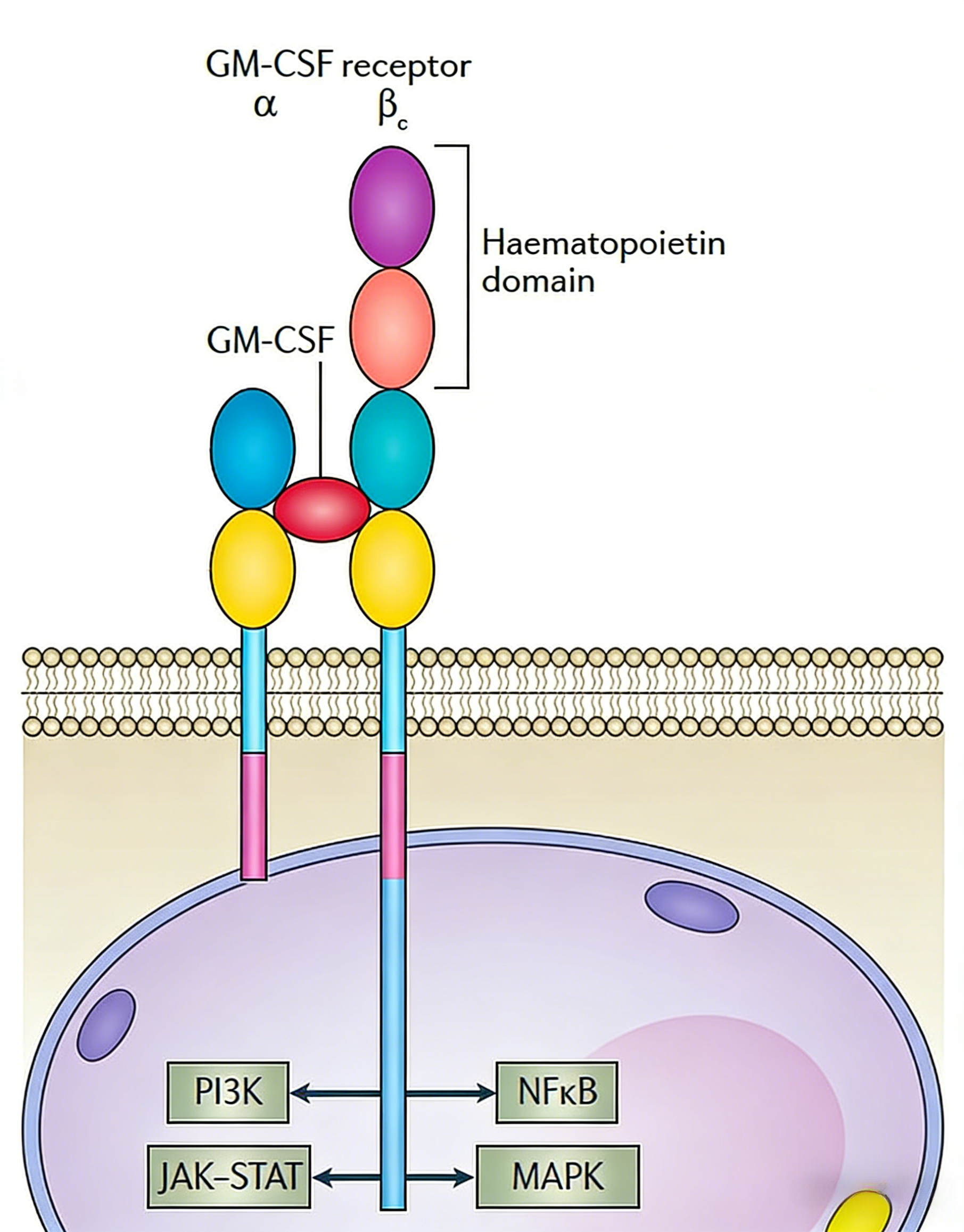
3. Structure and Signal Transduction Mechanism of GM-CSF Protein
GM-CSF protein is a secreted cytokine expressed in various immune cells, including granulocytes, dendritic cells, T cells, and B cells. Its receptor consists of two subunits: an α chain and a β chain, with the β chain being shared by GM-CSF, IL-3, and IL-5. Upon binding to its receptor, GM-CSF forms hexameric and dodecameric complexes, activating downstream signaling pathways such as JAK-STAT, PI3K, and NFκB. These pathways mediate the broad biological functions of GM-CSF in cell survival, proliferation, differentiation, and inflammatory responses. Its role in inflammatory diseases provides a molecular basis for targeted intervention.
4. Mechanistic Differences Between Targeting GM-CSF and Targeting IL-6
Mechanistically, blocking GM-CSF protein can inhibit granulocyte activation and reduce the production of multiple downstream cytokines. In contrast, blocking IL-6 primarily reduces IL-6 itself, with limited effects on granulocyte activation and downstream cytokine production. Cytokine storm involves various cytokines and chemokines such as MCP-1, MIP1a, MIG, IP10, and IL-1. Blocking GM-CSF can simultaneously suppress the production of these factors, offering broader control over inflammatory responses. In clinical practice, IL-6 monoclonal antibodies show limited efficacy in alleviating cytokine-related neurotoxicity during CAR-T-induced CRS, suggesting that targeting a single inflammatory factor may have limitations. This further supports the research value of GM-CSF as a target for cytokine storm intervention.
5. Research Value of GM-CSF in Inflammatory Diseases
GM-CSF protein plays an important role in various inflammatory diseases, and intervention strategies targeting this protein have entered clinical research stages for autoimmune diseases such as rheumatoid arthritis. In CAR-T therapy, studies on GM-CSF antibodies demonstrate that such interventions can enhance CAR-T antitumor effects while reducing levels of chemokines (e.g., MCP-1, IP-10) and cytokines (e.g., IL-6, IL-1), lowering neurotoxicity incidence without introducing new safety risks. These findings provide a preliminary foundation for the application of GM-CSF-targeted strategies in cytokine storm intervention.
6. Application Prospects of GM-CSF-Targeted Strategies
Given the critical role of GM-CSF protein in the immune characteristics of severe infection patients, clinical research on intervention strategies targeting this protein is underway. GM-CSF antibody drugs developed by various research institutions have completed early clinical studies for indications such as rheumatoid arthritis and are planned to expand to cytokine storm-related indications. These drugs neutralize GM-CSF protein, blocking granulocyte activation and downstream cytokine cascades to control excessive immune responses. Compared to single-target interventions, GM-CSF-targeted strategies may offer broader inflammatory control. As understanding of the immunopathological mechanisms of SARS-CoV-2 infection deepens, research on GM-CSF as a key target for cytokine storm will continue to advance.
7. Which Manufacturers Provide GM-CSF Protein?
Nanjing UA-Biotech Co., Ltd. (UA-Bio) has independently developed "GM-CSF Protein, Human", a high-quality recombinant protein reagent specifically designed for immune cell culture, dendritic cell differentiation, and tumor immunology research. This protein is human granulocyte-macrophage colony-stimulating factor (GM-CSF), which efficiently activates GM-CSF receptor signaling pathways, promoting the proliferation and differentiation of granulocytes, macrophages, and dendritic cells. It provides a stable and reliable standardized tool for research in hematopoietic development, cell therapy, and vaccine development.
| Core Product Advantages |
|---|
| High Purity and Full Biological Activity: The product employs internationally leading recombinant expression systems and highly standardized purification processes, validated through multidimensional quality control to ensure >95% purity, correct native conformation, and full biological functionality. The protein efficiently binds to human GM-CSF receptor complexes, accurately mimicking GM-CSF-mediated myeloid cell differentiation, dendritic cell maturation, and immunoregulatory signals under physiological conditions. |
| Excellent Batch-to-Batch Consistency and Stability: Strict management from gene construction, protein expression to purification and quality control, combined with a comprehensive release testing system, ensures stable biological activity, consistent purity, and excellent long-term stability for each batch. This provides reliable quality assurance for long-term and continuous immune cell culture and mechanistic research. |
| Ideal Tool for Multiple Applications: This protein performs excellently in various application systems, including in vitro dendritic cell (DC) induction and differentiation, macrophage polarization studies, hematopoietic stem cell expansion, immune cell therapy, and vaccine development. It is widely applicable to DC vaccine preparation, myeloid cell function research, signaling pathway analysis, and drug activity evaluation. |
| Low Endotoxin and High Batch Consistency: The product undergoes multi-step chromatography purification and endotoxin removal processes, with extremely low endotoxin levels (<0.1 EU/μg), meeting stringent requirements for cell culture and functional experiments. A rigorous quality control system ensures high consistency in protein activity and purity across batches. |
| Comprehensive Solutions and Professional Support: We provide fully validated standard experimental protocols, typical biological activity data, and detailed product analysis certificates to help you quickly establish stable and reproducible experimental workflows. Nanjing UA-Bio's professional technical team offers全程,专业的技术咨询与支持 (full-process, professional technical consultation and support) for your research design, experimental optimization, and data analysis. |
Nanjing UA-Biotech Co., Ltd. is committed to providing cutting-edge, high-quality core reagents and tools for immunology, cell therapy, and innovative drug development. For detailed technical parameters, validation data, or specific application inquiries regarding "GM-CSF Protein, Human" (Product No.: UA040002), please feel free to contact us.
This article is reviewed and published by the technical expert team of UA
Disclaimer: This article partially utilizes artificial intelligence assistance in its creation. If any content involves copyright or intellectual property issues, please let us know and we promise to verify and remove it as soon as possible.
Purchase recombinant protein, choose Nanjing UA-Bio
UA protein focuses on providing various protein reagents, raw materials, and services required for drug research and development, cell therapy, gene therapy, and basic scientific research, including drug target proteins, immune checkpoint proteins, cytokines, tool enzymes, customized protein expression, and full-length transmembrane protein development. Youai is committed to providing customers with high-quality products and professional services, and building a High-tech Biological Enterprise with International Competitiveness.







 Business license (three certificates in one)