

2-hour ultra-stable glow, leading the way—UA-Glo® NAD(P)H Detection System, born for HTS


Nicotinamide adenine dinucleotide (NAD⁺/NADH) and its phosphorylated derivatives (NADP⁺/NADPH) are essential coenzymes for cellular energy metabolism and redox homeostasis.
- Recent Advances
- Product Information
Nicotinamide adenine dinucleotide (NAD⁺/NADH) and its phosphorylated derivatives (NADP⁺/NADPH) are indispensable coenzymes for cellular energy metabolism and redox homeostasis. As the regulator of "energy currency," NAD⁺ drives key reactions such as glycolysis, the tricarboxylic acid cycle, and oxidative phosphorylation. Meanwhile, NADH and NADPH serve as electron donors, participating in core pathways that maintain cellular homeostasis, including fatty acid synthesis, antioxidant defense, and DNA repair. Studies have shown that dynamic changes in NAD⁺ levels are closely associated with aging, neurodegenerative diseases, cancer, and metabolic disorders.
The UA-Glo® NAD(P)H Detection System (Catalog #: UA079042) offers researchers and drug developers worldwide a precise, simple, stable, and high-throughput solution, powered by homogeneous coupled enzyme luminescence technology.
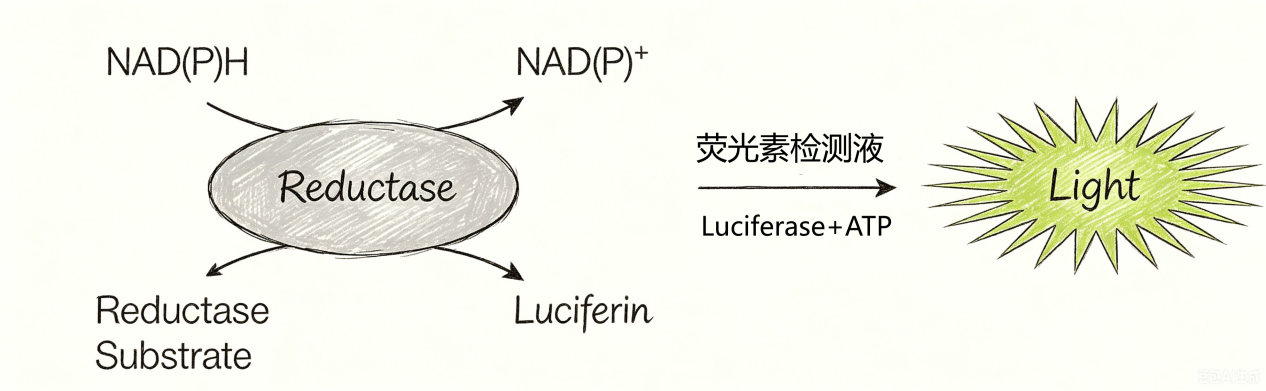
The core of the UA-Glo® NAD(P)H detection reagent lies in its dual-enzyme coupled reaction system. This system includes a highly efficient reductase and a highly active luciferase. The reductase equivalently utilizes NADH or NADPH in the sample as substrates to catalyze the conversion of specific substrates into luciferin molecules. Subsequently, the luciferin produces stable and intense bioluminescent signals under the catalysis of luciferase.
Core Advantages: Elevating NAD(P)H Detection from "Slow and Meticulous" to "Standardized Workflow"
1. Extremely Simple Operation—True "Add and Read" Homogeneous Assay
Traditional NAD(P)H detection often resembles conducting a multi-threaded symphony—requiring separate steps for NAD⁺ and NADH extraction, neutralization, heat inactivation, and more, which easily introduces human error. UA-Glo® liberates researchers from these complexities. As a homogeneous reagent, the workflow requires only "one-step addition"—simply mix the reagent with the sample and test inhibitors in the well, then proceed to luminescence detection, eliminating the need for additional centrifugation, separation, or purification steps. Compared to colorimetric and fluorescent methods, this not only significantly reduces experimental errors caused by multiple operations but also drastically shortens manual handling time.
2. Exceptionally Stable Glow Signals—"The Ultimate Gain for Enzyme Inhibition Screening"
In high-throughput drug screening or large-scale sample analysis, signal stability directly determines data reliability and throughput capacity. The UA-Glo® detection system delivers exceptionally stable bioluminescent glow signals with a half-life exceeding 2 hours. This means that even when processing hundreds or thousands of samples sequentially or in batches, luminescence intensity remains highly uniform for hours, completely free from the "signal decay during addition" issue. This feature makes it an ideal partner for high-throughput screening (HTS) of enzyme inhibitors based on NAD(P)H metabolism.
3. High Signal-to-Noise Ratio and Excellent Reproducibility
Due to the zero-background nature of bioluminescent detection, the UA-Glo® detection system outperforms traditional colorimetric and fluorescent methods in both sensitivity and specificity. Background signals are negligible, eliminating the need for complex corrections. Meanwhile, the homogeneous design and stable enzyme-coupled reactions ensure intra- and inter-batch data reproducibility, providing robust support for rigorous quantitative analysis.
Comparison of Different NAD(P)H Detection Methods
| Method Category | Detection Principle | Features | Major Limitations |
|---|---|---|---|
| Bioluminescence | Reductase + Luciferase Coupled Reaction | Homogeneous, high sensitivity, wide dynamic range, no fluorescence interference, stable signals, HTS-compatible | Cannot distinguish NADH and NADPH |
| UV Absorbance | Direct absorption of NAD(P)H at 340 nm | Simple operation, no reagents required | Low sensitivity (requires µmol/L level), severe interference from background metabolites |
| Autofluorescence | Natural fluorescence of NAD(P)H at 340 nm excitation/460 nm emission | Suitable for live-cell real-time imaging | NADH and NADPH share identical spectra; interference from tissue and medium autofluorescence |
| MTT/PES-Based Enzyme Cycling Colorimetry | NAD(P)H amplifies signals via redox cycling, producing colored/fluorescent products | Higher sensitivity than direct optical methods | Heterogeneous, complex steps, significant batch variability |
| LC-MS / LC-MS/MS | Direct detection based on mass and ionization efficiency | High resolution, distinguishes NAD⁺ and NADH, sensitivity at nmol level | Expensive equipment, complex sample preparation, low throughput |
Application Scenarios: Empowering Cutting-Edge Research
1. High-Throughput Screening of Enzyme Inhibitors
For metabolic enzymes (e.g., dehydrogenases, reductases), kinases, or any enzyme targets dependent on NAD(P)H as substrates or cofactors, inhibitor screening is one of the most routine yet critical steps in drug discovery.
2. Assessment of Cellular Energy Metabolism Status
By measuring changes in intracellular NAD(P)H levels under different conditions (e.g., drug treatment, gene knockout, metabolic stress), researchers can directly quantify cellular reducing power and oxidative stress. This metric provides key phenotypic evidence for studies on tumor metabolic reprogramming, mitochondrial dysfunction, and inflammatory pathway activation.
3. Universal Enzyme Activity Assay System
NAD(P)H is a direct product or reactant in hundreds of oxidoreductase reactions. Through signal amplification, UA-Glo® converts any enzyme reaction involving NAD(P)H generation or consumption into highly sensitive luminescent output, serving as a versatile "enzyme activity reporter tool."
Recommended Related Products
| Catalog # | Product Name |
|---|---|
| UA079042 | UA-Glo® NAD(P)H Detection System |
Other Bioluminescent Products
| Catalog # | Product Name | Notes |
|---|---|---|
| UA070101 | UA-Glo® Kinase ADP Assay | Kinase assay kit |
| UA079021 | UA-Glo® Kinase ADP Max Assay Kit | |
| UA079044 | ActRIIA Enzyme Activity Inhibitor Screening Kit | |
| UA079045 | ActRIIB Enzyme Activity Inhibitor Screening Kit | |
| UA079043 | UA-Glo® Kinase ADP Assay with PI3K Substrate PIP2:3PS | |
| UA079024 | UA-Glo® AMP Assay Kit | AMP detection |
| UA070103 | UA-Glo® Luminescent Cell Viability Assay | Cell viability assay |
| UA079014 | UA-Glo® Luminescent Cell Viability 2.0 Assay | |
| UA079011 | UA-Glo® 3D Cell Viability Assay | |
| UA079015 | UA-Glo® Fluorescent Cell Viability Assay | |
| UA079012 | UA-Glo® Caspase 3/7 Assay | Apoptosis |
| UA079041 | UA-Glo® LDH Luminescence Cytotoxicity Assay | Cytotoxicity |
| UA079035 | UA-Glo® Firefly/Nano Dual Luciferase Assay System | Reporter gene assay |
| UA070107 | UA-Glo® Dual Luciferase Assay System | |
| UA070104 | UA-Glo® Steady Luciferase Assay System | |
| UA070105 | UA-Glo® Bright Luciferase Assay System | |
| UA070106 | UA-Glo® Renilla Luciferase Assay System | |
| UA079032 | UA-Glo® Bio-luc Luciferase Assay System | |
| UA079010 | UA-Glo® One-luc Luciferase Assay System | |
| UA079013 | UA-Glo® Nano-Steady Luciferase Assay System | |
| UA070110 | UA-Glo® Nano luciferase Live Cell Assay System | Protein interaction |
| UA070108 | UA-Glo® Nano luciferase Lytic Detection System | |
| UA070109 | UA-Glo® Nano luciferase split Extracellular Assay System | |
| UA079039 | UA-Glo® BRET Detection System | |
| UA079028 | UA-Luc 4 Lucia/Gaussia Luminescence Detection Kit | Gaussia luciferase |
| UA079029 | UA-Blue SEAP Detection Kit | Alkaline phosphatase |
| UA079034 | UA-Glo® Beta-Gal Luminescence Detection Kit | β-galactosidase |
| UA079017 | UA-Myco Nest PCR Mycoplasma Detection Kit | Nested PCR mycoplasma |
| UA079018 | Extraction-free One-Step RT-qPCR Kit(SYBR Green) | Extraction-free one-step RT-qPCR |
```
This article is reviewed and published by the technical expert team of UA
Disclaimer: This article partially utilizes artificial intelligence assistance in its creation. If any content involves copyright or intellectual property issues, please let us know and we promise to verify and remove it as soon as possible.
Purchase recombinant protein, choose 
UA protein focuses on providing various protein reagents, raw materials, and services required for drug research and development, cell therapy, gene therapy, and basic scientific research, including drug target proteins, immune checkpoint proteins, cytokines, tool enzymes, customized protein expression, and full-length transmembrane protein development. Nanjing Univ is committed to providing customers with high-quality products and professional services, and building a High-tech Biological Enterprise with International Competitiveness.







 Business license (three certificates in one)