




Mechanism Analysis and Application Prospects of CD19 as a Core Target for B-Cell Immunotherapy
Author: Senior Product Manager of UA Views:107 


This article is based on the fundamental architecture of the immune system and the physiological functions of B cells, systematically elaborating on the structural characteristics of CD19 as a lineage-specific molecule in B cells, its co-receptor mechanism in B cell receptor signaling transduction, its expression patterns in B cell malignancies, and the clinical translation progress of chimeric antigen receptor T cell (CAR-T) therapies targeting this molecule. Furthermore, it introduces the detection and application value of fluorescently labeled recombinant proteins.
- Recent Advances
- Product Information
Recent Advances
Mechanisms and Application Prospects of CD19 as a Core Target in B-Cell Immunotherapy
Brief Summary: Based on the fundamental architecture of the immune system and the physiological functions of B cells, this article systematically elaborates on the structural features of CD19 as a B-cell lineage-specific molecule, its co-receptor mechanism in B-cell receptor (BCR) signal transduction, its expression patterns in B-cell malignancies, and the clinical translational progress of chimeric antigen receptor T-cell (CAR-T) therapy targeting this molecule. Furthermore, it introduces the application value of fluorescently labeled recombinant proteins in detection.
I. Basic Architecture of the Immune System and Physiological Functions of B Cells.
The human immune system is a highly sophisticated and functionally stratified defense system, whose primary functions encompass immune surveillance, immune defense, and maintenance of immune homeostasis. The body's ability to resist invasion by foreign pathogens and eliminate malignantly transformed and senescent cells is accomplished through the collaboration of two major branches: innate immunity and adaptive immunity. Innate immunity is mainly composed of macrophages, basophils, and others, providing a rapid and non-specific first line of defense; adaptive immunity, centered on T lymphocytes and B lymphocytes, endows the body with specific and memory-based immune responses. Relying on immune cells and their secreted cytokines and other active substances, a complex interaction network is formed among immune cells, between immune cells and immune molecules, and even between the immune system and other systems of the body during immune responses, collectively maintaining the body's homeostasis and defense functions. As key executors of adaptive immunity, B lymphocytes primarily function through secreting antibodies to neutralize pathogens and acting as antigen-presenting cells to present antigenic peptides to T cells.
II. Molecular Characteristics and Structural Composition of CD19.
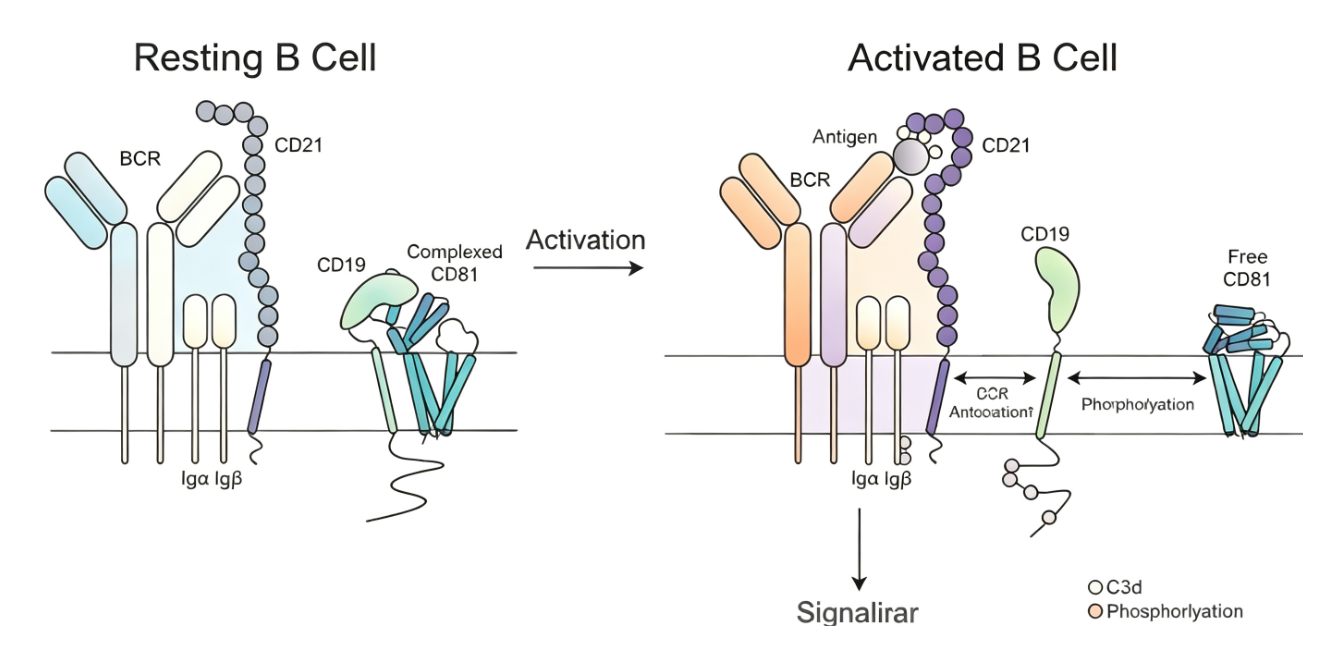
CD19 is a differentiation antigen specifically expressed on the surface of B lymphocytes and belongs to the immunoglobulin superfamily. This molecule is encoded by the CD19 gene located on the short arm of human chromosome 16 (16p11.2), and its protein product is a type I transmembrane glycoprotein with a theoretical molecular weight of approximately 95 kDa. From a structural biology perspective, the protein structure of CD19 can be divided into three functionally distinct modules: the extracellular domain contains two C2-type immunoglobulin-like domains carrying multiple N-linked glycosylation sites, where glycosylation is crucial for the stable surface expression of CD19 and the formation of complexes with other signaling molecules; the transmembrane domain is a single-pass transmembrane helix responsible for anchoring the protein in the lipid bilayer; the intracellular domain contains multiple highly conserved tyrosine residues that can be phosphorylated during signal transduction, serving as docking platforms for SH2 domain-containing signaling molecules and representing the core effector region through which CD19 mediates downstream signaling cascades.
III. Expression Lineage and Regulatory Mechanisms of CD19.
The expression of CD19 exhibits strict B-cell lineage specificity. During B lymphocyte differentiation, surface expression of CD19 begins at the early stage of immunoglobulin gene rearrangement, appearing from the pro-B cell stage, and persists through pre-B cells, immature B cells, and mature B cells, continuing through B-cell activation and proliferation, with expression gradually lost only after terminal differentiation into plasma cells. All B cell lineages except plasma cells, as well as follicular dendritic cells, express this molecule. At the regulatory level, PAX5, as the master transcription factor of the B-cell lineage, directly binds to the CD19 promoter and enhancer regions and is the core regulator initiating CD19 expression; CD81, as a molecular chaperone, plays a key role in the intracellular maturation of CD19, ensuring its correct folding and efficient localization to the cell surface.
IV. Co-receptor Mechanism of CD19 in BCR Signal Transduction.
CD19 is one of the most critical co-receptor molecules in the B-cell receptor signaling pathway. On the surface of mature B cells, CD19 forms the B-cell co-receptor complex together with CD21 (complement receptor 2) and CD81 (TAPA-1). The core function of this complex is to amplify the antigen stimulation signals transduced inward by the BCR complex, thereby significantly lowering the threshold for B-cell activation by antigen stimulation, promoting BCR recognition of antigens and effective B-cell activation. Specifically, when antigen binds to BCR, the resulting activation signals are transduced into the cell via Igα/β and CD19, providing the first signal for B-cell activation. At the molecular mechanism level, CD19 provides docking sites for various SH2 domain-containing effector molecules—including the p85 subunit of phosphoinositide 3-kinase, Src family kinases, and VAV guanine nucleotide exchange factors—through phosphorylation of specific tyrosine residues within its intracellular domain, thereby significantly enhancing and amplifying BCR-mediated signaling cascades. Experimental models with CD19 deficiency show significantly weakened B-cell responsiveness to transmembrane signals and impaired T-cell-dependent humoral immune responses, confirming from the reverse perspective CD19's important status as a "rheostat" of B-cell function.
V. Theoretical Basis for CD19 as a Target in Tumor Immunotherapy.
The expression characteristics of CD19 in B-cell malignancies provide a solid biological foundation for its use as an immunotherapeutic target. As a receptor on the B-cell surface that mediates specific signal transduction, this molecule is present at all stages of B-cell maturation and is also aberrantly expressed on many malignant B cells, such as those in leukemias. Studies have shown that CD19 is consistently highly expressed in the vast majority of B-cell lineage-derived malignancies—approximately 80% of B-cell acute lymphoblastic leukemias, 88% of B-cell non-Hodgkin lymphomas, and 100% of B-cell leukemias express CD19, with expression levels generally maintained at normal to high levels. More importantly, CD19 expression in normal tissues is highly restricted to the B-cell lineage, allowing immunotherapies targeting CD19 to achieve specific recognition of B-lineage tumor cells while maintaining relatively controllable effects on other tissues and organs. Since the immune killing effect of antibodies depends on the effector functions of other immune cells, CD19 antibodies specifically recognize CD19 molecules on the tumor surface, recruiting immune cells with killing capacity such as T cells to the vicinity of tumor cells, thereby precisely eliminating malignantly transformed B lymphocytes. This mechanism has made CD19 the most successful target in immunotherapy, particularly in chimeric antigen receptor T-cell therapy.
VI. Overview of CD19-Targeted CAR-T Cell Therapy.
Chimeric antigen receptor T-cell therapy involves fusing the antigen-binding domain of an antibody recognizing tumor antigens (such as CD19) with the intracellular signaling domains of CD3-ζ chain or FcεRIγ in vitro to create a chimeric protein, which is then introduced into patient T cells via gene transduction to enable them to express the chimeric antigen receptor. These "reprogrammed" T cells, after expansion in vitro, are infused back into the patient, where they can specifically recognize and eliminate CD19-expressing B cells and tumor cells. This therapy has achieved breakthrough clinical efficacy in indications such as B-cell acute lymphoblastic leukemia and non-Hodgkin lymphoma, promoting the approval and market launch of multiple products. Despite the great success of CAR-T therapy, antigen escape (i.e., downregulation or loss of CD19 expression) remains a major mechanism leading to relapse, which has driven the continued development of iterative strategies such as dual-target CAR-T.
VII. Conclusion.
CD19, by virtue of its lineage-specific expression throughout B-cell development, its finely regulated function as a core co-receptor in BCR signal transduction, and its high coverage rate in the vast majority of B-cell tumors, has evolved into the most classic and successful target in the field of immunotherapy. From the clinical breakthrough of CAR-T cell therapy to the ongoing optimization of dual-target strategies, the evolutionary trajectory of CD19-targeted therapies has set a paradigm for tumor immunotherapy. UniBio's Alexa Fluor 647-Labeled CD19 Fc Chimera Protein, Human, with its precise molecular design, Fc-tag-conferred dimerization advantages, and excellent optical labeling performance, provides a stable and reliable detection tool for CD19-related receptor-ligand binding analysis, targeted drug screening, and CAR cell functional evaluation.
This article is reviewed and published by the technical expert team of UA
Disclaimer: This article partially utilizes artificial intelligence assistance in its creation. If any content involves copyright or intellectual property issues, please let us know and we promise to verify and remove it as soon as possible.
Purchase recombinant protein, choose Nanjing UA-Bio
UA protein focuses on providing various protein reagents, raw materials, and services required for drug research and development, cell therapy, gene therapy, and basic scientific research, including drug target proteins, immune checkpoint proteins, cytokines, tool enzymes, customized protein expression, and full-length transmembrane protein development. Youai is committed to providing customers with high-quality products and professional services, and building a High-tech Biological Enterprise with International Competitiveness.
Target proteins | membrane proteins | cytokines | enzymes | viral antigens | protein customization
Nanjing UA Biotechnology Co., Ltd. Email:order@ua-bio.com Phone:+86-25-56221161

Product Information

Link:





©2021-2026 all rights reserved UA Biotechnology Co.,Ltd.
Privacy Policy 
网站备案号 浙ICP备2022019033号-2 浙公网安备33010202004867号
 Business license (three certificates in one)
 Tel:+86-25-56221161
E-mail:order@ua-bio.com
All products sold on this website shall not be used for clinical diagnosis or treatment of humans or animals, and shall only be used for non-medical purposes such as industrial or scientific research.
