




Research Progress on NNMT as a Core Metabolic Regulator in Cancer-Associated Fibroblasts and the Application of Its Recombinant Protein Tools
Author: Senior Product Manager of UA Views:69 


Based on a landmark study employing proteomics and laser capture microdissection, this article systematically elucidates the phenomenon of elevated nicotinamide N-methyltransferase (NNMT) expression in cancer-associated fibroblasts (CAFs) of high-grade serous ovarian cancer and other solid tumors. It analyzes the molecular mechanism by which NNMT drives the CAF phenotype and pro-tumor microenvironment through depletion of the methyl donor SAM and reduction of histone methylation, while exploring the clinical value of NNMT as a prognostic biomarker and therapeutic target.
- Recent Advances
- Product Information
Recent Advances
Research Advances on NNMT as a Core Metabolic Regulator in Cancer-Associated Fibroblasts and the Application of Recombinant Protein Tools
Brief Summary
Based on a landmark study employing proteomics and laser capture microdissection, this article systematically describes the high expression of nicotinamide N-methyltransferase (NNMT) in cancer-associated fibroblasts (CAFs) of high-grade serous ovarian cancer and other solid tumors, analyzes the molecular mechanism by which it drives CAF phenotypes and pro-tumor microenvironments through depletion of the methyl donor SAM and reduction of histone methylation, and discusses the clinical value of NNMT as a prognostic biomarker and therapeutic target.
Based on a landmark study employing proteomics and laser capture microdissection, this article systematically describes the high expression of nicotinamide N-methyltransferase (NNMT) in cancer-associated fibroblasts (CAFs) of high-grade serous ovarian cancer and other solid tumors, analyzes the molecular mechanism by which it drives CAF phenotypes and pro-tumor microenvironments through depletion of the methyl donor SAM and reduction of histone methylation, and discusses the clinical value of NNMT as a prognostic biomarker and therapeutic target.
I. Precision Stratification Technology for Tumor Microenvironment Research.
Tumor initiation and metastasis depend not only on the intrinsic properties of cancer cells but are also profoundly influenced by the surrounding microenvironment. Cancer-associated fibroblasts are the most abundant stromal cells in the tumor microenvironment, playing critical roles in promoting tumor progression and metastasis through secretion of cytokines, remodeling of the extracellular matrix, and regulation of immune cell infiltration. However, elucidating the molecular regulatory mechanisms of CAFs has long been constrained by technical bottlenecks—traditional proteomics methods require large amounts of tissue samples and are unable to distinguish the respective contributions of tumor cells and stromal cells.
To overcome this limitation, researchers developed a novel technology combining laser capture microdissection with ultra-sensitive proteomics. By precisely dissecting and performing mass spectrometry analysis on formalin-fixed paraffin-embedded tissue samples containing only a few thousand cells, this approach enables molecular profiling of tumor cells and stromal cells separately without disrupting tissue architecture. This technological breakthrough has made systematic investigation of CAF functional regulation in tumor metastasis possible.
II. Discovery and Validation of NNMT as a Core Regulatory Factor in CAFs.
Using the above technology platform, systematic proteomic analysis was performed on tumor and stromal tissues from different anatomical sites—including fallopian tubes, ovaries, and omentum—of 11 patients with high-grade serous ovarian cancer (HGSC), identifying a total of 6,944 proteins. In the stromal compartment, comparison of protein expression differences between primary and metastatic tumors identified 62 differentially expressed proteins, among which 21 upregulated proteins included known stromal pro-tumor factors such as FAP, LOX, TNC, and VCAN. Notably, nicotinamide N-methyltransferase (NNMT) was among these, showing significantly high expression in the stroma of omental metastases.
Further immunohistochemical validation confirmed that NNMT protein is highly expressed in metastatic stroma while showing very low expression in normal tissues. Gene knockdown and overexpression experiments demonstrated that NNMT is essential for maintaining the CAF phenotype, including cell morphology, marker expression, and extracellular matrix contraction capacity. Single-cell RNA sequencing data and multiplex immunofluorescence analysis further localized NNMT to CAF subpopulations, and high NNMT expression was significantly associated with poor prognosis in HGSC patients.
III. Epigenetic Regulatory Mechanism of NNMT-Driven CAF Phenotypes.
NNMT is a cytosolic metabolic enzyme that catalyzes the transfer of a methyl group from S-adenosylmethionine (SAM) to nicotinamide, generating 1-methylnicotinamide and S-adenosylhomocysteine (SAH). This reaction consumes the primary intracellular methyl donor SAM, while the produced SAH serves as a feedback inhibitor of various methyltransferases. Together, these effects constitute a "methylation sink" that reduces the overall methylation potential of the cell.
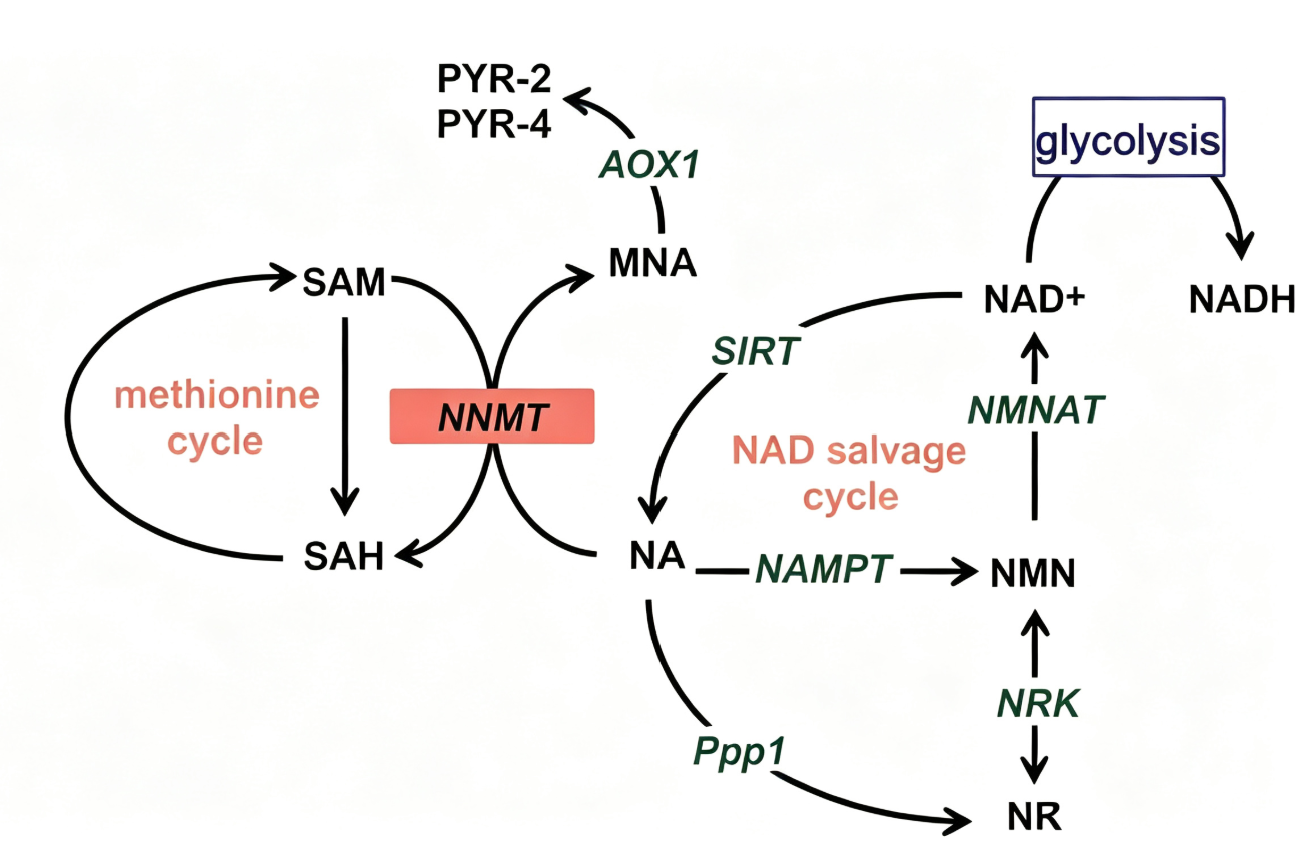
Studies have confirmed that NNMT upregulation in CAFs induces genome-wide changes in DNA methylation patterns, significantly affecting the methylation status of gene promoter regions. At the histone level, NNMT activity suppresses methylation levels of key histone marks including the transcription-activation-associated H3K4me3 and the transcription-repression-associated H3K27me3, thereby epigenetically regulating the expression of thousands of genes and driving the pro-tumor phenotype of CAFs. In lung cancer studies, loss of NNMT expression can upregulate extracellular matrix remodeling-related genes (including collagens, integrins, laminins, and matrix metalloproteinases) through increased H3K4me3 modification, thereby promoting cancer cell invasion and metastasis. Additionally, NNMT-induced H3K27me3 hypomethylation can drive CAFs to secrete complement components, recruiting myeloid-derived suppressor cells to tumor sites and forming an immunosuppressive microenvironment that attenuates the anti-tumor activity of CD8⁺ T cells. These findings collectively establish NNMT as a "metabolic-epigenetic interface" and a "regulatory hub of CAFs."
IV. Potential of NNMT as a Therapeutic Target.
The therapeutic potential of NNMT has been validated at multiple levels. In animal models, host Nnmt knockout significantly inhibited the growth of ovarian, breast, and colon cancers, accompanied by enhanced activation of intratumoral CD8⁺ T cells. Pharmacological intervention with NNMT-specific small molecule inhibitors not only reduced tumor burden and metastasis but also restored the efficacy of immune checkpoint blockade therapy, providing a rationale for combination treatment strategies. Furthermore, NNMT inhibitors can reverse the pro-tumor phenotype of CAFs, remodeling the tumor microenvironment toward an anti-tumor direction. These findings suggest that NNMT inhibitors hold promising translational prospects in multiple solid tumors including ovarian, lung, breast, and colon cancers.
V. Structural Biology Studies of Rhesus Macaque NNMT Recombinant Protein.
In the drug development process targeting NNMT, high-quality NNMT recombinant protein is an indispensable core tool for structural biology studies and inhibitor screening. In 2017, researchers reported for the first time the crystal structure of rhesus macaque NNMT (UniProt F7ERX8) in complex with the product 1-methylnicotinamide (MNA) and the cofactor SAH at 2.30 Å resolution. The structure confirmed that it is highly conserved with the known human NNMT structure, with MNA binding at the enzyme active center and being captured in the active site through a "bridge" structure formed between the long α3 helix at the active site entrance and the C-terminal loop, which structurally explains the mechanism by which MNA acts as a feedback inhibitor of NNMT. This study also purified and validated enzymatically active recombinant rhesus macaque NNMT protein, laying the foundation for subsequent structure-based drug design.
VI. Conclusion.
Through its unique "methylation sink" mechanism—depleting the methyl donor SAM and reducing histone methylation levels—NNMT plays an irreplaceable core role in maintaining CAF phenotypes and regulating pro-tumor functions. Its high expression in the stroma of various solid tumors and its correlation with poor prognosis make it a molecule of dual value as both a biomarker and a therapeutic target. With NNMT inhibitors demonstrating synergistic potential with immunotherapy in preclinical models, NNMT-targeting strategies are progressing from mechanistic exploration toward clinical translation.
To address research needs in NNMT structural biology, enzymatic mechanisms, and inhibitor screening, UniBio provides NNMT His Tag Protein, Rhesus macaque. This product can be used in application scenarios including three-dimensional structure determination of rhesus macaque NNMT and structure-based drug design, NNMT enzyme activity assays, and in vitro screening of inhibitors (such as substrate or cofactor binding site competitors).
This article is reviewed and published by the technical expert team of UA
Disclaimer: This article partially utilizes artificial intelligence assistance in its creation. If any content involves copyright or intellectual property issues, please let us know and we promise to verify and remove it as soon as possible.
Purchase recombinant protein, choose Nanjing UA-Bio
UA protein focuses on providing various protein reagents, raw materials, and services required for drug research and development, cell therapy, gene therapy, and basic scientific research, including drug target proteins, immune checkpoint proteins, cytokines, tool enzymes, customized protein expression, and full-length transmembrane protein development. Youai is committed to providing customers with high-quality products and professional services, and building a High-tech Biological Enterprise with International Competitiveness.
Target proteins | membrane proteins | cytokines | enzymes | viral antigens | protein customization
Nanjing UA Biotechnology Co., Ltd. Email:order@ua-bio.com Phone:+86-25-56221161

Product Information

Link:





©2021-2026 all rights reserved UA Biotechnology Co.,Ltd.
Privacy Policy 
网站备案号 浙ICP备2022019033号-2 浙公网安备33010202004867号
 Business license (three certificates in one)
 Tel:+86-25-56221161
E-mail:order@ua-bio.com
All products sold on this website shall not be used for clinical diagnosis or treatment of humans or animals, and shall only be used for non-medical purposes such as industrial or scientific research.
