




NNMT-mediated metabolic reprogramming of cancer-associated fibroblasts: mechanisms and therapeutic implications
Author: Senior Product Manager of UA Views:64 


This article systematically elaborates on the expression characteristics of Nicotinamide N-methyltransferase (NNMT) in cancer-associated fibroblasts (CAFs) and its mechanism of depleting the methyl donor S-adenosylmethionine (SAM). It analyzes the molecular pathways by which NNMT drives CAFs differentiation and promotes tumor progression through epigenetic regulation, and explores the potential of targeting NNMT as a tumor stromal therapeutic strategy.
- Recent Advances
- Product Information
Recent Advances
NNMT-Mediated Metabolic Reprogramming of Cancer-Associated Fibroblasts: Mechanisms and Therapeutic Implications
Brief Summary
This article systematically describes the expression characteristics of nicotinamide N-methyltransferase (NNMT) in cancer-associated fibroblasts (CAFs) and its mechanism of depleting the methyl donor S-adenosylmethionine (SAM), analyzes the molecular pathways through which NNMT drives CAF differentiation and promotes tumor progression via epigenetic regulation, and discusses the potential of targeting NNMT as a stromal-targeted therapeutic strategy.
This article systematically describes the expression characteristics of nicotinamide N-methyltransferase (NNMT) in cancer-associated fibroblasts (CAFs) and its mechanism of depleting the methyl donor S-adenosylmethionine (SAM), analyzes the molecular pathways through which NNMT drives CAF differentiation and promotes tumor progression via epigenetic regulation, and discusses the potential of targeting NNMT as a stromal-targeted therapeutic strategy.
I. Pathological Significance of the Tumor Stromal Microenvironment and CAFs.
High-grade serous carcinoma (HGSC) is the most common pathological type of ovarian cancer, with the majority of cases harboring TP53 mutations and tumor tissues being rich in stromal components. Cancer-associated fibroblasts (CAFs), as the most abundant stromal cell population in the tumor microenvironment, play a significant role in promoting tumor progression, metastasis, and drug resistance. Studies have shown that CAFs support tumor growth through secretion of cytokines, extracellular matrix remodeling, and metabolic reprogramming. However, the molecular mechanisms by which CAFs acquire pro-tumor phenotypes through metabolic regulation remain incompletely elucidated, and this knowledge gap has limited the development of stromal-targeted therapeutic strategies.
II. High Expression and Functional Validation of NNMT in Tumor Metastasis-Associated Stroma.
Researchers performed independent label-free proteomic analysis on tumor and stromal regions from different anatomical sites (primary tumors, invasive tubal lesions, invasive ovarian lesions, and omental metastases) of 11 HGSC patients, quantifying a total of 6,944 proteins. Analysis revealed that nicotinamide N-methyltransferase (NNMT) expression was significantly increased in the stroma of peritoneal and omental metastases compared to benign omental, tubal, and ovarian primary stroma, and this upregulation was detectable in early micro-metastases. In contrast, NNMT expression in the tumor epithelial compartment did not show significant changes across anatomical sites, suggesting that stromal NNMT upregulation is a specific molecular event of the metastatic microenvironment.
Further in vitro functional experiments confirmed that NNMT expression is necessary and sufficient for CAF phenotype acquisition. Overexpression of NNMT in normal fibroblasts induced upregulation of CAF markers (such as α-SMA and fibronectin) and promoted cancer cell proliferation. Conversely, NNMT knockdown in CAFs restored cell morphology toward a more normal fibroblast-like phenotype and significantly attenuated their capacity to support tumor cell proliferation and invasion.
III. NNMT-Mediated Methyl Metabolism Depletion and Epigenetic Remodeling Mechanisms.
NNMT is a cytosolic methyltransferase whose enzymatic function is to transfer the reactive methyl group from S-adenosylmethionine (SAM) to nicotinamide (NA), generating S-adenosylhomocysteine (SAH) and metabolically inert 1-methylnicotinamide (1-MNA). Through this reaction, NNMT continuously consumes SAM—the primary universal methyl donor in cells—leading to a decreased SAM/SAH ratio, i.e., reduced overall cellular methylation potential.
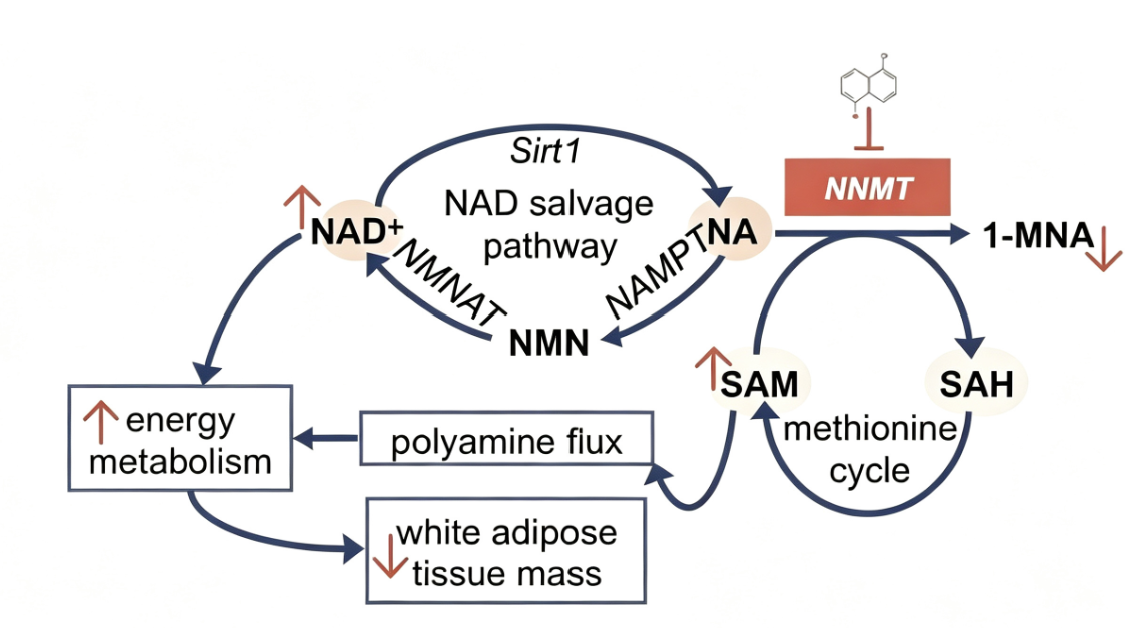
In CAFs, NNMT-mediated SAM depletion directly impacts histone methylation status. Mass spectrometry analysis showed that NNMT knockdown increased histone lysine and arginine methylation levels associated with transcriptional regulation, while NNMT overexpression led to decreased H3K27 and H3K4 trimethylation levels. This epigenetic remodeling further drove extensive gene expression changes, including DNA methylation alterations in the promoter regions of genes related to collagen production and myosin-driven contraction. Among these, the transcription of COMP—one of the most significantly upregulated proteins in all metastatic tumor stroma samples—was tightly regulated by NNMT expression, with promoter histone methylation increasing upon NNMT knockdown, indicating that NNMT drives CAF functional phenotypes through regulation of histone methylation at specific genes.
IV. Therapeutic Potential and In Vivo Validation of Targeting NNMT.
Based on the above mechanisms, researchers further evaluated the feasibility of NNMT as a therapeutic target. Treatment of human CAFs with a small molecule NNMT inhibitor (NNMTi) restored histone methylation levels and reversed the CAF phenotype. In a syngeneic mouse ovarian cancer metastasis model, NNMT knockdown in CAFs significantly inhibited in vivo tumor growth and metastasis. More importantly, in vivo treatment with NNMTi effectively reduced tumor burden and suppressed tumor cell proliferation in an orthotopic ovarian cancer peritoneal metastasis model. These results suggest that targeting stromal NNMT activity can reverse the pro-tumor CAF phenotype, providing a novel approach for cancer therapy.
V. Conclusion.
NNMT, as a core enzyme in the CAF metabolic regulatory network, drives the transformation of fibroblasts toward a pro-tumor phenotype by depleting the methyl donor SAM and reshaping the histone methylation landscape, providing a new perspective on the metabolic-epigenetic cross-regulation of tumor-stroma interactions. The anti-tumor activity demonstrated by NNMT inhibitors in preclinical models positions this molecule as a highly promising target in stromal microenvironment intervention strategies. In-depth elucidation of the differential regulatory mechanisms of NNMT across tumor types and microenvironments will provide a more solid foundation for its clinical translation. In NNMT-related mechanism research and drug screening, high-quality mouse NNMT recombinant protein serves as an important tool molecule. To address the above research needs, UniBio provides NNMT His Tag Protein, Mouse, which is suitable for NNMT-related basic research and drug discovery experiments.
This article is reviewed and published by the technical expert team of UA
Disclaimer: This article partially utilizes artificial intelligence assistance in its creation. If any content involves copyright or intellectual property issues, please let us know and we promise to verify and remove it as soon as possible.
Purchase recombinant protein, choose Nanjing UA-Bio
UA protein focuses on providing various protein reagents, raw materials, and services required for drug research and development, cell therapy, gene therapy, and basic scientific research, including drug target proteins, immune checkpoint proteins, cytokines, tool enzymes, customized protein expression, and full-length transmembrane protein development. Youai is committed to providing customers with high-quality products and professional services, and building a High-tech Biological Enterprise with International Competitiveness.
Target proteins | membrane proteins | cytokines | enzymes | viral antigens | protein customization
Nanjing UA Biotechnology Co., Ltd. Email:order@ua-bio.com Phone:+86-25-56221161

Product Information

Link:





©2021-2026 all rights reserved UA Biotechnology Co.,Ltd.
Privacy Policy 
网站备案号 浙ICP备2022019033号-2 浙公网安备33010202004867号
 Business license (three certificates in one)
 Tel:+86-25-56221161
E-mail:order@ua-bio.com
All products sold on this website shall not be used for clinical diagnosis or treatment of humans or animals, and shall only be used for non-medical purposes such as industrial or scientific research.
