




Structural Basis and Drug Development Potential of the CRBN-DDB1 Complex: The Substrate Recognition Module of E3 Ubiquitin Ligase
Author: Senior Product Manager of UA Views:92 


This article systematically elucidates the molecular basis of CRBN and DDB1 forming a functional complex, analyzes its core role as the substrate recognition module of the CUL4-RING E3 ubiquitin ligase complex, and explores the pivotal position of this complex in the development of PROTACs and molecular glue drugs.
- Recent Advances
- Product Information
Recent Advances
The CRBN-DDB1 Complex: Structural Basis of the E3 Ubiquitin Ligase Substrate Recognition Module and Its Value in Drug Development
Brief Summary
This article systematically describes the molecular basis for the formation of the functional complex between CRBN and DDB1, analyzes its core function as the substrate recognition module of the CUL4-RING E3 ubiquitin ligase complex, and discusses the critical role of this complex in the development of PROTACs and molecular glue drugs.
This article systematically describes the molecular basis for the formation of the functional complex between CRBN and DDB1, analyzes its core function as the substrate recognition module of the CUL4-RING E3 ubiquitin ligase complex, and discusses the critical role of this complex in the development of PROTACs and molecular glue drugs.
I. Molecular Characteristics of CRBN and DDB1 and Complex Formation.
CRBN (cereblon) is a 442-amino acid protein encoded by the CRBN gene, with a molecular weight of approximately 51 kDa. The CRBN protein contains an N-terminal TNF receptor-associated factor family protein-binding domain and a C-terminal superfamily domain, which consists of two subdomains forming a deep hydrophobic pocket capable of accommodating thalidomide and its analogs. DDB1 (DNA damage-binding protein 1) is a large protein composed of 1,140 amino acids (molecular weight approximately 127 kDa), functioning primarily as an adaptor protein for the CUL4-RING E3 ubiquitin ligase complex.
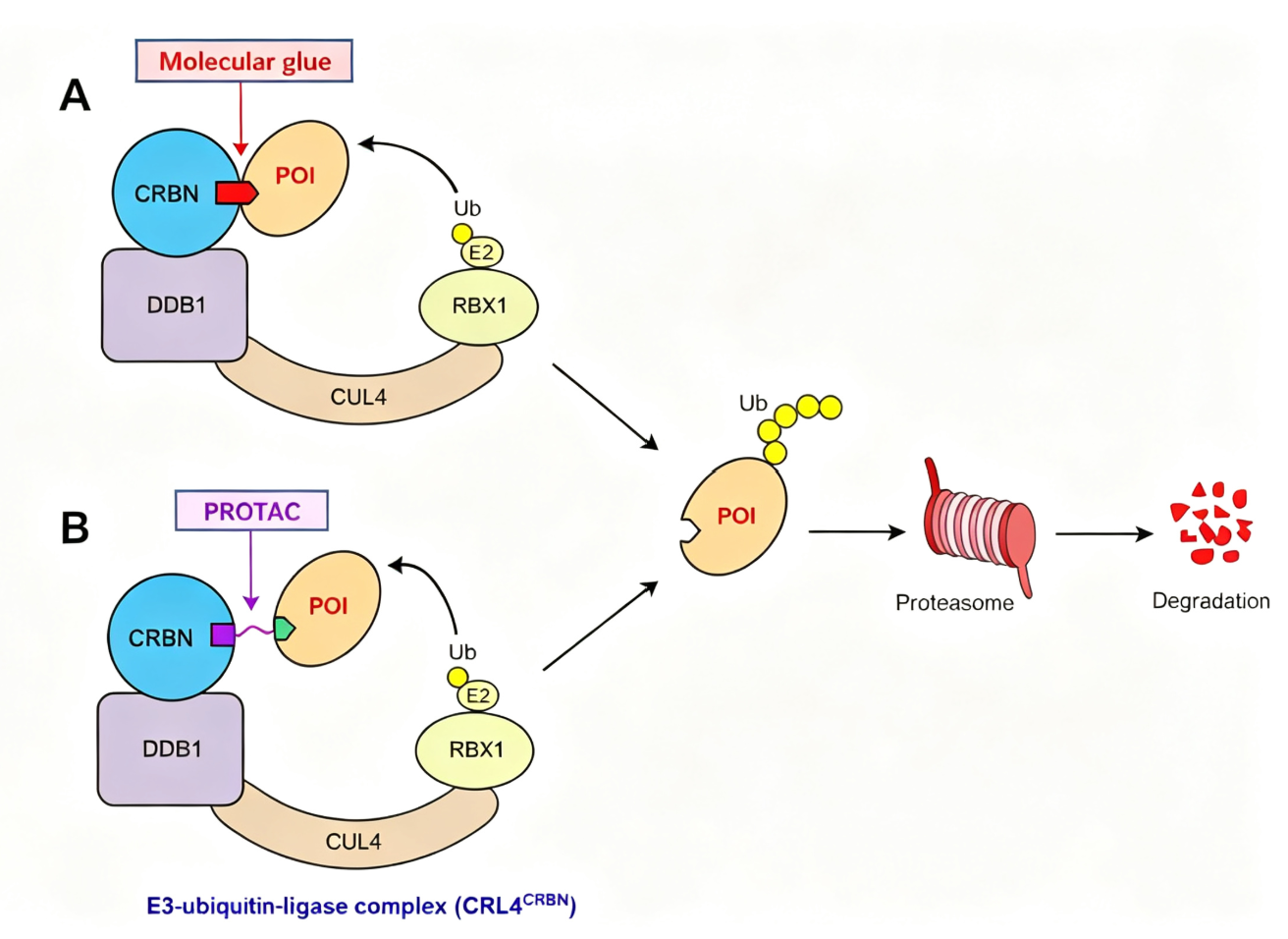
CRBN and DDB1 form a stable complex through direct protein-protein interactions. Cryo-electron microscopy and X-ray crystallography studies have shown that the N-terminal region of CRBN binds to the BPB (BPCV-proteasome-B) domain of DDB1, while the C-terminal superfamily domain of CRBN is exposed on the surface to accommodate drug molecules or substrate proteins. The CRBN-DDB1 complex serves as the substrate recognition module of the CUL4-RING E3 ubiquitin ligase complex, with CRBN functioning as the substrate receptor responsible for recognizing specific substrates, and DDB1 acting as a bridging molecule connecting CRBN to the CUL4A/B scaffold protein to complete the assembly of the E3 ligase holoenzyme.
II. Biological Functions of the CRBN-DDB1 Complex.
The CRBN-DDB1 complex, as a component of the CUL4-RING E3 ubiquitin ligase complex, plays a critical role in protein ubiquitination and degradation. Under physiological conditions, known natural substrates of CRBN include MEIS2 and GSK3β. CRBN recognizes substrates through its superfamily domain, mediating polyubiquitination of substrates and subsequent degradation via the proteasome pathway, thereby participating in the regulation of various biological processes including cell proliferation, development, and metabolism.
Research has revealed additional layers of functional regulation of the CRBN-DDB1 complex. Cryo-EM structures have shown that the CRBN-DDB1 complex exhibits conformational plasticity when bound to different ligands, with changes between open and closed states potentially related to substrate recognition selectivity. Furthermore, ternary complex structures formed by the CRBN-DDB1 complex with kinases such as NEK7 suggest that CRBN may participate in the regulation of cell cycle and inflammatory signaling pathways.
III. Central Role of the CRBN-DDB1 Complex in Drug Development.
The CRBN-DDB1 complex is one of the most widely used E3 ligase modules in the field of targeted protein degradation. Thalidomide and its derivatives (lenalidomide, pomalidomide, etc.), known as "molecular glues," directly bind to the superfamily domain of CRBN, altering its substrate recognition interface and enabling the recruitment and degradation of neosubstrates (such as IKZF1 and IKZF3), thereby exerting immunomodulatory and anti-tumor activities.
In PROTAC technology, the CRBN-DDB1 complex also occupies a central position. PROTAC molecules induce ubiquitination and degradation of target proteins by simultaneously binding the target protein (such as BRD4, ER, IRAK4, etc.) on one end and CRBN on the other, forming a target protein-CRBN-DDB1 ternary complex. Cryo-EM structural analysis has revealed the structural details of ternary complexes of CRBN-DDB1 with various target proteins mediated by different PROTAC molecules, with resolutions reaching 2.85 to 3.7 Å, providing precise structural models for rational drug design. Taking the IRAK4 degrader KT-474 as an example, its ternary complex structure with CRBN-DDB1 and IRAK4 demonstrates non-native protein-protein interaction surfaces, offering important insights for the design of selective degraders.
IV. Application Value of Recombinant CRBN/DDB1 Complex Proteins.
In CRBN-DDB1-related drug screening, binding analysis, and mechanism studies, high-quality recombinant CRBN/DDB1 complex protein is an indispensable core tool. Application scenarios for this complex primarily include: determination of PROTAC or molecular glue binding affinity to CRBN using HTRF or SPR technologies; evaluation of compound-mediated ternary complex formation efficiency between CRBN and target proteins (such as BRD4, ER, IRAK4, etc.); mechanistic exploration of the impact of CRBN-DDB1 complex conformational changes on substrate recognition; and use as a standard in immunoassay development.
To address the above needs, UniBio provides CRBN/DDB1 Complex His Tag Protein, Human, which is suitable for experimental scenarios including CRBN-DDB1 binding analysis, PROTAC molecule screening, and related basic research.
This article is reviewed and published by the technical expert team of UA
Disclaimer: This article partially utilizes artificial intelligence assistance in its creation. If any content involves copyright or intellectual property issues, please let us know and we promise to verify and remove it as soon as possible.
Purchase recombinant protein, choose Nanjing UA-Bio
UA protein focuses on providing various protein reagents, raw materials, and services required for drug research and development, cell therapy, gene therapy, and basic scientific research, including drug target proteins, immune checkpoint proteins, cytokines, tool enzymes, customized protein expression, and full-length transmembrane protein development. Youai is committed to providing customers with high-quality products and professional services, and building a High-tech Biological Enterprise with International Competitiveness.
Target proteins | membrane proteins | cytokines | enzymes | viral antigens | protein customization
Nanjing UA Biotechnology Co., Ltd. Email:order@ua-bio.com Phone:+86-25-56221161

Product Information

Link:





©2021-2026 all rights reserved UA Biotechnology Co.,Ltd.
Privacy Policy 
网站备案号 浙ICP备2022019033号-2 浙公网安备33010202004867号
 Business license (three certificates in one)
 Tel:+86-25-56221161
E-mail:order@ua-bio.com
All products sold on this website shall not be used for clinical diagnosis or treatment of humans or animals, and shall only be used for non-medical purposes such as industrial or scientific research.
