




SHP1: A key regulator of T cell development


T cells are core cells in the acquired immune system, responsible for recognizing antigens and initiating immune responses. T cell development is a complex process that is strictly regulated by the thymic microenvironment and signal transduction. In this process, tyrosine phosphorylation plays a vital role, and SHP1 (Src homology region 2 protein tyrosine phosphatase-1), as a key phosphatase, plays an important regulatory role in the development and function of T cells.
- Recent Advances
- Product Information
SHP1: A key regulator of T cell development
T cells are core cells in the acquired immune system, responsible for recognizing antigens and initiating immune responses. T cell development is a complex process that is strictly regulated by the thymic microenvironment and signal transduction. In this process, tyrosine phosphorylation plays a vital role, and SHP1 (Src homology region 2 protein tyrosine phosphatase-1), as a key phosphatase, plays an important regulatory role in the development and function of T cells.
The role of SHP1 in T cell development
SHP1 is a non-receptor protein tyrosine phosphatase that is mainly expressed in hematopoietic cells. It regulates multiple cell signaling pathways through dephosphorylation and is essential for the development and function of T cells. During T cell development, SHP1 affects the maturation and selection of T cells by regulating the T cell receptor (TCR) signaling pathway.
THEMIS: A new substrate of SHP1
In January 2024, the research groups of Fan Gaofeng and Wang Haopeng from Shanghai University of Science and Technology published an important study in the journal Nature Structural & Molecular Biology, revealing the role of THEMIS as a new substrate of SHP1 in T cell development. The researchers developed a new technology PEPSI (PUP-IT Enhanced PTP Substrate Identification) for high-throughput identification of phosphatase substrates and found that THEMIS is an important substrate of SHP1.
THEMIS is specifically expressed in T cells and plays an important role in the development of T cells from the double-positive stage to the single-positive stage. The study found that the phosphorylation modification of the Y34 site of THEMIS is positively and negatively regulated by the kinase LCK and SHP1. By constructing THEMIS Y34F knock-in and THEMIS knock-out mouse models, the researchers found that the thymic T cells of these mice showed a significant block in the development from the double-positive stage to the single-positive stage, and the number of CD4 single-positive T cells in the spleen was also significantly reduced.
Interaction mechanism between SHP1 and THEMIS
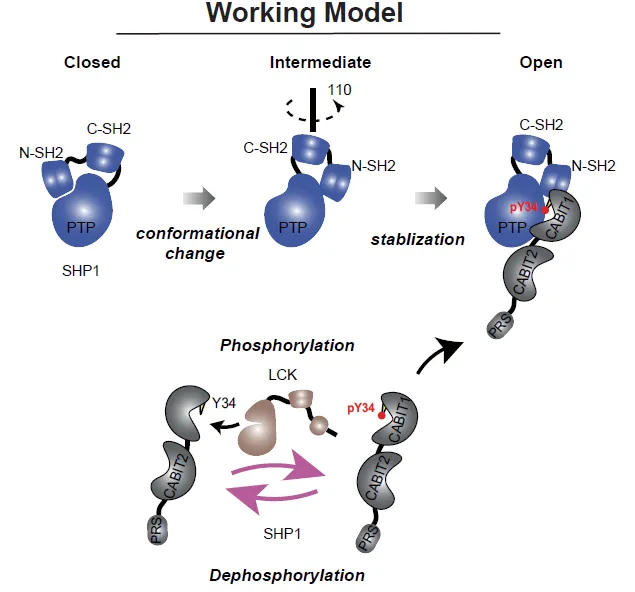
The study further revealed the interaction mechanism between SHP1 and THEMIS. Phosphorylated THEMIS can activate SHP1 and stabilize it in an open conformation, thereby enhancing the activity of SHP1. Using techniques such as hydrogen-deuterium exchange mass spectrometry and surface plasmon resonance, the researchers found that the phosphorylated THEMIS peptide binds to the K520 site of the PTP domain of SHP1, thereby stabilizing the activated conformation of SHP1.
Based on these findings, the researchers proposed a new THEMIS action model: after TCR stimulation, LCK phosphorylates the Y34 site of THEMIS, phosphorylated THEMIS stabilizes SHP1 in an open conformation, and activated SHP1 inhibits the transmission of TCR signals, thereby ensuring normal positive selection.
Research significance and future prospects
This study not only reveals a new mechanism of SHP1 in T cell development, but also provides important clues for the development of new T cell therapeutic targets. By regulating the activity of SHP1 and THEMIS, it is expected to develop new immunotherapy strategies for the treatment of T cell-related immune diseases and cancers.
Future studies will further explore the role of SHP1 and THEMIS in other immune cells and their potential applications in immunotherapy. With a deeper understanding of the interaction mechanism between SHP1 and THEMIS, new breakthroughs in the field of immunotherapy are expected.
This article is reviewed and published by the technical expert team of UA
Disclaimer: This article partially utilizes artificial intelligence assistance in its creation. If any content involves copyright or intellectual property issues, please let us know and we promise to verify and remove it as soon as possible.
Purchase recombinant protein, choose Nanjing UA-Bio
UA protein focuses on providing various protein reagents, raw materials, and services required for drug research and development, cell therapy, gene therapy, and basic scientific research, including drug target proteins, immune checkpoint proteins, cytokines, tool enzymes, customized protein expression, and full-length transmembrane protein development. Youai is committed to providing customers with high-quality products and professional services, and building a High-tech Biological Enterprise with International Competitiveness.







 Business license (three certificates in one)