




SPIDER technology: a "new key" to unlock protein interactions


Protein interaction research has always been a frontier field in life sciences, and the emergence of SPIDER technology has undoubtedly injected new vitality into this field. It not only provides scientists with a powerful tool, but also brings new hope for future medical research and clinical applications.
- Recent Advances
- Product Information
SPIDER technology: a "new key" to unlock protein interactions
Proteins are the main executors of life activities, and the interactions between proteins and other biomolecules (such as protein-protein interactions PPI, protein-nucleic acid interactions PNI, protein-small molecule interactions PSMI, etc.) play a key role in almost all biological processes. These interactions are like "social networks" within cells, regulating important life activities such as signal transduction, gene expression, and metabolic processes. However, it is not easy to study these interactions, especially those weak, transient or membrane-based interactions, because most of them are non-covalent and can be easily lost during the experiment.
The birth of SPIDER technology
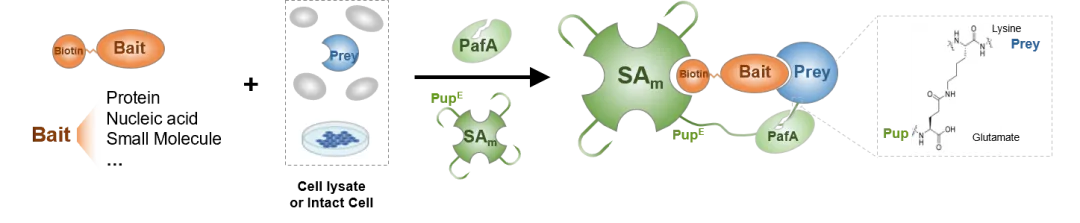
Recently, Tao Shengce's team at Shanghai Jiao Tong University published a breakthrough research result in "SCIENCE CHINA Life Sciences", developing a method called Specific Pupylation as IDEntity Reporter (SPIDER) for identifying the interaction between proteins and other biomolecules. This technology is inspired by the Pupylation pathway of Mycobacterium tuberculosis. Researchers found that this pathway has a substrate-based proximity labeling activity, that is, the reaction is triggered by the proximity of the substrate (Pup) to the target protein, rather than relying on the proximity of the enzyme.
How SPIDER technology works
The core of SPIDER technology is to convert non-covalent binding into covalent binding. In the experiment, only biotinylated bait molecules and target samples (such as purified proteins, cell lysates or cells) need to be prepared. Through the SPIDER reaction, the non-covalent binding between the bait molecule and the target protein will be converted into a covalent connection between the target protein and streptavidin (SA). This covalent connection is extremely stable, allowing the target protein to be enriched by biotin agarose beads and identified by mass spectrometry.
Advantages of SPIDER technology
Compared with traditional protein interaction research methods, SPIDER technology has significant advantages. First, it is applicable to a variety of biological molecules, and only biotinylation of the bait molecule is required, which can be performed in vivo or in vitro. Second, SPIDER technology is simple to operate, similar to the classic immunoprecipitation-mass spectrometry (AP-MS) method, but there is no need to worry about the degradation of the bait molecule. In addition, since the interaction is converted into a covalent bond, the experimental results can be easily visualized by gel electrophoresis, which greatly simplifies the verification process. Finally, the key reagents of SPIDER can be standardized and prepared in large quantities and stored, which is convenient for subsequent high-throughput experiments.
Application of SPIDER technology
Tao Shengce's team systematically evaluated the application of SPIDER technology in identifying protein-biomolecule interactions. For example, in protein-protein interaction (PPI) studies, SPIDER technology successfully identified a new substrate of prokaryotic protein deacetylase CobB. In protein-nucleic acid interaction (PNI) studies, SPIDER technology identified a new potential reader SRSF7 for m6A modification and revealed the mRNA-protein interactome before and after THP-1 cell differentiation. In addition, SPIDER technology has also been used to identify interacting proteins of the small molecule drug Lenalidomide and explore the distribution of SARS-CoV-2 specific receptors on the surface of living cells.
The future of SPIDER technology
The emergence of SPIDER technology provides a new tool for protein interaction research. It can not only efficiently and specifically identify the interaction between proteins and other biomolecules, but also simplify experimental operations, reduce costs, and improve research efficiency. With the continuous optimization and promotion of SPIDER technology, it is expected to play an important role in drug development, disease mechanism research, and personalized medicine.
Protein interaction research has always been a frontier field in life sciences, and the emergence of SPIDER technology has undoubtedly injected new vitality into this field. It not only provides scientists with a powerful tool, but also brings new hope for future medical research and clinical applications.
This article is reviewed and published by the technical expert team of UA
Disclaimer: This article partially utilizes artificial intelligence assistance in its creation. If any content involves copyright or intellectual property issues, please let us know and we promise to verify and remove it as soon as possible.
Purchase recombinant protein, choose Nanjing UA-Bio
UA protein focuses on providing various protein reagents, raw materials, and services required for drug research and development, cell therapy, gene therapy, and basic scientific research, including drug target proteins, immune checkpoint proteins, cytokines, tool enzymes, customized protein expression, and full-length transmembrane protein development. Youai is committed to providing customers with high-quality products and professional services, and building a High-tech Biological Enterprise with International Competitiveness.







 Business license (three certificates in one)