




Leukocyte Immunoglobulin-like Receptors: "Master Regulators" in the Immune System and New Hope for Tumor Treatment


LILRs are a group of immune regulatory receptors expressed by a variety of hematopoietic cell types, including monocytes, macrophages, dendritic cells, granulocytes, natural killer (NK) cells, T cells and B cells.
- Recent Advances
- Product Information
Leukocyte Immunoglobulin-like Receptors: "Master Regulators" in the Immune System and New Hope for Tumor Treatment
In the human immune system, there is a complex and delicate balance mechanism. On the one hand, immune cells need to be vigilant at all times to identify and eliminate invading pathogens and abnormal cells; on the other hand, the immune response cannot be excessive to avoid accidentally injuring normal tissues. In this process, Leukocyte Immunoglobulin-like Receptors (LILRs), also known as Ig-like Transcripts (ILTs), play a vital role. They are the "master regulators" in the immune system and play a key role in maintaining immune balance. In recent years, the potential application of LILRs in tumor immunotherapy has attracted widespread attention from scientists.
LILRs family: the "double-edged sword" of immune cells
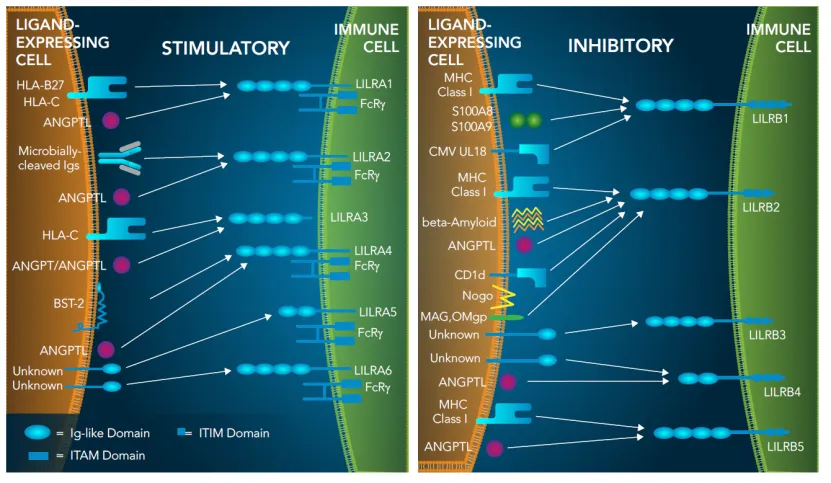
LILRs are a group of immune regulatory receptors expressed by a variety of hematopoietic cell types, including monocytes, macrophages, dendritic cells, granulocytes, natural killer (NK) cells, T cells and B cells. This family is divided into two main subfamilies: the LILRA subfamily (LILRA1-6) and the LILRB subfamily (LILRB1-5). Members of the LILRA subfamily are stimulatory receptors that promote the activation of immune cells through immunoreceptor tyrosine-based activation motifs (ITAMs) signaling, just like "refueling" immune cells, allowing them to more actively fight pathogens and abnormal cells. Members of the LILRB subfamily are inhibitory receptors that inhibit the activation of immune cells through immunoreceptor tyrosine-based inhibitory motifs (ITIMs) signaling, acting as a "brake" to prevent excessive immune response.
This "double-edged sword" regulatory mechanism allows LILRs to play a delicate balancing role in the immune system. When the body is infected or abnormal cells appear, the LILRA receptor can help activate immune cells and quickly initiate an immune response; when the immune response reaches a certain level, the LILRB receptor will play a role in inhibiting the excessive activation of immune cells and protecting normal tissues from damage.
LILRB subfamily: "key players" of immune checkpoints
The proteins of the LILRB subfamily are specific to humans and primates, and the only homologs identified in mice are paired immunoglobulin-like receptor B (PirB) and gp49B1. The ligands of LILRB subfamily members are very rich, including classical (HLA-A, HLA-B and HLA-C) and non-classical (HLA-E, HLA-F and HLA-G) MHC class I molecules, S100A8 and S100A9, and viral MHC homologs UL18 (for LILRB1/ILT2), as well as several angiopoietin-like proteins (ANGPTLs), CD1d, myelin-associated glycoprotein (MAG), oligodendrocyte myelin glycoprotein (OMgp), oligomeric β-amyloid protein (Aβ) and reticulin 4 (RTN4/NOGO) (for LILRB2/ILT4).
It is particularly worth mentioning that LILRB1/ILT2 requires β2-microglobulin when binding to HLA ligands, and its binding to HLA-G is stronger than that to classical HLA class I molecules. LILRB2/ILT4 binds to ANGPTL proteins more strongly than to HLA-G. These abundant ligands and different binding affinities make the LILRB subfamily highly diverse and complex in immune regulation.
Due to their immunosuppressive properties, members of the LILRB subfamily are considered immune checkpoint receptors. Immune checkpoints are an important mechanism in the immune system that act like a "checkpoint" to prevent excessive immune responses. Under normal circumstances, immune checkpoints help maintain immune balance, but when tumors occur, tumor cells use immune checkpoints to escape the attack of the immune system. Ligands of LILRB, such as HLA-G, can be highly expressed on tumor cells, and the interaction between HLA-G and LILRB1 has been shown to inhibit the function of natural killer cells (NK cells), dendritic cells, monocytes/macrophages, T cells, and B cells, thereby allowing tumors to escape immune surveillance.
Potential of LILRB in tumor immunotherapy
In recent years, tumor immunotherapy has become a hot topic in the field of cancer treatment. Scientists have found that the LILRB subfamily has great potential in tumor immunotherapy. LILRB is not only upregulated on tumor cells, but also expressed on immune cells found in the tumor microenvironment, including tumor-associated macrophages (TAMs) and myeloid-derived suppressor cells (MDSCs). These cells play an important role in tumor growth, angiogenesis, and metastasis.
In the Lewis lung cancer model, blocking LILRB2 was shown to enhance anti-tumor immune responses and reduce the number of granulocytic MDSCs and regulatory T cells. More importantly, when LILRB2 blockade was combined with anti-PD-L1 therapy, tumor progression could be inhibited to a greater extent. This suggests that LILRB may be an important target for future tumor immunotherapy.
Future Outlook: Application Prospects of LILRs in Tumor Therapy
The complex role of the LILRs family in immune regulation and its potential application in tumor immunotherapy provide scientists with new research directions. With a deeper understanding of the functions of the LILRs family and further exploration of their mechanisms of action in the tumor microenvironment, it is expected that new immunotherapy strategies targeting LILRs will be developed.
For example, by designing specific antibodies or small molecule inhibitors to block the binding of LILRB to ligands, the suppression of tumor cells on the immune system can be relieved and the ability of immune cells to attack tumors can be enhanced. In addition, combining with other immune checkpoint inhibitors, such as anti-PD-1 or anti-CTLA-4, may produce a more powerful synergistic effect, bringing new hope to cancer patients.
In short, leukocyte immunoglobulin-like receptors (LILRs), as "master regulators" in the immune system, play an important role in maintaining immune balance and tumor immunotherapy. In the future, with further research on the LILRs family, they are expected to become new targets for tumor treatment and bring more effective treatment options to cancer patients.
This article is reviewed and published by the technical expert team of UA
Disclaimer: This article partially utilizes artificial intelligence assistance in its creation. If any content involves copyright or intellectual property issues, please let us know and we promise to verify and remove it as soon as possible.
Purchase recombinant protein, choose Nanjing UA-Bio
UA protein focuses on providing various protein reagents, raw materials, and services required for drug research and development, cell therapy, gene therapy, and basic scientific research, including drug target proteins, immune checkpoint proteins, cytokines, tool enzymes, customized protein expression, and full-length transmembrane protein development. Youai is committed to providing customers with high-quality products and professional services, and building a High-tech Biological Enterprise with International Competitiveness.







 Business license (three certificates in one)