




Sialic acid-binding immunoglobulin-like lectin: "precise navigation" for targeted drug delivery


In recent years, sialic acid, as a natural ligand, has become a new favorite in targeted drug delivery systems due to its unique biological properties and chemical modifiability. And sialic acid-binding immunoglobulin-like lectin (Siglec) is the key target in sialic acid targeted drug delivery systems.
- Recent Advances
- Product Information
Sialic acid-binding immunoglobulin-like lectin: "precise navigation" for targeted drug delivery
In modern medicine, targeted drug delivery systems have attracted much attention because they can achieve targeted release of drugs at specific sites. Among them, active targeted drug delivery systems are considered to be the most promising targeted drug delivery systems. However, commonly used nanomaterials have many disadvantages in constructing multifunctional drug carriers, such as low biocompatibility, easy elimination by the mononuclear phagocyte system, and difficulty in modification, which limits their application. In recent years, sialic acid, as a natural ligand, has become a new favorite in targeted drug delivery systems due to its unique biological properties and chemical modifiability. And sialic acid-binding immunoglobulin-like lectin (Siglec) is the key target in sialic acid targeted drug delivery systems.
Sialic acid-binding immunoglobulin-like lectin (Siglec): "recognizer" on the cell surface
Sialic acid-binding immunoglobulin-like lectin (Siglec) is a class of cell surface receptors that can specifically recognize sialic acid. They are mainly present on immune cells, such as macrophages, dendritic cells, T cells and B cells. Siglec participates in cell-to-cell recognition and signal transduction by recognizing sialic acid modifications on the cell surface. Under physiological conditions, the binding of Siglec can regulate the activity of immune cells and maintain the balance of the immune system.
Sialic acid: a natural "targeting ligand"
Sialic acid is a natural nine-carbon sugar that usually exists on the cell surface as the terminal sugar of polysaccharides on glycoproteins or glycolipids. As an endogenous substance, sialic acid has the characteristics of high biosafety, uniform and clear molecular structure, and easy chemical modification. These characteristics make sialic acid an ideal targeting ligand that can specifically bind to Siglec to achieve precise drug delivery.
Sialic acid-functionalized nanoparticles: "precision missiles" for targeted drug delivery
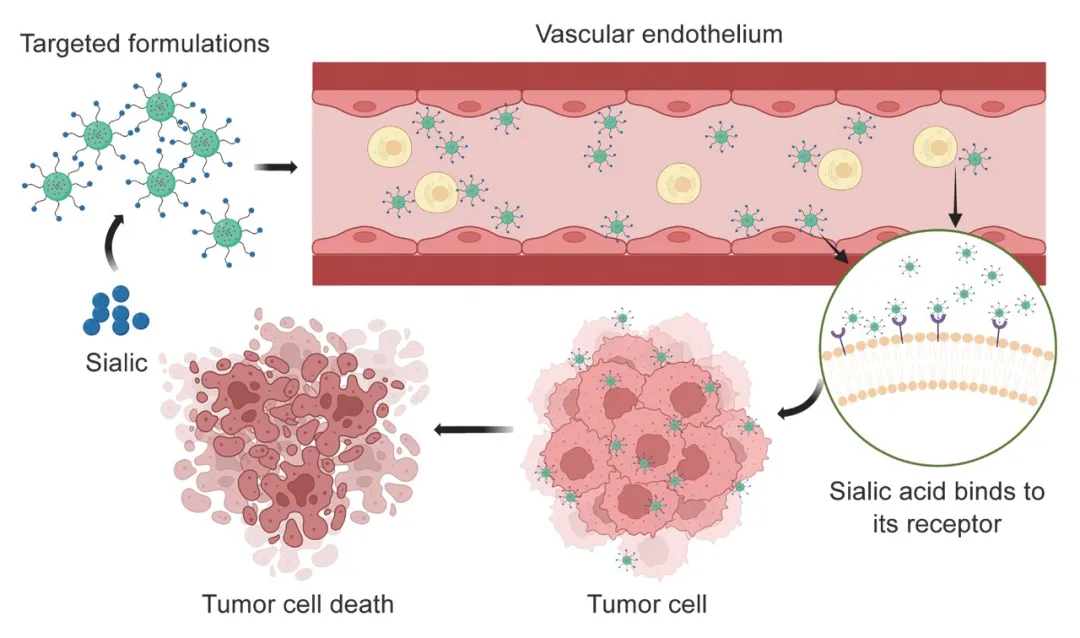
In recent years, scientists have developed sialic acid-functionalized nanoparticles using the properties of sialic acid. These nanoparticles can specifically bind to Siglec by modifying their surfaces with sialic acid, thereby achieving targeted drug delivery. This targeted drug delivery system shows great potential in the treatment of tumors and inflammation.
In tumor treatment, sialic acid-functionalized nanoparticles can carry anticancer drugs and deliver them precisely to the surface of tumor cells. Since Siglec is usually highly expressed on the surface of tumor cells, sialic acid-functionalized nanoparticles can specifically bind to tumor cells and release drugs, thereby improving the efficacy of drugs and reducing damage to normal tissues. In the treatment of inflammation, sialic acid-functionalized nanoparticles can carry anti-inflammatory drugs and deliver them to the site of inflammation in a targeted manner to reduce the inflammatory response.
Chemical modification: improving targeting affinity and selectivity
In order to further improve the binding affinity and selectivity of sialic acid-functionalized nanoparticles to Siglec, scientists have chemically modified sialic acid. By changing the structure of sialic acid, such as introducing different functional groups or changing the length of its sugar chain, the binding properties of sialic acid to Siglec can be optimized. These chemical modifications not only improve the targeting efficiency of nanoparticles, but also enhance their stability and biocompatibility in vivo.
Future Outlook: Broad Prospects for Sialic Acid Targeted Drug Delivery
As a key target in the targeted drug delivery system, sialic acid-binding immunoglobulin-like lectin (Siglec) provides new ideas and methods for drug delivery. Sialic acid-functionalized nanoparticles have broad application prospects in tumor and inflammation treatment. In the future, with the in-depth study of the biological functions of Siglec and the continuous development of sialic acid chemical modification technology, the sialic acid targeted drug delivery system is expected to play an important role in the treatment of more diseases and bring more accurate and effective treatment plans to patients.
In short, the application of sialic acid-binding immunoglobulin-like lectin (Siglec) in targeted drug delivery system provides a new precision treatment method for modern medicine. Through sialic acid-functionalized nanoparticles, drugs can be accurately delivered to the lesion site, improve the treatment effect and reduce side effects. Research and application in this field will bring more innovations and breakthroughs to future medical technology.
This article is reviewed and published by the technical expert team of UA
Disclaimer: This article partially utilizes artificial intelligence assistance in its creation. If any content involves copyright or intellectual property issues, please let us know and we promise to verify and remove it as soon as possible.
Purchase recombinant protein, choose Nanjing UA-Bio
UA protein focuses on providing various protein reagents, raw materials, and services required for drug research and development, cell therapy, gene therapy, and basic scientific research, including drug target proteins, immune checkpoint proteins, cytokines, tool enzymes, customized protein expression, and full-length transmembrane protein development. Youai is committed to providing customers with high-quality products and professional services, and building a High-tech Biological Enterprise with International Competitiveness.







 Business license (three certificates in one)