




Acidic fibroblast growth factor: the "magic factor" of wound repair


In the long river of life, trauma is an unavoidable accident. Whether it is an accidental abrasion, a surgical incision, or a skin ulcer caused by a disease, the healing of wounds is inseparable from a magical substance-acidic fibroblast growth factor (aFGF).
- Recent Advances
- Product Information
Acidic fibroblast growth factor: the "magic factor" of wound repair
In the long river of life, trauma is an unavoidable accident. Whether it is an accidental abrasion, a surgical incision, or a skin ulcer caused by a disease, the healing of wounds is inseparable from a magical substance-acidic fibroblast growth factor (aFGF).
aFGF: An important role in the evolution of life
Acidic fibroblast growth factor is a polypeptide growth factor widely present in organisms. It plays an extremely important role in the process of life evolution and is an indispensable key factor in the process of wound repair. When our body suffers trauma, aFGF will be quickly activated, like a brave commander, commanding various cells to rush to the wound site. It can promote the proliferation and differentiation of various cells such as fibroblasts and endothelial cells. These cells are like "bricks and stones" for repairing wounds. Under the guidance of aFGF, they quickly fill the wound and build a new tissue structure, thereby accelerating the healing process of the wound.
Challenges in the clinical application of aFGF
Although aFGF has great potential in wound repair, it faces many challenges in actual clinical applications. First, aFGF has poor stability and is easily inactivated by various factors in an in vitro environment. For example, slight changes in temperature, pH, or even light can cause changes in the structure of aFGF, thereby losing its biological activity. Second, aFGF has a very short half-life in the body, which means that it has a very limited time to work in the body. Once it enters the human body, it is quickly metabolized and cannot continue to work locally in the wound. This requires extremely strict conditions to be controlled during the storage, transportation, and clinical use of aFGF, greatly limiting its wide application.
Scientific breakthrough: the birth of a new hydrogel
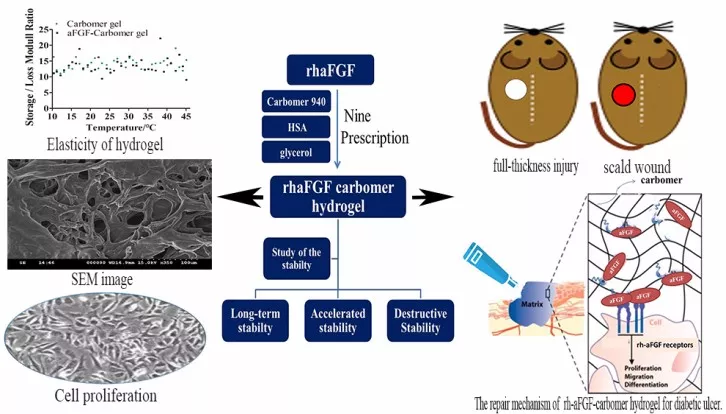
However, scientists have never stopped studying and exploring aFGF. Recently, a new drug team led by Professor Wang Xiaojie and Dr. Hui Qi published a breakthrough research result in the journal ACS Biomaterials-Science & Engineering. Based on an in-depth study of the stability of recombinant human acidic fibroblast growth factor (rh-aFGF), they designed and screened a rh-aFGF-carbomer hydrogel with a polymer material carbomer as the matrix. The emergence of this new hydrogel has brought new hope for the clinical application of aFGF.
Carbomer is a polymer material with good biocompatibility and mechanical properties. In rh-aFGF-carbomer hydrogel, carbomer forms an interconnected sponge-like three-dimensional network structure. This three-dimensional network structure is like a protective "cage" that wraps aFGF in it. It not only provides a stable environment for aFGF, avoids the aggregation of aFGF due to intermolecular forces, thereby improving the stability of aFGF, but also enables the slow release of aFGF locally on the wound surface. This slow release mechanism enables aFGF to continue to play a role locally in the wound, greatly prolonging its effective action time in the body.
After a series of experimental verifications, rh-aFGF-carbomer hydrogel can be stably stored for 24 months at 5℃±3℃, which greatly solves the stability problem of traditional aFGF preparations during storage and transportation. In the study of full-thickness skin injury and scald models in type 2 diabetic rats, this new hydrogel showed significant therapeutic effects. It can significantly promote the healing of skin wounds and accelerate the proliferation of fibroblasts, capillaries and collagen fibers. Its effect is even better than the rh-aFGF freeze-dried powder preparation currently used in the market.
Future Outlook: The Broad Prospects of aFGF
This research result not only provides a new preparation form for the clinical application of aFGF, but also brings new hope to the field of trauma repair. With further research and development, it is believed that this new type of rh-aFGF-carbomer hydrogel will be more widely used in clinical practice. It is expected to become a powerful weapon for treating various traumas, especially chronic and difficult-to-heal wounds, and bring good news to countless patients suffering from trauma.
Acidic fibroblast growth factor, this "magic factor" that has silently contributed in the evolution of life, is now shining with new brilliance with the help of scientists' wisdom and innovation. It will continue to play an important role in the battlefield of trauma repair and protect human health and life.
This article is reviewed and published by the technical expert team of UA
Disclaimer: This article partially utilizes artificial intelligence assistance in its creation. If any content involves copyright or intellectual property issues, please let us know and we promise to verify and remove it as soon as possible.
Purchase recombinant protein, choose Nanjing UA-Bio
UA protein focuses on providing various protein reagents, raw materials, and services required for drug research and development, cell therapy, gene therapy, and basic scientific research, including drug target proteins, immune checkpoint proteins, cytokines, tool enzymes, customized protein expression, and full-length transmembrane protein development. Youai is committed to providing customers with high-quality products and professional services, and building a High-tech Biological Enterprise with International Competitiveness.







 Business license (three certificates in one)