




GITR and AITR: Mysterious twin stars in immune regulation


In the human immune system, there are many complex signaling pathways and molecular mechanisms that work together to maintain the balance of immune responses. Among them, glucocorticoid-induced tumor necrosis factor receptor (GITR) and its ligand (AITR, i.e. GITRL) are a pair of co-stimulatory molecules that have attracted much attention.
- Recent Advances
- Product Information
GITR and AITR: Mysterious twin stars in immune regulation
In the human immune system, there are many complex signaling pathways and molecular mechanisms that work together to maintain the balance of immune responses. Among them, glucocorticoid-induced tumor necrosis factor receptor (GITR) and its ligand (AITR, i.e. GITRL) are a pair of co-stimulatory molecules that have attracted much attention. They play an important role in regulating immune cell function, affecting inflammatory response, and participating in tumor immune escape.
Discovery and structure of GITR and AITR
GITR is an important T lymphocyte co-stimulatory molecule that belongs to the tumor necrosis factor receptor superfamily. It was first discovered in 1997 by Nocentini et al. from T lymphocyte hybridomas treated with dexamethasone. Subsequently, scientists cloned AITR that can specifically bind to GITR from human umbilical cord endothelial cells and mouse spleen cells. GITR is mainly expressed in T lymphocytes, including effector T cells and regulatory T cells (Treg), while AITR is mainly expressed in antigen-presenting cells, such as endothelial cells, dendritic cells, and macrophages.
Structurally, both GITR and AITR are transmembrane proteins, containing an intracellular segment, a transmembrane domain, and an extracellular segment. The intracellular segment of GITR can recruit TNF receptor-associated factors (TRAFs), thereby transmitting downstream signals and regulating the activation and function of immune cells. AITR, by binding to GITR, transmits co-stimulatory signals to T cells, regulating the proliferation, survival, and cytokine secretion of T cells.
The role of GITR and AITR in immune regulation
Activate effector T cells and play a pro-inflammatory role
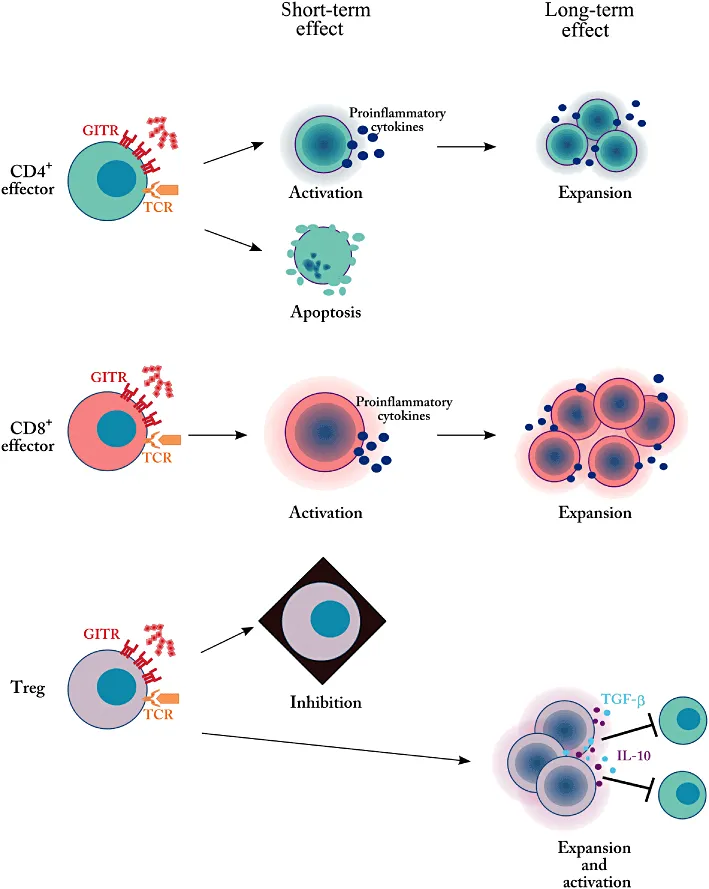
Effector T cells play a key role in immune response, and they can recognize and attack infected cells and tumor cells. In the resting state, the expression level of GITR on the surface of effector T cells is low, but once activated by antigens, the expression of GITR will increase significantly. After binding to GITR, AITR can enhance the survival, activation, and proliferation of effector T cells, promote the secretion of inflammatory factors such as IL-2 and IFNγ, and thus enhance the intensity of the immune response. This co-stimulatory effect is essential for the elimination of pathogens and tumor cells.
Regulate Treg cells to maintain immune balance
Unlike effector T cells, regulatory T cells (Treg) play the role of "brakes" in the immune system. They can inhibit excessive immune responses and prevent the occurrence of autoimmune diseases. Treg cells characteristically highly express GITR, and in certain pathological conditions, such as tumor microenvironments, GITR expression is further increased. The combination of AITR and GITR can not only promote the proliferation of Treg, but also enhance its immunosuppressive function. However, interestingly, when GITR-activating antibodies (such as DTA-1) are used, the immunosuppressive function of Treg can be inhibited, thereby breaking the immunosuppressive state in the tumor microenvironment and enhancing anti-tumor immune responses. This dual mechanism of action makes the GITR/AITR pathway have a complex and important position in immune regulation.
Affect other immune cells and participate in immune responses
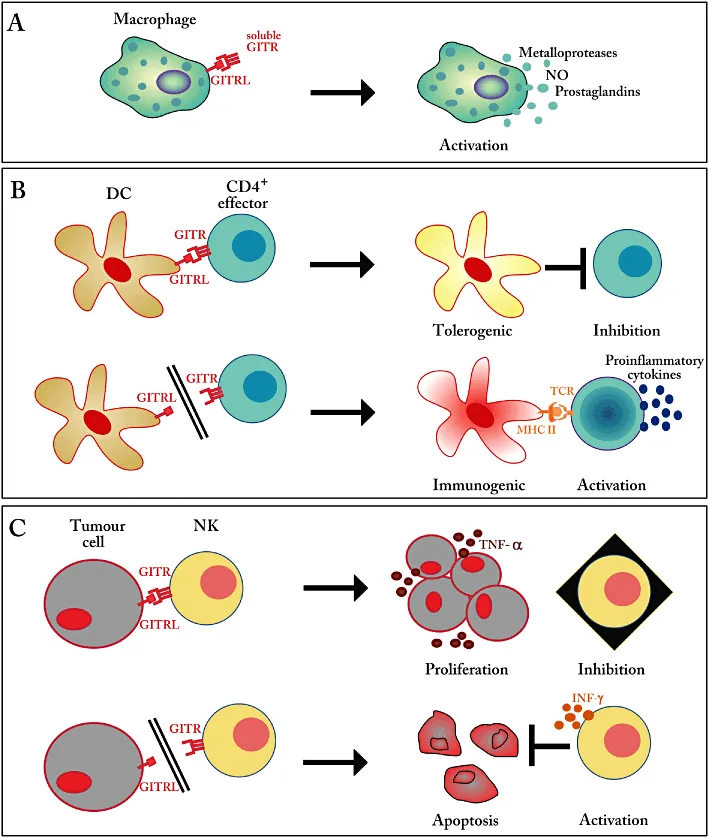
In addition to T cells and Treg cells, GITR/AITR signals can also affect the functions of other immune cells. For example, the expression of AITR on endothelial cells can increase the expression of cell adhesion molecules, promote the adhesion and migration of inflammatory cells, and thus enhance the inflammatory response. In dendritic cells (DCs), activation of AITR can inhibit the expression of pro-inflammatory cytokine IL-12, while promoting the production of anti-inflammatory cytokines, playing an immunomodulatory role. In addition, activation of AITR in macrophages can also induce cytokine secretion and extracellular matrix adhesion, and participate in the immune response process.
Research progress of GITR and AITR in liver diseases
In recent years, scientists have found that the GITR/AITR pathway also plays an important role in liver diseases. After liver transplantation, increased expression of AITR is closely related to immune rejection. By intervening in GITR/AITR signals, it is expected to improve immune tolerance after liver transplantation and reduce the occurrence of rejection. In gene therapy, AITR has also been shown to be a key molecule for inducing immune tolerance, which can promote the proliferation of antigen-specific Tregs and prevent exogenous gene products from being cleared by the immune system. In addition, in liver tumors, Treg cells with high expression of GITR are involved in the immune escape process of tumors. By activating GITR/AITR signals, the immunosuppressive function of Tregs can be reduced and the anti-tumor activity of effector T cells can be enhanced, providing new ideas for immunotherapy of liver tumors.
Future Outlook
Although some progress has been made in the study of the GITR/AITR pathway, there are still many issues to be further explored. For example, the mechanism of action of GITR/AITR signaling in other liver diseases has not been fully clarified, especially in anti-infection and autoimmune liver diseases, and its specific functions and regulatory mechanisms still need to be further studied. In addition, how to safely and effectively intervene in GITR/AITR signaling to achieve the purpose of treating liver diseases is also an important direction for future research. With the continuous in-depth understanding of the GITR/AITR pathway, it is believed that its application prospects in the treatment of liver diseases will become more and more broad, bringing more hope and good news to patients.
This article is reviewed and published by the technical expert team of UA
Disclaimer: This article partially utilizes artificial intelligence assistance in its creation. If any content involves copyright or intellectual property issues, please let us know and we promise to verify and remove it as soon as possible.
Purchase recombinant protein, choose Nanjing UA-Bio
UA protein focuses on providing various protein reagents, raw materials, and services required for drug research and development, cell therapy, gene therapy, and basic scientific research, including drug target proteins, immune checkpoint proteins, cytokines, tool enzymes, customized protein expression, and full-length transmembrane protein development. Youai is committed to providing customers with high-quality products and professional services, and building a High-tech Biological Enterprise with International Competitiveness.







 Business license (three certificates in one)