




H-2Kb MHC Tetramer Uncovers Immune Pathways Regulating mRNA Vaccine - Induced Lung - Resident Memory T Cell Differentiation


mRNA vaccination has multiple immunological advantages. It can activate CD8 + T cells and CD4 + T cells and induce antibody production, forming an adaptive immune response network. It doesn't rely on viral - vector delivery systems, avoiding the potential limits of pre - existing vector immunity on booster vaccination. Also, the modular design of its industrial production process enables rapid large - scale preparation.
- Recent Advances
- Product Information
Route of self-amplifying mRNA vaccination modulates the establishment of pulmonary resident memory CD8 and CD4 T cells
The mRNA vaccination platform demonstrates multiple immunological advantages: it activates CD8⁺ T cells, CD4⁺ T cells, and antibody-producing B cells to establish a coordinated adaptive immune network; eliminates reliance on viral vectors, circumventing pre-existing immunity that limits boosting efficacy; and enables rapid industrial scaling through modular manufacturing. Standard regimens employ two intramuscular (IM) injections spaced 21 days (BNT162b2) or 28 days (mRNA-1273) apart, with boosters administered 5 months post-priming to reinforce immunological memory. As the technology expands to universal influenza vaccines and cancer immunotherapy—applications critically dependent on tissue-resident memory T cell (Trm) responses—there is an urgent need to dissect the differentiation trajectories and tissue distribution profiles of mRNA vaccine-induced memory CD8⁺ and CD4⁺ T cells.
Conventional vaccines, while successful against many pathogens, exhibit significant limitations in controlling HIV, Plasmodium, Mycobacterium tuberculosis, and influenza viruses, underscoring the need for novel vaccine paradigms. The SARS-CoV-2 pandemic highlighted mRNA vaccines' rapid development and broad immunogenicity, effectively preventing severe disease.
Unlike circulating memory T cells (Tcm) patrolling blood and lymphatics, tissue-resident memory T cells (Trm) serve as frontline sentinels in non-lymphoid tissues, enabling immediate pathogen clearance through cytotoxic and innate-like effector functions. Pulmonary CD8⁺ Trm populations synergize with CD4⁺ Th1-type Trm-derived IFN-γ to establish antiviral barriers, while lung-resident CD4⁺ T follicular helper cells (Tfh) promote mucosal antibody affinity maturation during heterologous influenza challenges. Trm detected in mediastinal lymph nodes (medLN) suggest regional lymphoid memory contributions to respiratory protection. Given their proven critical role in murine and human respiratory defenses, evaluating whether mRNA priming-boosting strategies can induce functional Trm in respiratory mucosae and draining lymph nodes holds transformative clinical potential. However, lung Trm establishment typically requires local antigen exposure, necessitating rigorous validation of whether systemic IM routes can overcome anatomical barriers to induce respiratory Trm responses.
A recent study published in Science Immunology by the University of Minnesota's Center for Immunology systematically investigated how vaccination route modulates self-amplifying mRNA vaccine-induced pulmonary Trm formation. Using dendron-modified nanoparticles (MDNP) to deliver influenza nucleoprotein (NP)-encoding self-amplifying mRNA, the team dissected pathway-specific effects on antigen-specific T cell and humoral immunity. By deploying multi-parametric immune monitoring, they revealed how vaccine delivery route shapes Trm differentiation, tissue residency, and functional maintenance in respiratory mucosal microenvironments, providing critical insights for optimizing mRNA vaccines' mucosal immunogenicity.
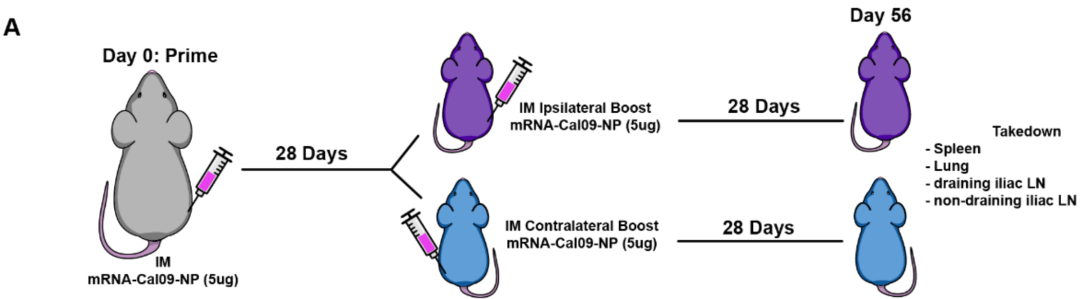
The researchers constructed a self-amplifying mRNA vaccine targeting influenza A virus nucleoprotein (NP), encapsulated in MDNP for efficient delivery. They compared immune outcomes across routes—including contralateral/ipsilateral IM boosting, intravenous (IV) injection, and intranasal (IN) administration—and employed parabiosis models to tissue-specific memory T cell dynamics.
Primary immunization used 5 μg Cal09 NP mRNA via right hindlimb IM injection, followed ≥28 days later by boosts in either ipsilateral (right) or contralateral (left) hindlimbs. MHC class I (H-2Kᵇ/NP366-375) and class II (I-Aᵇ/NP261-277) tetramer staining at 28 days post-final immunization revealed robust splenic H-2Kᵇ/NP366-375⁺ CD8 memory T cell expansion regardless of boost side. Contralateral lymph nodes (LN) exhibited site-specific memory CD8 T cell accumulation, potentially linked to CD62L downregulation altering homing patterns.
Further analysis confirmed IM immunization induced pulmonary and draining LN CD8⁺ Trm marked by extravascular (IV⁻) and tissue-retention (CD69⁺) phenotypes. Ipsilateral boosting enhanced serum antibody titers, while contralateral immunization promoted left iliac LN CD69⁺ CD8 T cell and CD4⁺ Tfh memory formation. Although IN delivery induced moderate circulating memory, it significantly enriched respiratory Trm. Notably, sequential IM prime-IN boost synergistically amplified systemic T cell memory and pulmonary Trm responses.
The study demonstrated that mRNA vaccine route spatially patterns humoral and cellular immunity. IM priming-boosting sufficed for pulmonary Trm induction, while IN boosting optimized mucosal barriers. This heterologous strategy provides a blueprint for next-generation respiratory pathogen vaccines.
Comparative route analyses revealed IN boosting dramatically increased lung parenchymal CD103⁺ CD8 T cell recruitment. While human mRNA vaccines exclusively use IM delivery, conventional lipid nanoparticles (LNP) risk severe nasal inflammation—a concern mitigated by MDNP's demonstrated safety in mice (100% survival post-IN dosing) and reduced pro-inflammatory cytokine (IP-10, IL-6, MCP-1, CXCL1, RANTES) production versus LNP.
To route-specific effects on memory T cell distribution, the team compared IM, IV, and IN strategies. IM and IV induced comparable secondary lymphoid organ H-2Kᵇ/NP366-375⁺ T cell counts, but IV failed to establish iliac LN CD62L⁻CD69⁺ memory pools. IN immunization reduced splenic/iliac LN memory cells while selectively enriching medLN Trm. Notably, IN boosting in IM-primed mice induced medLN H-2Kᵇ/NP366-375⁺ T cell clonal expansion, suggesting route-specific regulatory mechanisms.
Route-dependent Tfh differentiation and lung Trm formation were also observed. All routes induced germinal center Tfh in draining LN, but pulmonary antigen-specific CD4 memory remained sparse. IN delivery specifically increased lung I-Aᵇ:NP261-277⁺ CD4 T cells with IV⁻CD69⁺ (but low CD103) phenotypes, consistent with non-lymphoid CD4 Trm signatures. Unlike influenza infection, mRNA vaccination did not generate Tfh-like (PSGL1ᴸᴼ FR4ᴴᴵ) CD4 memory, though IN immunization induced FR4-intermediate TH1-like Trm.
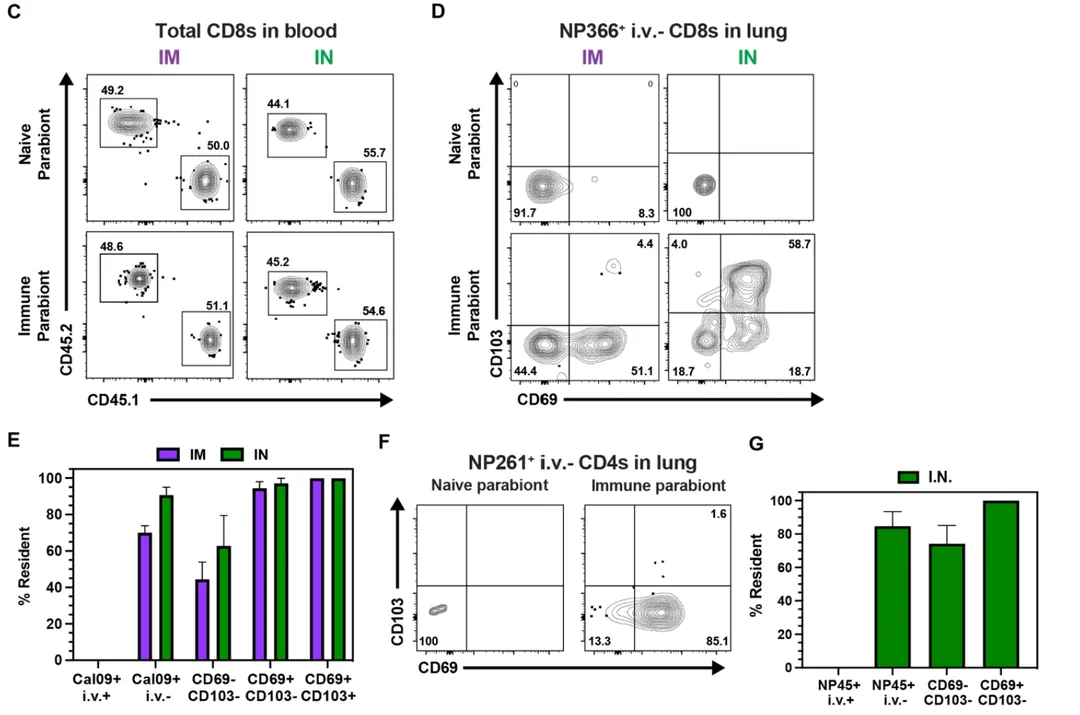
Parabiosis experiments validated functional pulmonary Trm induction. While CD69 marks Trm, not all CD69⁺ cells are resident. Immunized mice showed lung extravascular NP366⁺ CD8 T cell enrichment versus controls, confirming IM-induced functional Trm. Phenotypic grading (CD69⁻CD103⁻ to CD69⁺CD103⁺) correlated with tissue residency (40% to 95% to 100%). IN boosting increased extravascular T cells 10-fold while elevating residency from 70% to 90%. For CD4 T cells, IN immunization resulted in 90% lung retention (100% within CD69⁺ subsets), confirming route-dependent Trm optimization.
Combining IM priming with IN boosting synergistically elevated circulating and pulmonary Trm. While IM-IM induced high systemic NP366⁺ CD8 T cells, IN boosting favored lung Trm maturation. This heterologous approach amplified splenic/mesenteric LN and pulmonary (via IV access) antigen-specific T cells, with IN boosting specifically enhancing lung CD69⁺CD103⁺ CD8 Trm and CD69⁺ CD4 Trm phenotypes.
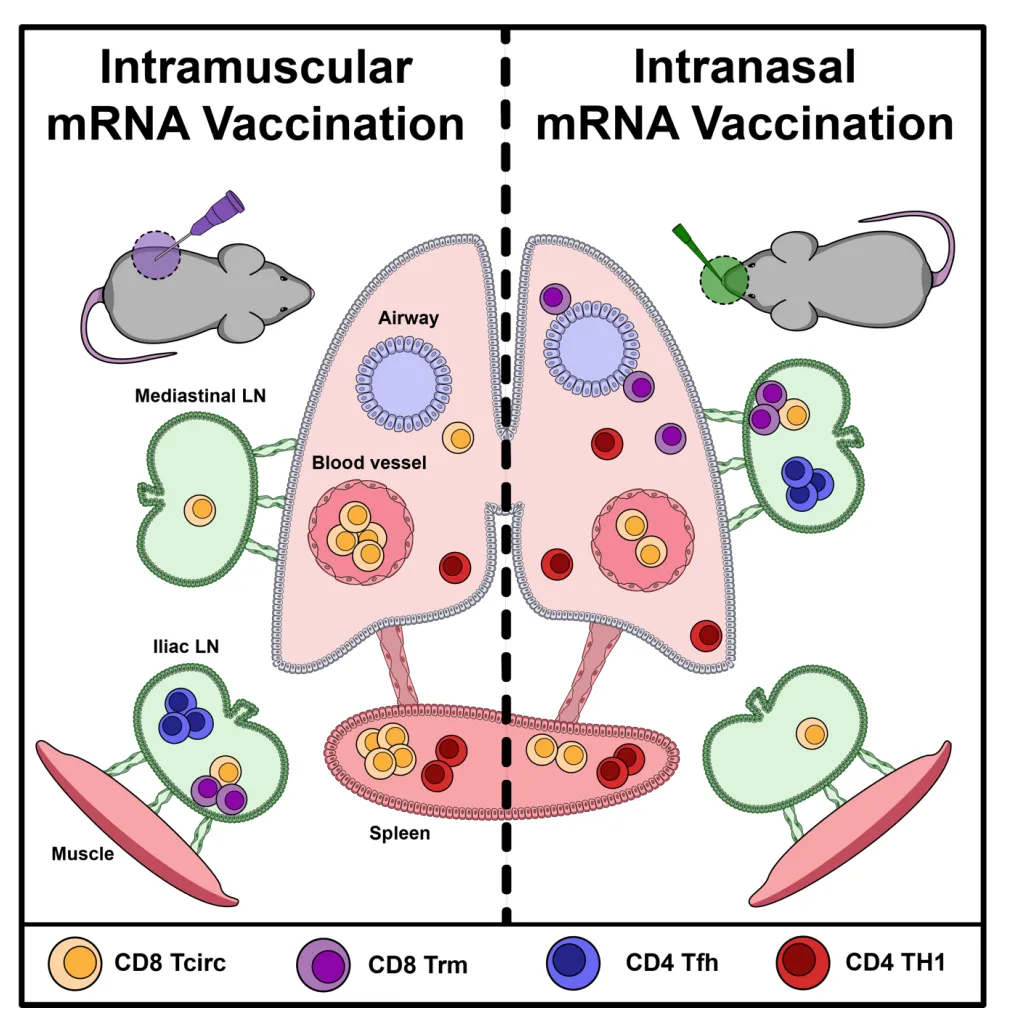
This study comprehensively mapped mRNA vaccine-induced antigen-specific CD8⁺/CD4⁺ memory T cell heterogeneity and anatomical distribution. It confirms that mRNA vaccines establish pulmonary Trm irrespective of route, providing critical protection against respiratory pathogens. The findings align with universal influenza vaccine criteria—establishing durable mucosal immunity at infection portals. Leveraging mRNA platforms' antigenic flexibility and absence of vector immunity, future work must elucidate mechanisms underlying broad protective immunity.
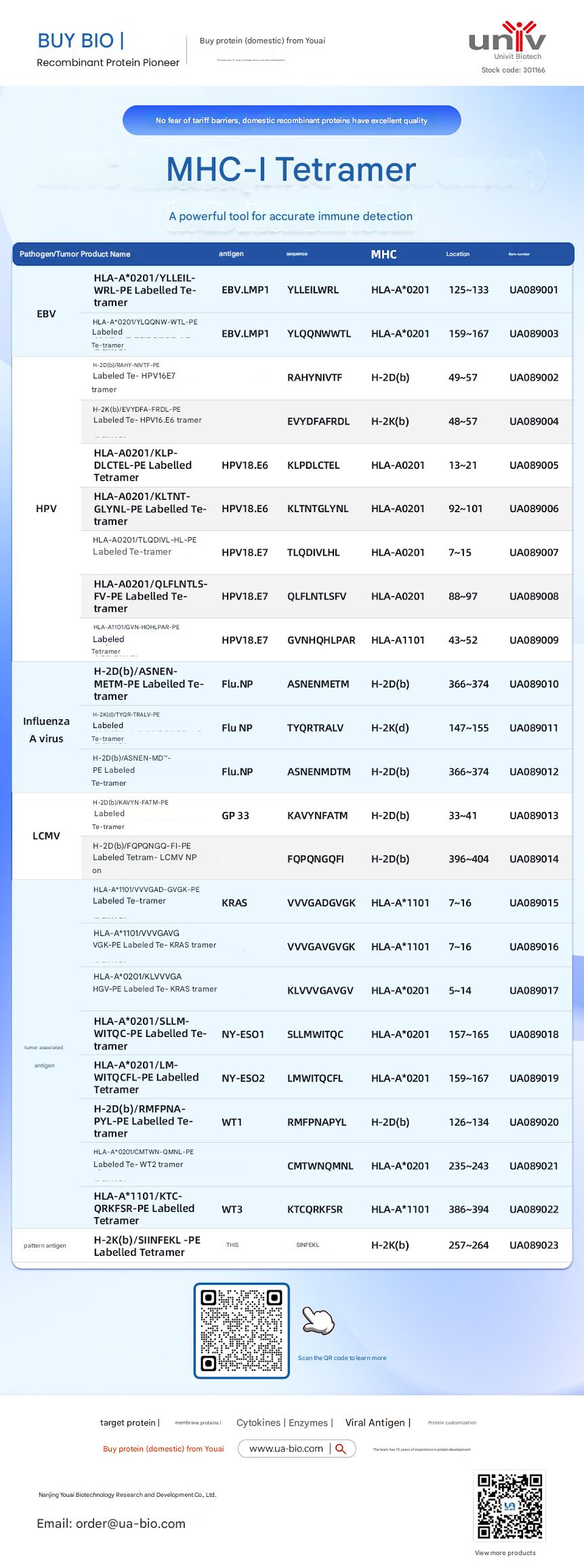
| Disease Category | Product Name | Antigen | Sequence | MHC | Position | Product Number |
|---|---|---|---|---|---|---|
| EBV | HLA-A*0201/YLELLVWRL-PE Labelled Tetramer | EBV.LMP1 | YLELLVWRL | HLA-A*0201 | 125-133 | UA089001 |
| EBV | HLA-A*0201/YLQQNWTL-PE Labelled Tetramer | EBV.LMP1 | YLQQNWTL | HLA-A*0201 | 159-167 | UA089003 |
| EBV | H-2Db(b)/RAHY-NIVTF-PE Labelled Tetramer | HPV16.E7 | RAHYNIVTF | H-2Db | 49-57 | UA089002 |
| HPV | H-2K(b)/EVYDFA-FRQL-PE Labelled Tetramer | HPV16.E6 | EVYDFARDL | H-2Kb | 48-57 | UA089004 |
| HPV | HLA-A*0201/KLP-DLCTL-PE Labelled Tetramer | HPV18.E6 | KLPDCTL | HLA-A*0201 | 13-21 | UA089005 |
| HPV | HLA-A*0201/KLTNT-GLYQL-PE Labelled Tetramer | HPV18.E6 | KLTNTGLYNL | HLA-A*0201 | 92-101 | UA089006 |
| HPV | HLA-A*0201/TLODIVIHL-PE Labelled Tetramer | HPV18.E7 | TLODIVIHL | HLA-A*0201 | 7~15 | UA089007 |
| HPV | HLA-A*0201/QFLNTL-FV-PE Labelled Tetramer | HPV18.E7 | QFLNTLFSV | HLA-A*0201 | 88-97 | UA089008 |
| HPV | HLA-A*1101/GVNHQLPAR-PE Labelled Tetramer | HPV18.E7 | GVNHQLPAR | HLA-A*1101 | 43-52 | UA089009 |
| Influenza A Virus | H-2D(b)/ASNENMETM-PE Labelled Tetramer | Flu.NP | ASNENMETM | H-2Db | 366-374 | UA089010 |
| Influenza A Virus | H-2K(d)/TYQR-TRALY-PE Labelled Tetramer | Flu.NP | TYQRTRALY | H-2Kd | 147-155 | UA089011 |
| Influenza A Virus | H-2D(b)/ASNEN-MDTM-PE Labelled Tetramer | Flu.NP | ASNENMDTM | H-2Db | 366-374 | UA089012 |
| LCMV | H-2D(b)/KAVYNFATM-PE Labelled Tetramer | GP 33 | KAVYNFATM | H-2Db | 33-41 | UA089013 |
| LCMV | H-2D(b)/FQPGQGFVK-PE Labelled Tetramer | LCMV NP | FQPGQGFVK | H-2Db | 396-404 | UA089014 |
| Tumor-related | HLA-A*1101/VVGADGVK-PE Labelled Tetramer | KRAS | VVGADGVK | HLA-A*1101 | 7~16 | UA089015 |
| Tumor-related | HLA-A*1101/VVGAGVGK-PE Labelled Tetramer | KRAS | VVGAGVGK | HLA-A*1101 | 7~16 | UA089016 |
| Tumor-related | HLA-A*0201/KLVVGAGV-PE Labelled Tetramer | KRAS | KLVVGAGV | HLA-A*0201 | 5~14 | UA089017 |
| Tumor-related | HLA-A*0201/SLLMWITQC-PE Labelled Tetramer | NY-ESO1 | SLLMWITQC | HLA-A*0201 | 157-165 | UA089018 |
| Melanoma | HLA-A*0201/LMWITQCFL-PE Labelled Tetramer | NY-ESO2 | LMWITQCFL | HLA-A*0201 | 159-167 | UA089019 |
| Melanoma | H-2Db(b)/MMFPNA-P1-PE Labelled Tetramer | WT1 | RMFPNAPL | H-2Db | 126-134 | UA089020 |
| Melanoma | HLA-A*0201/CMTWV-PE Labelled Tetramer | WT2 | CMTWVNMDM | HLA-A*0201 | 235-243 | UA089021 |
| Melanoma | HLA-A*1101/KTCQRKSF-PE Labelled Tetramer | WT3 | KTCQRKSF | HLA-A*1101 | 386-394 | UA089022 |
| Ovarian Cancer | H-2K(b)/SINFEKL-PE Labelled Tetramer | OVA | SINFEKL | H-2Kb | 257-264 | UA089023 |
This article is reviewed and published by the technical expert team of UA
Disclaimer: This article partially utilizes artificial intelligence assistance in its creation. If any content involves copyright or intellectual property issues, please let us know and we promise to verify and remove it as soon as possible.
Purchase recombinant protein, choose Nanjing UA-Bio
UA protein focuses on providing various protein reagents, raw materials, and services required for drug research and development, cell therapy, gene therapy, and basic scientific research, including drug target proteins, immune checkpoint proteins, cytokines, tool enzymes, customized protein expression, and full-length transmembrane protein development. Youai is committed to providing customers with high-quality products and professional services, and building a High-tech Biological Enterprise with International Competitiveness.







 Business license (three certificates in one)