




Tumor-Associated MHC Tetramer Technology: An Immunological Revolution from Basic Research to Clinical Translation


MHC tetramer technology, a revolutionary tool in immunology, has fundamentally transformed the paradigm of tumor immune monitoring and therapeutic strategy development through direct visualization of antigen-specific T cells. This review systematically examines the technical principles of MHC tetramers, their pivotal applications in tumor immunology research, breakthrough advancements in novel tetramer technologies, and their prospects for clinical translation.
- Recent Advances
- Product Information
-
MHC Folding Optimization: Using recombinant expression technology to solve the in vitro folding of MHC heavy chains with β2-microglobulin (β2m).
-
Antigen Peptide Loading Strategy: Utilizing UV-mediated peptide exchange technologies (e.g., Photo-CLEFT) for reversible peptide loading.
-
Polymerization Technology Evolution: From tetramers to decamers (Dextramers) and streptavidin mutants (Streptamers), significantly enhancing detection sensitivity.
-
Barcoded Tetramers: Combined with DNA oligonucleotide labeling to enable single-cell TCR sequencing and phenotypic analysis.
-
Nanoparticle Tetramers: Using quantum dots or magnetic nanoparticles to enhance signal strength and surpass flow cytometry detection limits.
-
Live Cell Tetramers: Designed with non-covalent binding for dynamic T cell monitoring and in vivo tracking.
-
Neoantigen Prediction Validation: Integrating whole-exome sequencing (WES) with MHC tetramer screening to improve validation efficiency of predicted neoantigens to over 80%.
-
Immunediting Mechanism Analysis: Longitudinally monitoring neoantigen-specific T cells in peripheral blood and tumors to reveal immune evasion patterns.
-
Checkpoint Inhibitor Response Prediction: A significant positive correlation between baseline neoantigen-specific T cell frequency and the efficacy of PD-1/PD-L1 inhibitors.
-
CAR-T Cell Therapy Quality Control: Tetramer detection ensures that tumor-specific T cells account for >15% of CAR-T products, directly related to clinical remission rates.
-
Exhaustion Phenotype Markers: Combining with inhibitory receptors like PD-1 and TIM-3 to identify residual functional precursor cells in exhausted T cell subsets.
-
Metabolic Reprogramming Analysis: Using tetramer sorting with CyTOF to reveal mitochondrial dysfunction characteristics in tumor-infiltrating lymphocytes (TILs).
-
NeoVax Clinical Trials: Using tetramers to select patient-specific neoantigens for personalized peptide vaccines, improving the 2 - year recurrence-free survival rate in melanoma patients to 62%.
-
mRNA-4157 Vaccine Breakthrough: Combining tetramer monitoring with mRNA delivery to target nine neoantigens simultaneously and induce broad T cell responses in solid tumors.
-
TIL Cell Selection: Enriching tumor-reactive TILs with tetramers to enhance anti-tumor activity 3 - 5 times.
-
TCR-T Cell Design: Identifying high-affinity TCRs with tetramers to construct TCR-T cells for difficult targets like KRAS G12D, achieving partial remission in clinical trials.
-
HLA Allele Limitations: Existing tetramers mainly cover common alleles like HLA-A02:01, with a lack of reagents for rare alleles like HLA-B44:03.
-
Low-Affinity Epitope Challenges: Weak binding of tumor neoantigens to MHC (KD > 100 μM) makes detection difficult.
-
Tissue Penetration Limitations: In vivo imaging tetramers need to address rapid clearance and background signal interference.
-
Pan-HLA Tetramer Libraries: Establishing a tetramer kit covering >90% of human HLA alleles using AI prediction and high-throughput screening.
-
Conditional Tetramer Systems: Developing light - or small - molecule - controlled tetramers for precise spatiotemporal manipulation of T cell activation.
-
Single-Cell Tetramer-ATAC Joint Detection: Revealing the epigenetic regulatory network of tumor-specific T cells.
-
Spatial Tetramer Technology: Combining with mass spectrometry imaging (MIBI) to analyze T cell clonotypes and spatial distribution in situ.
-
Standardized Detection Processes: Establishing ISO-certified standards for tetramer detection to facilitate multi-center clinical trial data recognition.
-
Low-Cost Reagent Development: Reducing tetramer production costs to 1/10 of current levels using cell-free expression systems and microfluidic technologies.
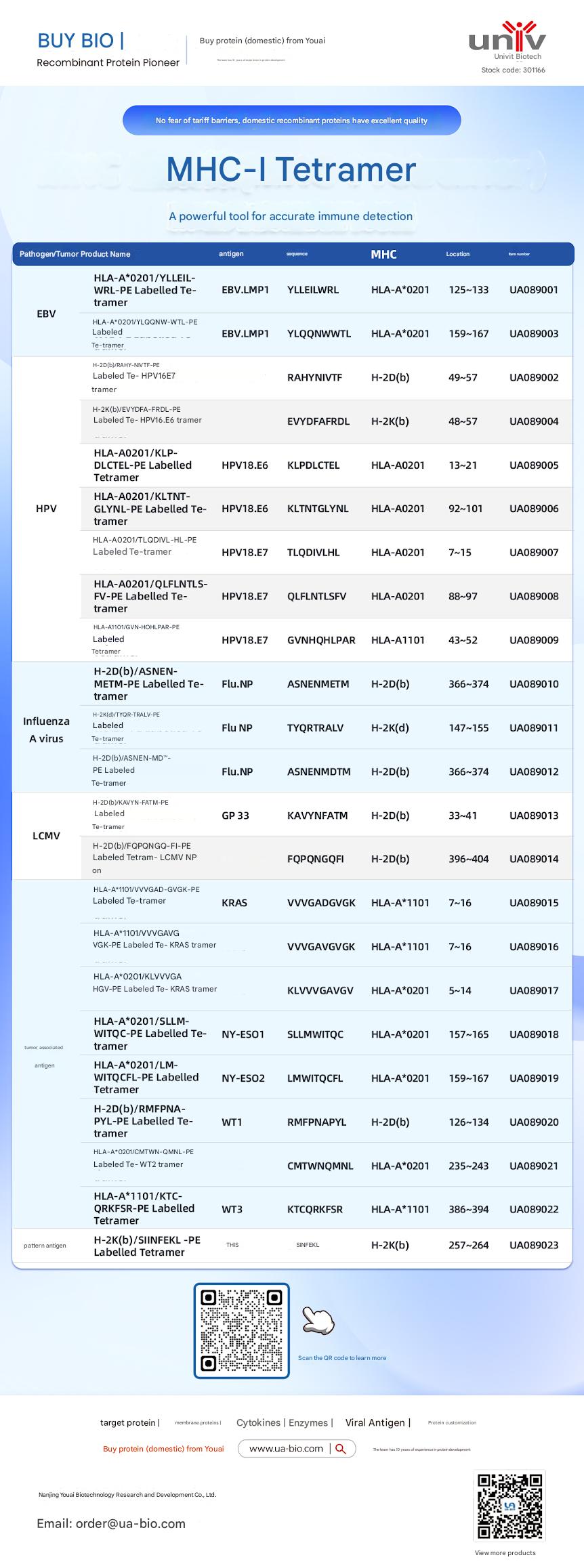
| Disease Category | Product Name | Antigen | Sequence | MHC | Position | Product Number |
|---|---|---|---|---|---|---|
| EBV | HLA-A*0201/YLELLVWRL-PE Labelled Tetramer | EBV.LMP1 | YLELLVWRL | HLA-A*0201 | 125-133 | UA089001 |
| EBV | HLA-A*0201/YLQQNWTL-PE Labelled Tetramer | EBV.LMP1 | YLQQNWTL | HLA-A*0201 | 159-167 | UA089003 |
| EBV | H-2Db(b)/RAHY-NIVTF-PE Labelled Tetramer | HPV16.E7 | RAHYNIVTF | H-2Db | 49-57 | UA089002 |
| HPV | H-2K(b)/EVYDFA-FRQL-PE Labelled Tetramer | HPV16.E6 | EVYDFARDL | H-2Kb | 48-57 | UA089004 |
| HPV | HLA-A*0201/KLP-DLCTL-PE Labelled Tetramer | HPV18.E6 | KLPDCTL | HLA-A*0201 | 13-21 | UA089005 |
| HPV | HLA-A*0201/KLTNT-GLYQL-PE Labelled Tetramer | HPV18.E6 | KLTNTGLYNL | HLA-A*0201 | 92-101 | UA089006 |
| HPV | HLA-A*0201/TLODIVIHL-PE Labelled Tetramer | HPV18.E7 | TLODIVIHL | HLA-A*0201 | 7~15 | UA089007 |
| HPV | HLA-A*0201/QFLNTL-FV-PE Labelled Tetramer | HPV18.E7 | QFLNTLFSV | HLA-A*0201 | 88-97 | UA089008 |
| HPV | HLA-A*1101/GVNHQLPAR-PE Labelled Tetramer | HPV18.E7 | GVNHQLPAR | HLA-A*1101 | 43-52 | UA089009 |
| Influenza A Virus | H-2D(b)/ASNENMETM-PE Labelled Tetramer | Flu.NP | ASNENMETM | H-2Db | 366-374 | UA089010 |
| Influenza A Virus | H-2K(d)/TYQR-TRALY-PE Labelled Tetramer | Flu.NP | TYQRTRALY | H-2Kd | 147-155 | UA089011 |
| Influenza A Virus | H-2D(b)/ASNEN-MDTM-PE Labelled Tetramer | Flu.NP | ASNENMDTM | H-2Db | 366-374 | UA089012 |
| LCMV | H-2D(b)/KAVYNFATM-PE Labelled Tetramer | GP 33 | KAVYNFATM | H-2Db | 33-41 | UA089013 |
| LCMV | H-2D(b)/FQPGQGFVK-PE Labelled Tetramer | LCMV NP | FQPGQGFVK | H-2Db | 396-404 | UA089014 |
| Tumor-related | HLA-A*1101/VVGADGVK-PE Labelled Tetramer | KRAS | VVGADGVK | HLA-A*1101 | 7~16 | UA089015 |
| Tumor-related | HLA-A*1101/VVGAGVGK-PE Labelled Tetramer | KRAS | VVGAGVGK | HLA-A*1101 | 7~16 | UA089016 |
| Tumor-related | HLA-A*0201/KLVVGAGV-PE Labelled Tetramer | KRAS | KLVVGAGV | HLA-A*0201 | 5~14 | UA089017 |
| Tumor-related | HLA-A*0201/SLLMWITQC-PE Labelled Tetramer | NY-ESO1 | SLLMWITQC | HLA-A*0201 | 157-165 | UA089018 |
| Melanoma | HLA-A*0201/LMWITQCFL-PE Labelled Tetramer | NY-ESO2 | LMWITQCFL | HLA-A*0201 | 159-167 | UA089019 |
| Melanoma | H-2Db(b)/MMFPNA-P1-PE Labelled Tetramer | WT1 | RMFPNAPL | H-2Db | 126-134 | UA089020 |
| Melanoma | HLA-A*0201/CMTWV-PE Labelled Tetramer | WT2 | CMTWVNMDM | HLA-A*0201 | 235-243 | UA089021 |
| Melanoma | HLA-A*1101/KTCQRKSF-PE Labelled Tetramer | WT3 | KTCQRKSF | HLA-A*1101 | 386-394 | UA089022 |
| Ovarian Cancer | H-2K(b)/SINFEKL-PE Labelled Tetramer | OVA | SINFEKL | H-2Kb | 257-264 | UA089023 |
This article is reviewed and published by the technical expert team of UA
Disclaimer: This article partially utilizes artificial intelligence assistance in its creation. If any content involves copyright or intellectual property issues, please let us know and we promise to verify and remove it as soon as possible.
Purchase recombinant protein, choose Nanjing UA-Bio
UA protein focuses on providing various protein reagents, raw materials, and services required for drug research and development, cell therapy, gene therapy, and basic scientific research, including drug target proteins, immune checkpoint proteins, cytokines, tool enzymes, customized protein expression, and full-length transmembrane protein development. Youai is committed to providing customers with high-quality products and professional services, and building a High-tech Biological Enterprise with International Competitiveness.







 Business license (three certificates in one)