




The Analysis of MHC-Ia Tetramer Technology: From Molecular Mechanisms to Revolutionary Applications in Tumor Immunotherapy.


In the adaptive immune response, MHC-Ia molecules are crucial for antigen presentation and CTL activation. While studies often focus on their classical role, a PNAS study by Shi Yufang and Wang Ying's team at the Chinese Academy of Sciences reveals new insights into the interaction between non-classical MHC-Ib molecules and CD8+ T cells.
- Recent Advances
- Product Information
MHC-Ia Tetramers
Introduction
In the core mechanisms of adaptive immune responses, MHC-I molecules serve as critical carriers for antigen presentation, with their functional diversity directly influencing the activation efficiency of cytotoxic T lymphocytes (CTLs). Traditional immunological research has long focused on the role of classical MHC-Ia molecules (such as HLA-A, HLA-B, HLA-C) in conventional antigen presentation. However, a study published in PNAS by Shi Yufeng and Wang Ying's team from the Chinese Academy of Sciences has unveiled a novel dimension of interactions between non-classical MHC-Ib molecules and CD8⁺ T cells. The MHC-Ia tetramer technology developed by this team not only transcends the limitations of traditional detection methods but also demonstrates revolutionary potential in the field of tumor immunotherapy. This article systematically analyzes the technical principles, molecular mechanisms, and breakthrough applications of MHC-Ia tetramers in tumor immunotherapy.
Technical Principles and Structural Advantages of MHC-Ia Tetramers
Molecular Evolution of Tetramer Technology
The MHC-Ia tetramer technology is based on the classical tetramer framework established by Altman et al., utilizing genetic engineering to fuse a biotinylated substrate peptide (BSP) to the carboxyl terminus of the MHC-Ia heavy chain. This enables in vitro assembly with β2-microglobulin and antigenic peptides. Each tetramer comprises four pMHC complexes linked via a streptavidin scaffold, forming a multivalent ligand with spatial symmetry. Compared to traditional monomers, tetramers exhibit enhanced binding constants with TCRs, significantly improving detection sensitivity.
Advantages of Fluorescent Labeling and Flow Cytometric Sorting
Modern MHC-Ia tetramers employ a dual-color fluorescent labeling strategy, where streptavidin is labeled with fluorophores such as PE/APC, enabling multiparametric flow cytometric analysis. This design surpasses the limitations of traditional population-level detection methods like ELISPOT or intracellular cytokine staining, allowing single-cell resolution analysis of TCR affinity, phenotypic characteristics, and functional states.

Molecular Mechanisms Underlying MHC-Ia-Mediated Activation of Ib-CD8⁺ T Cells
Non-Canonical Activation Pathways
Shi Yufeng's team discovered that MHC-Ia molecules do not directly activate Ib-CD8⁺ T cells but instead function as costimulatory agents by lowering TCR signaling thresholds. This manifests through:
- TCR Signal Calibration: MHC-Ia tetramer binding enhances ZAP70 recruitment via Lck kinase phosphorylation.
- Metabolic Reprogramming: Activated Ib-CD8⁺ T cells upregulate glucose transporter 1 (GLUT1) expression, increasing glycolytic rates.
- Epigenetic Regulation: TET2 demethylase-mediated DNA demethylation at the Tbx21 promoter region.
Central Role of the Tbet Axis
Research confirms that the Tbet transcription factor is a key executor of MHC-Ia-induced activation signals:
- Gene Knockout Experiments: In K(b⁻/⁻)D(b⁻/⁻) mice, Tbet deletion abolishes Gzmb and Ifng expression induced by MHC-Ia tetramers.
- Chromatin Accessibility Analysis: ATAC-seq reveals increased chromatin openness at Tbet binding sites post-activation in Ib-CD8⁺ T cells.
- Clonal Tracking: TCR sequencing demonstrates convergent evolutionary patterns of Tbet⁺ clones in spleen and tumor microenvironments.
Breakthrough Applications in Tumor Immunotherapy
In Vitro Functional Validation
The research team's Ia+MSC system induces tumor-killing T cells with the following features:
- Cytotoxic Factor Profile: Elevated Gzmb expression and enhanced Ifng secretion compared to conventional methods.
- Proliferative Potential: High Ki-67 positivity without exhaustion markers (PD-1/Tim-3).
- Phenotypic Conversion: Predominance of CD62Llow CD44high effector memory phenotype.
In Vivo Antitumor Effects
Xenograft models confirm that MHC-Ia tetramer-activated Ib-CD8⁺ T cells exhibit:
- Tumor Homing Capacity: CX3CR1⁺ subsets infiltrate tumor tissues at densities up to /mm².
- Bystander Killing Effects: Elimination of MHC-Ib-negative tumor cells via IFN-γ-induced upregulation of MHC-I molecules.
- Memory Maintenance: Survival exceeding days in vivo without exogenous cytokine support.
Clinical Translation Potential
This adoptive T cell therapy paradigm offers several advantages:
- GVHD Risk Elimination: Ex vivo activation removes alloreactive T cell clones.
- Low Immunogenicity: TCR sequencing reveals high prevalence of public TCR clones in therapeutic cell pools.
- Standardized Production: GMP-compliant manufacturing reduces preparation time from PBMCs to therapeutic cells to days.
Technological Upgrades and Future Directions
Next-Generation Multimer Technologies
Dextramer technology, utilizing dextran scaffolds for increased pMHC density, demonstrates 10–100-fold higher sensitivity than traditional tetramers for low-affinity TCR detection. The Streptamer system's reversible binding enables:
- Dynamic Functional Analysis: Real-time monitoring of T cell activation status via biotin elution.
- Reusability: Dissociated pMHC molecules can be reassembled for multiple experiments.
Spatial Omics Integration
Combining MHC-Ia tetramers with CODEX multiplexed imaging technology allows spatial profiling of Ib-CD8⁺ T cell distribution and interaction networks within tumor microenvironments. Preliminary data indicate that the density of these cells in tertiary lymphoid structures correlates positively with patient prognosis.
Conclusion
The MHC-Ia tetramer technology opens new avenues for tumor immunotherapy by precisely modulating non-canonical T cell activation pathways. This platform not only deepens understanding of MHC-I molecular functional heterogeneity but also establishes a complete translational pipeline through Tbet axis elucidation and CX3CR1 biomarker identification. With advancements in reversible multimer technologies and spatial omics, MHC-Ia tetramers are poised to play a central role in developing personalized tumor vaccines and novel cell therapy products, ushering in a new era of precision immune modulation.
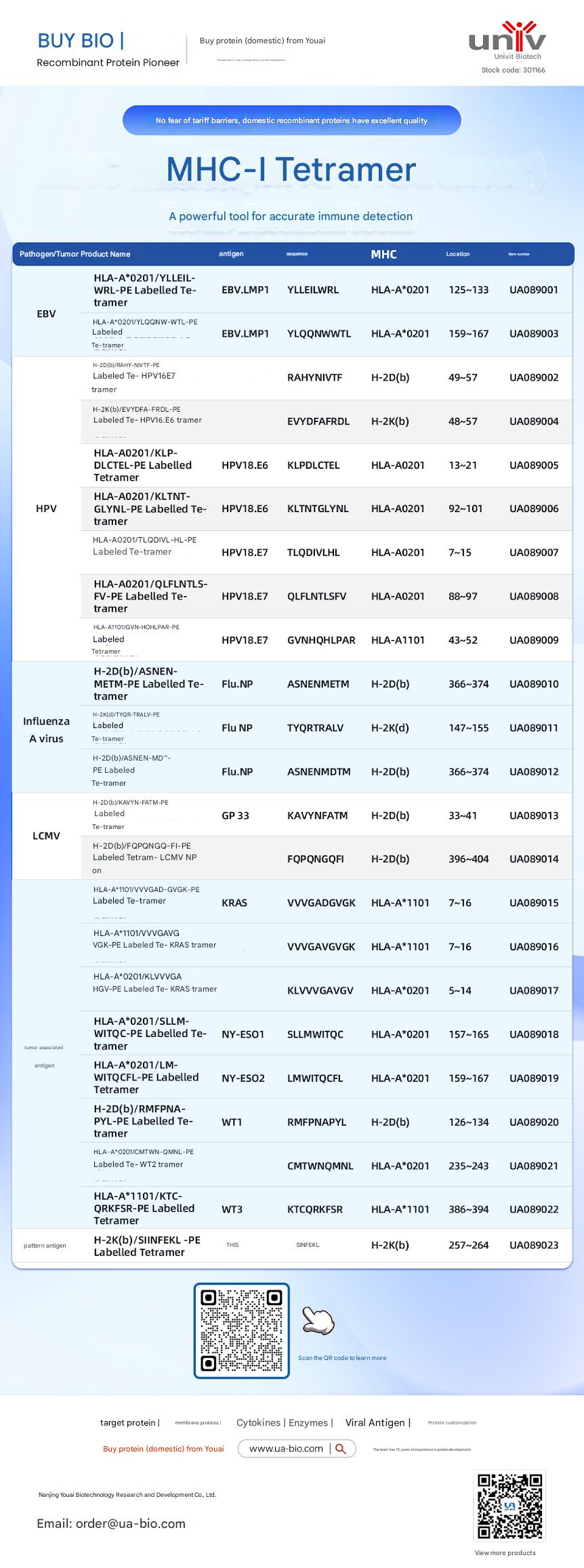
| Disease Category | Product Name | Antigen | Sequence | MHC | Position | Product Number |
|---|---|---|---|---|---|---|
| EBV | HLA-A*0201/YLELLVWRL-PE Labelled Tetramer | EBV.LMP1 | YLELLVWRL | HLA-A*0201 | 125-133 | UA089001 |
| EBV | HLA-A*0201/YLQQNWTL-PE Labelled Tetramer | EBV.LMP1 | YLQQNWTL | HLA-A*0201 | 159-167 | UA089003 |
| EBV | H-2Db(b)/RAHY-NIVTF-PE Labelled Tetramer | HPV16.E7 | RAHYNIVTF | H-2Db | 49-57 | UA089002 |
| HPV | H-2K(b)/EVYDFA-FRQL-PE Labelled Tetramer | HPV16.E6 | EVYDFARDL | H-2Kb | 48-57 | UA089004 |
| HPV | HLA-A*0201/KLP-DLCTL-PE Labelled Tetramer | HPV18.E6 | KLPDCTL | HLA-A*0201 | 13-21 | UA089005 |
| HPV | HLA-A*0201/KLTNT-GLYQL-PE Labelled Tetramer | HPV18.E6 | KLTNTGLYNL | HLA-A*0201 | 92-101 | UA089006 |
| HPV | HLA-A*0201/TLODIVIHL-PE Labelled Tetramer | HPV18.E7 | TLODIVIHL | HLA-A*0201 | 7~15 | UA089007 |
| HPV | HLA-A*0201/QFLNTL-FV-PE Labelled Tetramer | HPV18.E7 | QFLNTLFSV | HLA-A*0201 | 88-97 | UA089008 |
| HPV | HLA-A*1101/GVNHQLPAR-PE Labelled Tetramer | HPV18.E7 | GVNHQLPAR | HLA-A*1101 | 43-52 | UA089009 |
| Influenza A Virus | H-2D(b)/ASNENMETM-PE Labelled Tetramer | Flu.NP | ASNENMETM | H-2Db | 366-374 | UA089010 |
| Influenza A Virus | H-2K(d)/TYQR-TRALY-PE Labelled Tetramer | Flu.NP | TYQRTRALY | H-2Kd | 147-155 | UA089011 |
| Influenza A Virus | H-2D(b)/ASNEN-MDTM-PE Labelled Tetramer | Flu.NP | ASNENMDTM | H-2Db | 366-374 | UA089012 |
| LCMV | H-2D(b)/KAVYNFATM-PE Labelled Tetramer | GP 33 | KAVYNFATM | H-2Db | 33-41 | UA089013 |
| LCMV | H-2D(b)/FQPGQGFVK-PE Labelled Tetramer | LCMV NP | FQPGQGFVK | H-2Db | 396-404 | UA089014 |
| Tumor-related | HLA-A*1101/VVGADGVK-PE Labelled Tetramer | KRAS | VVGADGVK | HLA-A*1101 | 7~16 | UA089015 |
| Tumor-related | HLA-A*1101/VVGAGVGK-PE Labelled Tetramer | KRAS | VVGAGVGK | HLA-A*1101 | 7~16 | UA089016 |
| Tumor-related | HLA-A*0201/KLVVGAGV-PE Labelled Tetramer | KRAS | KLVVGAGV | HLA-A*0201 | 5~14 | UA089017 |
| Tumor-related | HLA-A*0201/SLLMWITQC-PE Labelled Tetramer | NY-ESO1 | SLLMWITQC | HLA-A*0201 | 157-165 | UA089018 |
| Melanoma | HLA-A*0201/LMWITQCFL-PE Labelled Tetramer | NY-ESO2 | LMWITQCFL | HLA-A*0201 | 159-167 | UA089019 |
| Melanoma | H-2Db(b)/MMFPNA-P1-PE Labelled Tetramer | WT1 | RMFPNAPL | H-2Db | 126-134 | UA089020 |
| Melanoma | HLA-A*0201/CMTWV-PE Labelled Tetramer | WT2 | CMTWVNMDM | HLA-A*0201 | 235-243 | UA089021 |
| Melanoma | HLA-A*1101/KTCQRKSF-PE Labelled Tetramer | WT3 | KTCQRKSF | HLA-A*1101 | 386-394 | UA089022 |
| Ovarian Cancer | H-2K(b)/SINFEKL-PE Labelled Tetramer | OVA | SINFEKL | H-2Kb | 257-264 | UA089023 |
This article is reviewed and published by the technical expert team of UA
Disclaimer: This article partially utilizes artificial intelligence assistance in its creation. If any content involves copyright or intellectual property issues, please let us know and we promise to verify and remove it as soon as possible.
Purchase recombinant protein, choose Nanjing UA-Bio
UA protein focuses on providing various protein reagents, raw materials, and services required for drug research and development, cell therapy, gene therapy, and basic scientific research, including drug target proteins, immune checkpoint proteins, cytokines, tool enzymes, customized protein expression, and full-length transmembrane protein development. Youai is committed to providing customers with high-quality products and professional services, and building a High-tech Biological Enterprise with International Competitiveness.







 Business license (three certificates in one)