




Cardiac troponin T: Unlocking the "code" for diagnosing myocardial infarction


In the medical field, the name of cardiac troponin T (cTnT) may be relatively unfamiliar to many people, but for cardiologists, it is the key "code" for diagnosing acute myocardial infarction (AMI). Today, let us step into the world of cTnT and unveil its mysterious veil.
- Recent Advances
- Product Information
Cardiac troponin T: Unlocking the "code" for diagnosing myocardial infarction
In the medical field, the name of cardiac troponin T (cTnT) may be relatively unfamiliar to many people, but for cardiologists, it is the key "code" for diagnosing acute myocardial infarction (AMI). Today, let us step into the world of cTnT and unveil its mysterious veil.
cTnT: The "gold standard" for diagnosing myocardial infarction
Acute myocardial infarction occurs when the blood vessels of the heart are blocked and myocardial cells are damaged or die due to ischemia. In this case, cTnT in myocardial cells is released into the blood. Because cTnT has high myocardial specificity and sensitivity, it has become the preferred marker for diagnosing AMI. In clinical practice, doctors can quickly and accurately determine whether a patient has had a myocardial infarction by detecting the level of cTnT in the blood, thereby buying precious time for timely treatment.
cTnT's "transformation" in the blood
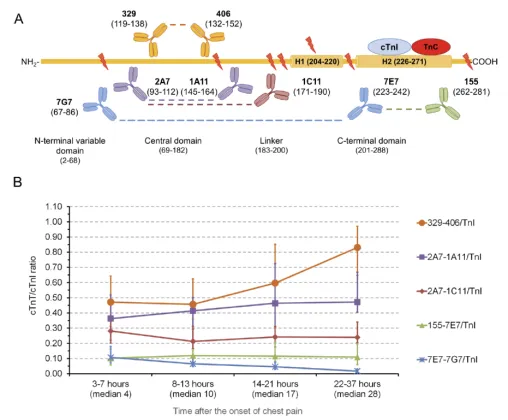
Although cTnT plays an important role in the diagnosis of myocardial infarction, scientists have been controversial about its existence in the patient's blood. Recently, a study revealed the "transformation" of cTnT in the blood. Researchers found that in the blood of patients with myocardial infarction, cTnT does not exist in a single form, but there are up to 23 fragments of different molecular weights. The generation of these fragments is mainly due to the degradation of cTnT in two specific areas.
The "time journey" of cTnT fragments
More interestingly, the abundance of cTnT fragments will change over time. In the early stage of myocardial infarction, cTnT in the blood mainly exists in the form of high molecular weight fragments of 37kDa and 29kDa. However, over time, these high molecular weight fragments will gradually degrade into low molecular weight fragments of 10-15kDa. This finding suggests that the existence of cTnT in the blood is dynamically changing at different stages after myocardial infarction.
The "stability mystery" of cTnT
In addition to the existence form and abundance changes in the blood, the stability of cTnT is also a problem worthy of attention. The researchers incubated blood samples from patients with myocardial infarction at 37°C for 48 hours and found that the degree of degradation of cTnT was very low. This suggests that cTnT is quite stable in the blood, and most of its degradation may not occur in the blood, but in damaged myocardial cells. This finding is of great significance for the development of cTnT detection reagents.
Future Outlook: More Accurate Diagnostic Strategies
Based on these new findings, we are expected to develop more accurate cTnT detection reagents in the future. For example, detection reagents can be developed for the middle region fragment of cTnT and the full-length or high molecular weight cTnT, respectively, so as to more accurately distinguish acute myocardial injury and subsequent secondary injury. This will help doctors to more accurately assess the patient's condition and develop more personalized treatment plans.
In short, as an important marker for the diagnosis of myocardial infarction, cTnT provides us with rich information in terms of its existence form, abundance changes, and stability in the blood. With the continuous deepening of research, it is believed that cTnT will play a greater role in the diagnosis and treatment of heart disease and bring hope to more patients.
This article is reviewed and published by the technical expert team of UA
Disclaimer: This article partially utilizes artificial intelligence assistance in its creation. If any content involves copyright or intellectual property issues, please let us know and we promise to verify and remove it as soon as possible.
Purchase recombinant protein, choose Nanjing UA-Bio
UA protein focuses on providing various protein reagents, raw materials, and services required for drug research and development, cell therapy, gene therapy, and basic scientific research, including drug target proteins, immune checkpoint proteins, cytokines, tool enzymes, customized protein expression, and full-length transmembrane protein development. Youai is committed to providing customers with high-quality products and professional services, and building a High-tech Biological Enterprise with International Competitiveness.







 Business license (three certificates in one)