




EndoS2: The "magic key" to unlock the new future of antibody-drug conjugates


In the field of biomedicine, antibody-drug conjugates (ADCs) are gradually becoming a powerful weapon in the fight against cancer. They achieve efficient killing of tumors by precisely connecting cytotoxins to antibodies and using the targeting ability of antibodies to deliver toxins directly into cancer cells.
- Recent Advances
- Product Information
EndoS2: The "magic key" to unlock the new future of antibody-drug conjugates
In the field of biomedicine, antibody-drug conjugates (ADCs) are gradually becoming a powerful weapon in the fight against cancer. They achieve efficient killing of tumors by precisely connecting cytotoxins to antibodies and using the targeting ability of antibodies to deliver toxins directly into cancer cells. However, there are many challenges in the traditional ADC preparation method, especially how to achieve precise toxin connection. Today, let's talk about a glycosidase called EndoS2, which has brought a revolutionary breakthrough in the precise preparation of ADCs.
1. What is EndoS2?
EndoS2 is a glycosidase that can specifically recognize and cut the sugar chain at position N297 of the antibody Fc domain. The antibody Fc domain is a conserved region in the antibody molecule, and position N297 is its glycosylation site. Almost all IgG antibodies carry sugar chains at this position. The specificity of EndoS2 enables it to accurately modify antibodies, providing new ideas for the preparation of ADCs.
2. Traditional ADC preparation methods and challenges
The traditional ADC preparation method usually adopts random coupling, that is, randomly connecting cytotoxins to the amino acid residues of antibodies. However, this method has many problems. First, random coupling will lead to structural heterogeneity of ADC, and the drug-to-antibody ratio (DAR) is difficult to control, which directly affects the efficacy and safety of ADC. Second, random coupling may destroy the antigen binding ability of antibodies and reduce their targeting effect. In addition, the traditional sugar chain site-specific coupling strategy requires a complex sugar engineering process, involving the participation of multiple enzymes and multi-step reactions. The synthesis process is cumbersome and depends on bioorthogonal reactions, which is not conducive to systematic structure-activity relationship research.
3. Breakthrough brought by EndoS2
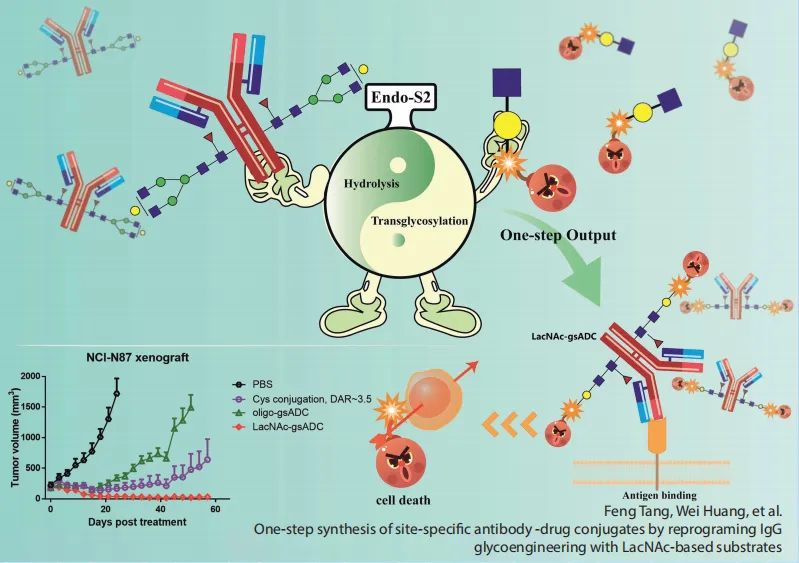
The team of researcher Huang Wei from the Shanghai Institute of Materia Medica, Chinese Academy of Sciences, has developed a sugar chain site-specific ADC preparation strategy based on EndoS2, which has brought a major breakthrough in the ADC field. They took advantage of the specificity of EndoS2 and designed and synthesized LacNAc (lactodisaccharide)-based drug-linkers to achieve the "one-step" site-specific connection of small molecule cytotoxic drugs to antibody glycosylation sites. This method not only simplifies the preparation process, but also significantly improves the structural uniformity and stability of ADC.
Simplified preparation process
The traditional sugar chain fixed-point ADC preparation requires the participation of 2~3 enzymes and 3~4 steps of reaction, while the EndoS2 strategy can be completed in just one step. By screening a variety of sugar substrates and endoglycosidases, the researchers established a "one-step" sugar engineering technology for natural antibodies based on LacNAc and wild-type EndoS2. This technology not only simplifies the operation steps, but also greatly shortens the preparation time.
Efficient structural uniformity
LacNAc-based fixed-point ADC compounds have very high structural uniformity, and the drug-to-antibody ratio (DAR) is precisely controlled at 2. This uniformity is crucial for the efficacy and safety of ADCs because it ensures that each ADC molecule carries the same amount of toxins, thereby achieving a more precise therapeutic effect.
Excellent stability and activity
The experiments showed that the ADC compounds prepared based on the LacNAc and EndoS2 strategies showed excellent stability and activity both in vitro and in vivo. In the NCI-N87 tumor model, the sugar chain-directed ADC compounds developed by this strategy still showed stronger in vivo tumor inhibition activity even at low drug loading, which has significant advantages over ADC compounds prepared by traditional methods.
4.The significance of the EndoS2 strategy
The emergence of the EndoS2 strategy provides a new idea for the preparation of ADC. It not only simplifies the preparation process, but also significantly improves the structural uniformity and stability of ADC, laying a solid foundation for the development of more efficient and safer ADC drugs. In addition, the versatility of this strategy enables it to be widely used in the modification of a variety of antibodies, providing more possibilities for personalized medicine.
5.Future prospects
With the continuous development of biotechnology, the EndoS2 strategy is expected to play an important role in more fields. For example, by further optimizing the performance of EndoS2 and developing more LacNAc-based drug-linkers, more precise ADC design can be achieved. In addition, this strategy can also be combined with other biotechnologies to develop more efficient ADC drug delivery systems, bringing new hope for cancer treatment.
In short, EndoS2 is not only a magical enzyme, but also a "key" to open a new future for ADC. It provides us with a completely new approach and allows us to take a big step forward in the fight against cancer.
This article is reviewed and published by the technical expert team of UA
Disclaimer: This article partially utilizes artificial intelligence assistance in its creation. If any content involves copyright or intellectual property issues, please let us know and we promise to verify and remove it as soon as possible.
Purchase recombinant protein, choose Nanjing UA-Bio
UA protein focuses on providing various protein reagents, raw materials, and services required for drug research and development, cell therapy, gene therapy, and basic scientific research, including drug target proteins, immune checkpoint proteins, cytokines, tool enzymes, customized protein expression, and full-length transmembrane protein development. Youai is committed to providing customers with high-quality products and professional services, and building a High-tech Biological Enterprise with International Competitiveness.







 Business license (three certificates in one)