




FOLR1: Emerging Targets and CAR-T Technology Potential in Targeted Therapy of Ovarian Cancer


Epithelial ovarian cancer (OvCa) is one of the most deadly malignant tumors in the female reproductive system. It is difficult to diagnose early, has a high recurrence rate, and has a low five-year survival rate, making it a difficult problem to be overcome in the field of oncology. In recent years, with the rapid development of molecular biology and immunotherapy, folate receptor 1 (FOLR1, also known as FRα) has gradually become a hot spot in the study of targeted therapy of ovarian cancer due to its specific expression in epithelial tumors.
- Recent Advances
- Product Information
FOLR1: Emerging Targets and CAR-T Technology Potential in Targeted Therapy of Ovarian Cancer
Epithelial ovarian cancer (OvCa) is one of the most deadly malignant tumors in the female reproductive system. It is difficult to diagnose early, has a high recurrence rate, and has a low five-year survival rate, making it a difficult problem to be overcome in the field of oncology. In recent years, with the rapid development of molecular biology and immunotherapy, folate receptor 1 (FOLR1, also known as FRα) has gradually become a hot spot in the study of targeted therapy of ovarian cancer due to its specific expression in epithelial tumors.
Biological characteristics and expression pattern of FOLR1
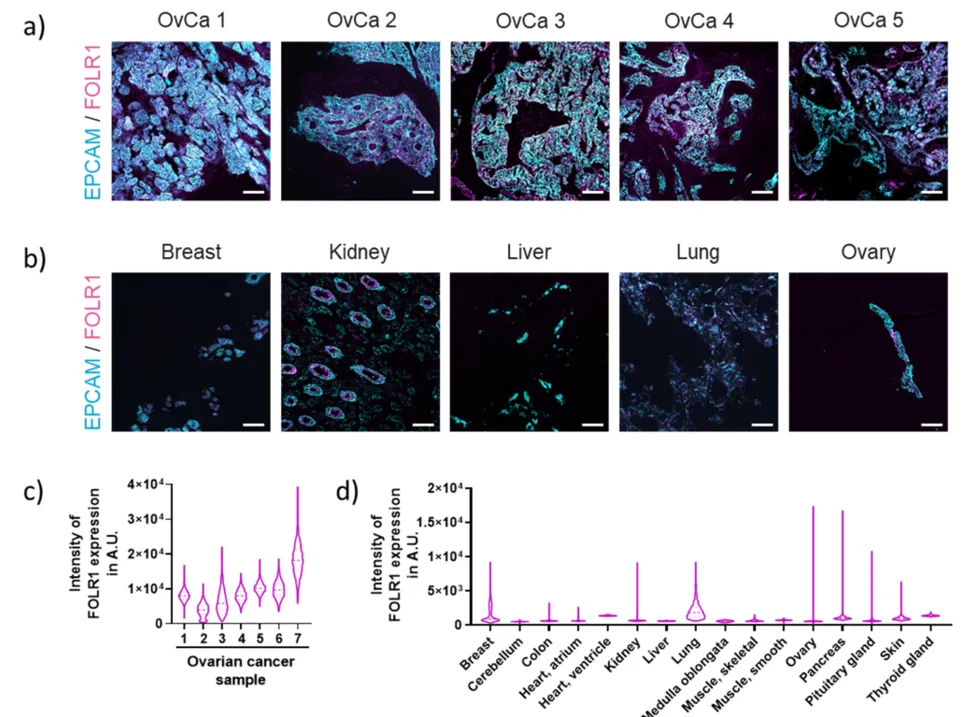
FOLR1 is a glycosylphosphatidylinositol (GPI)-anchored membrane protein that participates in cell proliferation and metabolism by transporting folic acid. It is abnormally highly expressed in epithelial tumors such as ovarian cancer, while its expression level is extremely low in normal tissues. This characteristic makes it an ideal tumor-specific target. Studies have shown that in high-grade serous ovarian cancer (HGSOC), the expression rate of FOLR1 is close to 100%, and the expression intensity is positively correlated with the malignancy of the tumor. This differential expression pattern not only provides a potential marker for the early diagnosis of ovarian cancer, but also lays a molecular foundation for the development of targeted treatment strategies.
Validation of FOLR1 as a CAR-T target
Chimeric antigen receptor T cell (CAR-T) technology modifies T cells through genetic engineering, enabling them to specifically recognize and kill tumor cells. In the study of FOLR1-targeted CAR-T therapy, researchers screened candidate molecules with high affinity and specificity for FOLR1 by constructing a variety of CAR structures. These CAR-T cells showed strong killing activity against FOLR1-positive ovarian cancer cells in in vitro experiments, and had no significant toxicity to FOLR1-negative cells, which preliminarily verified their safety and effectiveness. In addition, animal model experiments further confirmed that FOLR1-targeted CAR-T cells can effectively inhibit tumor growth and prolong survival, indicating its great potential in the treatment of ovarian cancer.
CAR-T technology optimization and challenges
Although FOLR1-targeted CAR-T therapy has shown significant efficacy, its clinical application still faces multiple challenges. First, the optimization of CAR structure needs to balance affinity and safety to avoid off-target toxicity caused by nonspecific activation. Secondly, immunosuppressive factors in the tumor microenvironment (such as Treg cells and PD-L1 expression) may weaken the persistence and function of CAR-T cells. Therefore, combining immune checkpoint inhibitors or modifying CAR-T cells to enhance their anti-exhaustion ability has become an important direction of current research. In addition, how to improve the infiltration and penetration ability of CAR-T cells in solid tumors is also the key to breaking through the bottleneck of ovarian cancer treatment.
Future Outlook
FOLR1, as a specific target for ovarian cancer treatment, combined with the precision and efficiency of CAR-T technology, provides new possibilities for breaking through existing treatment limitations. With the development of gene editing technology (such as CRISPR/Cas9) and synthetic biology, CAR-T cells can be engineered in the future to achieve multi-target collaborative recognition, dynamic regulation function and long-term memory formation, further enhancing their anti-tumor activity. In addition, nanocarrier delivery systems or bispecific antibody design based on FOLR1 may also open up new avenues for ovarian cancer treatment.
FOLR1-targeted CAR-T technology has brought a revolutionary breakthrough in the treatment of ovarian cancer. The combination of its specific expression pattern and CAR-T technology not only provides a new strategy for solving the problems of ovarian cancer recurrence and drug resistance, but also injects new vitality into the development of tumor immunotherapy. With the deepening of research and the improvement of technology, FOLR1 is expected to become a core target for precision treatment of ovarian cancer.
This article is reviewed and published by the technical expert team of UA
Disclaimer: This article partially utilizes artificial intelligence assistance in its creation. If any content involves copyright or intellectual property issues, please let us know and we promise to verify and remove it as soon as possible.
Purchase recombinant protein, choose Nanjing UA-Bio
UA protein focuses on providing various protein reagents, raw materials, and services required for drug research and development, cell therapy, gene therapy, and basic scientific research, including drug target proteins, immune checkpoint proteins, cytokines, tool enzymes, customized protein expression, and full-length transmembrane protein development. Youai is committed to providing customers with high-quality products and professional services, and building a High-tech Biological Enterprise with International Competitiveness.







 Business license (three certificates in one)