

HAVCR2 (TIM-3): A novel mechanism of immune checkpoint regulation and its potential in tumor therapy


As an important member of the TIM family (TIM1/HAVCR1, TIM3/HAVCR2, TIM4/TIMD4), TIM-3 has attracted much attention for its critical role in autoimmune and tumor immune regulation
- Recent Advances
- Reference
introduction
In March 2016, Nature Reviews Clinical Oncology published a review titled "PD-1 says goodbye, TIM-3 says hello", pushing HAVCR2 (encoding TIM-3 protein) to the forefront of tumor immunotherapy research. As an important member of the TIM family (TIM1/HAVCR1, TIM3/HAVCR2, TIM4/TIMD4), TIM-3 has attracted much attention for its critical role in autoimmune and tumor immune regulation.
Biological characteristics of TIM-3
TIM-3 (T cell immunoglobulin and mucin domain containing protein 3) was initially identified as a marker receptor for IFN - γ+CD4+/CD8+T cells, and subsequent studies have confirmed its expression in regulatory T cells (Treg), dendritic cells (DCs), NK cells, and myeloid cells. Its structural features include:
N-terminal IgV domain: mediating ligand recognition
Mucin like domain: involved in signal transduction
Transmembrane region and cytoplasmic tail: transmitting inhibitory signals
Ligand interaction network and functional regulation
TIM-3 achieves immune microenvironment specific regulation through a multi ligand system (Figure 1):
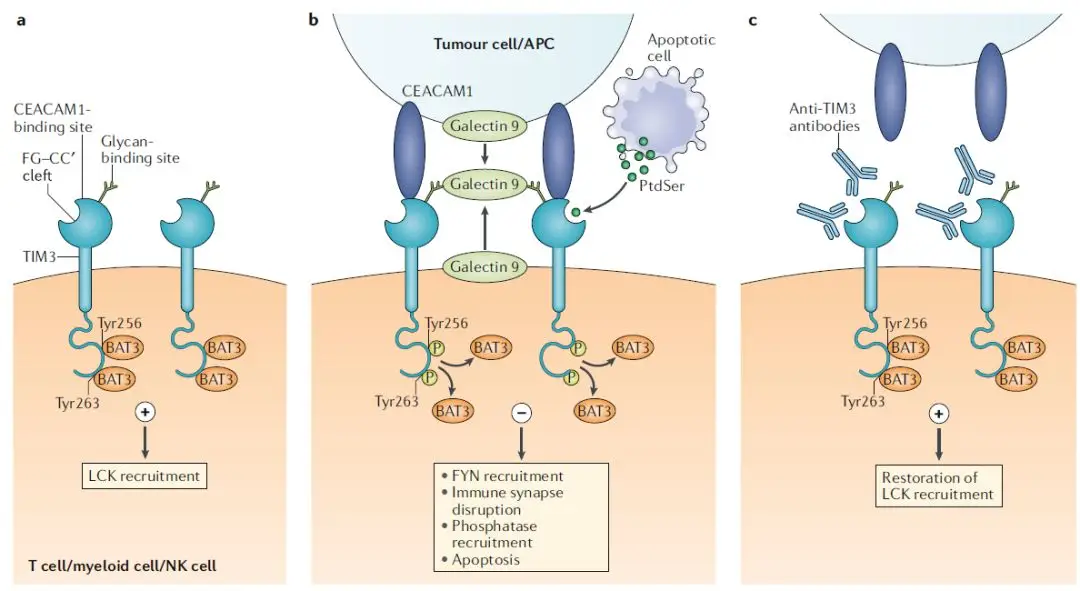
1. Galectin-9
Mechanism of action: Binding to glycosylation sites in the TIM-3 IgV domain induces calcium influx and T cell apoptosis
Pathological significance: Mediating T cell depletion in tumor microenvironment (TME)
2. Phosphatidylserine (PtdSer)
Functional features:
Promote antigen cross presentation of TIM-3+DCs
Regulating the clearance of apoptotic cells through the "eat me" signaling pathway
3. HMGB1
Research progress: Although identified as a TIM-3 ligand, its binding site and downstream pathways are still unclear
4. CEACAM1
Regulatory complexity:
Display of anticancer effect in colorectal cancer model (CEACAM1 −/− increased tumor burden in mice)
High expression in melanoma can inhibit T cell function
Therapeutic targeting: The efficacy of anti-TIM-3 antibodies is positively correlated with interference with TIM-3/CEACAM1 binding ability
the core role of TIM-3 in tumor immune escape
1. T cell regulation
Exhaustion markers: TIM-3+PD-1+CD8+T cells are the most significantly dysfunctional subset
Clinical association: High expression of TIM-3 is significantly associated with poor prognosis in patients with NSCLC, CRC, etc. (HR=1.8-2.3, p<0.01)
2. Non T cell function
| Cell Type | TIM-3 Function | Therapeutic Implications |
|---|---|---|
| Tregs | Maintains immunosuppressive microenvironment (constitutes 60% of Tregs in lung cancer) | Targeted depletion of TIM-3+ Tregs |
| Dendritic Cells (DCs) | Suppresses CXCL9 secretion and impairs CD8+ T cell infiltration | Combination with CXCR3 agonists |
| NK Cells | Marker of dysfunctional state | Blockade restores cytotoxic activity |
| Myeloid Cells | Promotes M2-type polarization | Combination with CSF-1R inhibitors |
Progress in Clinical Translational Research
1. Limitations of monotherapy
TSR-022 (Tesaro): Only one sarcoma patient achieved PR in phase I trial, ORR<5%
Mechanism bottleneck: TIM-3 blockade relies on synergistic activation of the PD-1 pathway
2. Combination therapy strategy
PD-1 inhibitor: significantly increases ORR in melanoma/CRC model (mouse model: monotherapy 20% vs combination 60%)
New combination:
LY3321367 (Lilly)+PD-1 antibody: Phase I shows controllable toxicity (Gr3-4 AE<15%)
Bispecific antibody RO7121661: synchronously targeting TIM-3/PD-1, has entered phase I clinical trials
Challenges and Prospects
1,Molecular Mechanism Deepening: Need to Analyze the Heterogeneity of TIM-3 Signal Transduction in Different Immune Cells
2,Biomarker development: patient stratification strategy based on TIM-3 expression profile
3,Next generation drug design:
Allosteric regulatory antibodies (selectively blocking specific ligands)
Three specific antibodies (TIM-3/PD-1/LAG-3)
Conclusion: HAVCR2, as an emerging target for immunotherapy, provides a new approach for overcoming PD-1 resistance due to its multicellular regulatory properties. With a deeper understanding of TIM-3 ligand interactions and tissue-specific functions, precise intervention strategies targeting this pathway are expected to become an important breakthrough point in tumor immunotherapy.
This article is reviewed and published by the technical expert team of UA
Disclaimer: This article partially utilizes artificial intelligence assistance in its creation. If any content involves copyright or intellectual property issues, please let us know and we promise to verify and remove it as soon as possible.
Purchase recombinant protein, choose 
UA protein focuses on providing various protein reagents, raw materials, and services required for drug research and development, cell therapy, gene therapy, and basic scientific research, including drug target proteins, immune checkpoint proteins, cytokines, tool enzymes, customized protein expression, and full-length transmembrane protein development. Nanjing Univ is committed to providing customers with high-quality products and professional services, and building a High-tech Biological Enterprise with International Competitiveness.

[1] Monney, L. et al. Th1-specific cell surface protein Tim-3 regulates macrophage activation and severity of an autoimmune disease. Nature (2002)
[2] Yochai Wolf et al. TIM3 comes of age as an inhibitory receptor. Nature Reviews Immunology (2019).
[3] Chiba, S. et al. Tumor-infiltrating DCs suppress nucleic acid-mediated innate immune responses through interactions between the receptor TIM-3 and the alarmin HMGB1. Nature Immunology(2012).
[4] Leung, N. et al. Deletion of the carcinoembryonic antigen-related cell adhesion molecule 1 (Ceacam1) gene contributes to colon tumor progression in a murine model of carcinogenesis. Oncogene(2006).
[5] Wiener, Z. et al. TIM-3 is expressed in melanoma cells and is upregulated in TGF-beta stimulated mast cells. J. Invest. Dermatol.(2007).






 Business license (three certificates in one)