In the field of cancer treatment, Antibody-Drug Conjugates (ADCs) have become a research hotspot due to their dual advantages of targeting and cytotoxicity. ADCs combine highly targeted monoclonal antibodies with cytotoxic chemotherapeutic drugs through specific biochemical linkers, enabling "targeted chemotherapy" that precisely releases cytotoxic drugs at tumor sites. This approach exerts potent anti-tumor effects while reducing damage to normal tissues. Currently, popular targets for ADC drugs include mature targets such as HER2, EGFR, and CLDN18.2. As an ideal new anti-tumor target, Nectin-4 has received extensive attention in recent years, bringing new hope to cancer treatment.
I. Biological Characteristics of the Nectin-4 Target
Nectin-4 is a transmembrane protein belonging to the nectin family, playing an important role in cell-cell adhesion and signal transduction. Under normal physiological conditions, its expression level in human tissues is low, mainly restricted to embryonic tissues and some epithelial tissues. However, in various malignant tumors, Nectin-4 shows abnormally high expression, particularly significant in urothelial carcinoma, making it an ideal candidate target for tumor-targeted therapy. The highly specific expression of Nectin-4 provides a molecular basis for the precise targeting of ADC drugs. Through the specific binding of antibodies to Nectin-4, efficient enrichment of drugs at tumor sites can be achieved.
Urothelial carcinoma is one of the most common malignant tumors in the urinary system, originating from the bladder urothelium and accounting for more than 90% of bladder cancers. In 2020, there were 516,000 new cases of urothelial carcinoma worldwide, including approximately 77,000 new cases in China. It is estimated that by 2025, the number of new global cases will reach 586,000 (about 91,000 cases in China). Traditional treatment for urothelial carcinoma is mainly based on platinum-based combination chemotherapy. However, for platinum-resistant patients, the response rate to anti-PD-L1 checkpoint inhibitor immunotherapy is only about 20% on average, leaving patients facing treatment dilemmas. The high expression of Nectin-4 in urothelial carcinoma makes it a key target for the treatment of this type of tumor.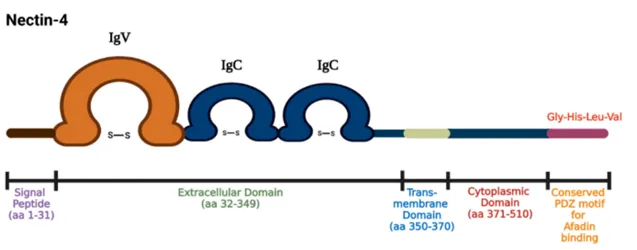
II. Development and Application of the Nectin-4 Targeted ADC Drug Enfortumab Vedotin
Currently, there are relatively few products targeting the Nectin-4 target globally, with only one ADC product, Enfortumab Vedotin (trade name: Padcev), approved for marketing. This drug consists of a human anti-Nectin-4 monoclonal antibody conjugated with the cytotoxic microtubule-disrupting agent monomethyl auristatin E (MMAE) through a protease-hydrolyzable linker. Its mechanism of action is as follows: after injection, the antibody specifically binds to Nectin-4 on the surface of tumor cells, enabling drug enrichment at tumor sites; subsequently, the linker between the antibody and the payload MMAE is hydrolyzed by proteases, releasing MMAE, which disrupts microtubules and induces cell apoptosis, thereby exerting anti-tumor effects.
The indication approval history of Enfortumab Vedotin has gradually expanded. In December 2019, the U.S. FDA approved it for the treatment of adult patients with locally advanced or metastatic urothelial carcinoma who have previously received PD-1/PD-L1 inhibitors and platinum-containing chemotherapy in the neoadjuvant, adjuvant, locally advanced, or metastatic settings, based on the results of cohort 1 of the EV201 study. The study showed that among 128 enrolled patients, the objective response rate (ORR) reached 42%, the complete response rate (CR) was 9%, and the median survival time was nearly one year. The ORR for patients with immune checkpoint inhibitor resistance or liver metastases was 38% and 36% respectively.
In July 2021, the FDA approved it for patients ineligible for cisplatin therapy who have received PD-1/PD-L1 inhibitor treatment, based on the results of cohort 2 of the EV201 study. Among 91 enrolled patients, the ORR was 52%, the CR reached 20%, the median duration of response (DOR) was 10.9 months, the median progression-free survival (PFS) was 5.8 months, and the median overall survival (OS) was 14.7 months. In April 2022, the drug was approved for marketing in the European Union and subsequently in Japan.
In April 2023, based on the results of the Ib/II phase KEYNOTE-869 study, the FDA granted accelerated approval for the combination of Enfortumab Vedotin with pembrolizumab (a PD-1 monoclonal antibody) for the first-line treatment of locally advanced or metastatic urothelial carcinoma in patients ineligible for cisplatin-based chemotherapy. This is the first approved PD-1 and ADC combination therapy. Combined efficacy analysis showed that among 121 patients, the ORR reached 68%, with CR of 12% and partial response (PR) of 55%. The median DOR in the dose-escalation cohort plus cohort A was 22.1 months, and the DOR in cohort K has not yet been reached. Currently, the "NCCN Clinical Practice Guidelines in Oncology: Bladder Cancer 2023 v2" has listed the combination of Enfortumab Vedotin and Keytruda as a preferred recommendation for first-line treatment of locally advanced or metastatic urothelial carcinoma in patients ineligible for cisplatin-based chemotherapy.
In March 2023, the Center for Drug Evaluation (CDE) of China's National Medical Products Administration accepted the Biologics License Application (BLA) for Enfortumab Vedotin for the treatment of patients with locally advanced or metastatic urothelial carcinoma who have previously received PD-1/PD-L1 inhibitors and platinum-containing chemotherapy, based on data from the EV-203 trial. This trial, as a bridging study to global studies, confirmed that the efficacy, safety, and pharmacokinetic characteristics of Padcev in Chinese patients were consistent with global data, with the primary endpoint of ORR reaching statistical significance.
Long-term follow-up results of the phase III EV-301 trial presented at the 2022 ASCO showed that after a follow-up of 23.75 months, the median OS in the Enfortumab Vedotin group was significantly prolonged by 3.97 months compared with the chemotherapy group (12.91 months vs. 8.94 months). In addition, OS benefits of Enfortumab Vedotin were observed in most subgroup analyses. The PFS in the Enfortumab Vedotin group (median PFS 5.55 months) was also significantly improved compared with the chemotherapy group (median PFS 3.71 months).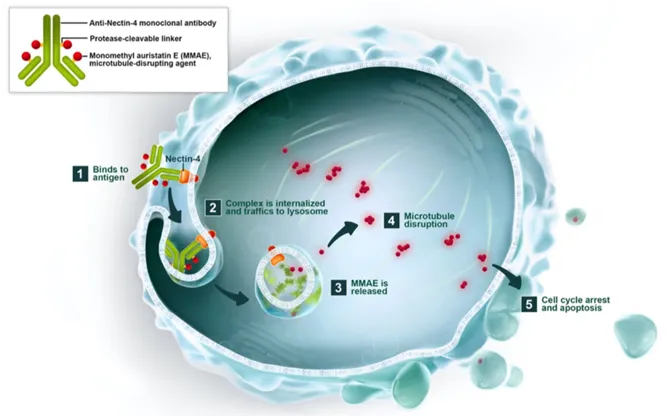
III. Research Progress and Future Prospects of Nectin-4 Targeted Drugs
The recommended dosage and administration of Enfortumab Vedotin are as follows: the recommended dose is 1.25 mg/kg, with a maximum dose of 125 mg. It is administered as an intravenous infusion over 30 minutes on days 1, 8, and 15 of a 28-day treatment cycle, until disease progression or unacceptable toxicity occurs. It must not be administered as an intravenous push or mixed with other drugs, and its use should be avoided in patients with moderate or severe hepatic impairment.
Currently, there are 25 Nectin-4 targeted drugs under development worldwide, with 8 entering clinical development stages. In addition to Padcev, 3 Nectin-4 ADC candidates in clinical research are independently developed by domestic pharmaceutical companies, including 9MW2821 from Maiwei Bio, BAT8007 from Bio-Thera Solutions, and SYS6002 from CSPC Pharmaceutical Group. SKB410 from Kelun-Biotech has also been approved for clinical trials. The development of these drugs will further enrich the options for Nectin-4 targeted therapy, bringing more hope to patients with urothelial carcinoma and other tumors.
With the deepening of research, the value of Nectin-4 as a new target for cancer treatment has become increasingly prominent. ADC drugs represented by Enfortumab Vedotin have shown significant efficacy in the treatment of urothelial carcinoma, and combination therapy regimens have further expanded application scenarios. In the future, with the advancement of more clinical studies, the indications of Nectin-4 targeted drugs are expected to expand, and their efficacy and safety will continue to be optimized, providing stronger support for the precise treatment of cancer patients.











 Business license (three certificates in one)