The Nectin family and Nectin-like molecules (Necl) are important classes of cell adhesion molecules that play multiple roles in physiological and pathological processes of the organism. They mediate Ca²⁺-independent cell adhesion and are widely involved in basic physiological processes such as maintaining epithelial cell junctions and forming neuronal synaptic connections. The Nectin family includes 4 core members (Nectin1-4, also known as PVRL1-4 or CD111, CD112, CD113, PRR4) and 5 Necl molecules (Necl1-5, namely SynCAM1-4 and PVR/CD155). These molecules are all type I transmembrane proteins with three immunoglobulin (Ig)-like domains in their extracellular regions, which can form homodimers or heterodimers to achieve signal transmission and functional regulation.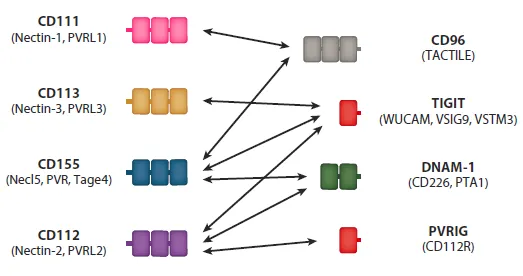
I. Construction of the Immunoregulatory Network of the Nectin Family
Although cell adhesion is the core function of the Nectin family, recent studies have revealed their key role in immune regulation. Molecules of this family form a complex network of co-stimulatory and co-inhibitory signals through interactions with receptors on the surface of immune cells. Among them, CD155 (Necl5/PVR) and CD112 (Nectin-2/PVRL2) are important ligands for the co-stimulatory molecule CD226 (DNAM-1) and also ligands for the co-inhibitory molecule TIGIT; CD155 and CD111 (Nectin-1) can also bind to CD96, and CD112 can interact with CD112R (PVRIG). These receptor-ligand pairs regulate the activation status of T cells and NK cells through signal balance: TIGIT and CD112R marked in red transmit inhibitory signals, CD226 marked in green mediates activating signals, and CD96 marked in gray has dual regulatory potential, together forming an elaborate immune regulatory mechanism.
II. Molecular Interaction Characteristics of the Nectin Family
Structural biology studies have revealed the conserved binding mode of Nectin family molecules: Nectin molecules form homodimers through the extracellular distal D1 domain, while receptors and ligands form heterodimers through the D1 domain at a 1:1 molar ratio. Affinity measurements show that these interactions mostly reach nanomolar-level strength, but there are significant differences between different ligands. For example, the affinity of TIGIT for CD155 is significantly higher than that of CD226 for CD155, and the affinity of CD112 for CD112R is also higher than its binding to CD226. This difference in affinity provides a basis for competitive binding, and the spatiotemporal expression patterns, expression levels, and dimer formation status of molecules on the cell membrane further increase the complexity of signal regulation, enabling the Nectin family to flexibly adjust the intensity of immune responses according to changes in the microenvironment.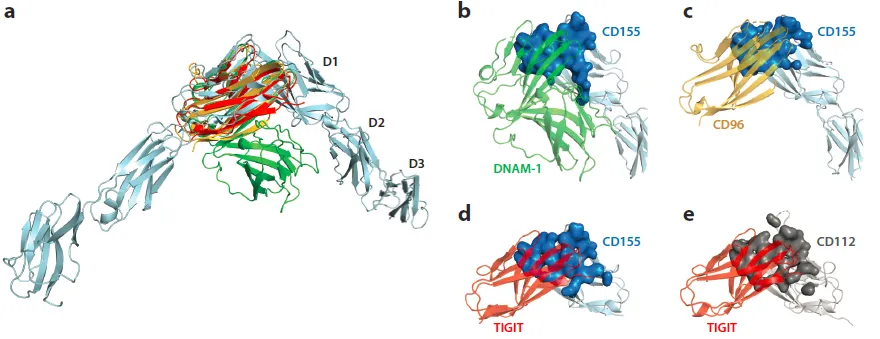
III. Tumor Regulatory Role of the Key Member CD155
As an important member of the Nectin family, CD155 is not only a poliovirus receptor but also plays a key role in tumorigenesis and development. It exists in two forms: transmembrane (α, δ subtypes) and secreted (β, γ subtypes). CD155 is often abnormally highly expressed in tumor cells and is closely related to tumor malignancy—in melanoma, hematological tumors, and various solid tumors, patients with high CD155 expression are often accompanied by enhanced tumor invasiveness, increased lymph node metastasis rate, and poor prognosis.
CD155 promotes tumor progression through multiple mechanisms: the α subtype of transmembrane CD155 recruits SHP-2 phosphatase through the intracellular ITIM domain, initiates inhibitory signaling pathways, and promotes cell proliferation and migration; secreted CD155 can interfere with NK cell function and reduce tumor immune surveillance. At the same time, CD155 regulates the immune microenvironment through interactions with receptors such as TIGIT and CD226—highly expressed CD155 is more likely to bind to TIGIT to transmit inhibitory signals, weaken the cytotoxicity of T cells and NK cells, and lead to tumor immune escape. Its widespread and uniform expression pattern in tumor tissues suggests that its expression is regulated by genes, providing a stable target for targeted therapy.
IV. Immune Functions and Clinical Significance of CD112 and CD226
CD112 (Nectin-2), as another core adhesion molecule, is highly expressed in various tumors such as acute myeloid leukemia and multiple myeloma, and is related to the invasion, metastasis, and poor prognosis of tumors such as gallbladder cancer. It transmits co-stimulatory signals by binding to CD226, enhancing NK cell-mediated cytotoxicity; it can also bind to TIGIT but with low affinity. The discovery of CD112R in 2016 as an inhibitory receptor for CD112 further expanded its immune regulatory network, providing a new perspective for understanding the immune escape mechanism of tumors with high CD112 expression.
As a key co-stimulatory molecule, CD226 maintains the killing activity of T cells and NK cells by binding to CD155/CD112. CD226-deficient mice have significantly reduced anti-tumor ability, and the downregulation of CD226 expression in tumor patients is often accompanied by functional exhaustion of immune cells. Studies have found that high expression of CD155 in tumor cells may lead to decreased CD226 expression through competitive binding. This mechanism may be an important reason for tumor immune escape, but the specific regulatory details remain to be further explored.
CD155/CD112与其配体间亲和力的差别
Summary
The Nectin family constructs an elaborate immune regulatory network through complex receptor-ligand interactions, among which CD155, CD112, and CD226 profoundly affect tumor progression by regulating immune cell functions. These findings provide a theoretical basis for the development of tumor immunotherapies targeting the Nectin family. In the next issue, we will continue to discuss other members such as TIGIT, CD96, and CD112R, as well as immunotherapies related to the Nectin family, patient selection, and biomarker strategies.












 Business license (three certificates in one)