In the complex processes of life activities, cells must continuously respond to various environmental stresses to maintain homeostasis. Stress conditions such as heat shock and heavy metal exposure can trigger a series of adaptive responses in cells, among which the dynamic regulation of transcription and translation is a key link to ensure cell survival. In recent years, the phenomenon of biomolecular condensation through liquid-liquid phase separation (LLPS) has become a frontier in the study of cellular stress responses. This article focuses on the negative elongation factor (NELF) complex, systematically expounds the formation mechanism of NELF nuclear condensation under stress conditions and its role in transcriptional downregulation, and reveals its molecular basis as a cellular stress survival strategy.
Environmental stress can rapidly reshape the gene expression pattern of cells. Under typical stress conditions such as heat shock and arsenic exposure, cells preferentially inhibit the transcription and translation of housekeeping genes, metabolism-related genes, and cell cycle genes, and concentrate resources on stress protection-related pathways. The core mechanism of this transcriptional reprogramming involves the activity regulation of RNA polymerase II (Pol II), and the NELF complex, as a key inhibitor of Pol II elongation, plays a central role in it.
By binding to Pol II and the proximal region of gene promoters, NELF can effectively block the elongation of Pol II from the promoter region to the coding region, thereby inhibiting gene transcription. Traditional studies believe that NELF achieves transcriptional inhibition by enhancing its binding to chromatin under stress conditions, while the latest research has found that the nuclear condensates formed by NELF under stress conditions are an important structural basis for its transcriptional regulatory function, providing a new perspective for understanding the molecular mechanism of cellular stress responses.
The nuclear condensation of NELF under stress conditions is a rapid and dynamic process. Heat shock treatment can lead to a significant downregulation of overall transcriptional activity, which can be verified by the decrease in the ChIP signal of RNA Pol II. At the same time, the binding signal of NELF at the promoters of downregulated genes is significantly enhanced, and the abundance of chromatin-associated NELF complexes is also significantly increased, indicating that the recruitment of NELF to chromatin is closely related to transcriptional downregulation.
Fluorescence microscopy shows that the fluorescently labeled NELFA subunit can reorganize into bright nuclear foci within 30 minutes of heat stimulation. These nuclear foci have liquid-like properties: the fluorescence recovery after photobleaching (FRAP) experiment shows that the fluorescence intensity of the bleached area can recover rapidly, proving that NELF molecules have high mobility inside the condensates; time-lapse imaging observes that small nuclear foci can fuse to form larger spherical structures, reflecting the fusion ability of the liquid phase. In addition, NELF nuclear foci are highly sensitive to 1,6-hexanediol treatment, which can specifically disrupt the structure of condensates formed by liquid-liquid phase separation, further confirming that NELF nuclear condensation is achieved through the LLPS mechanism.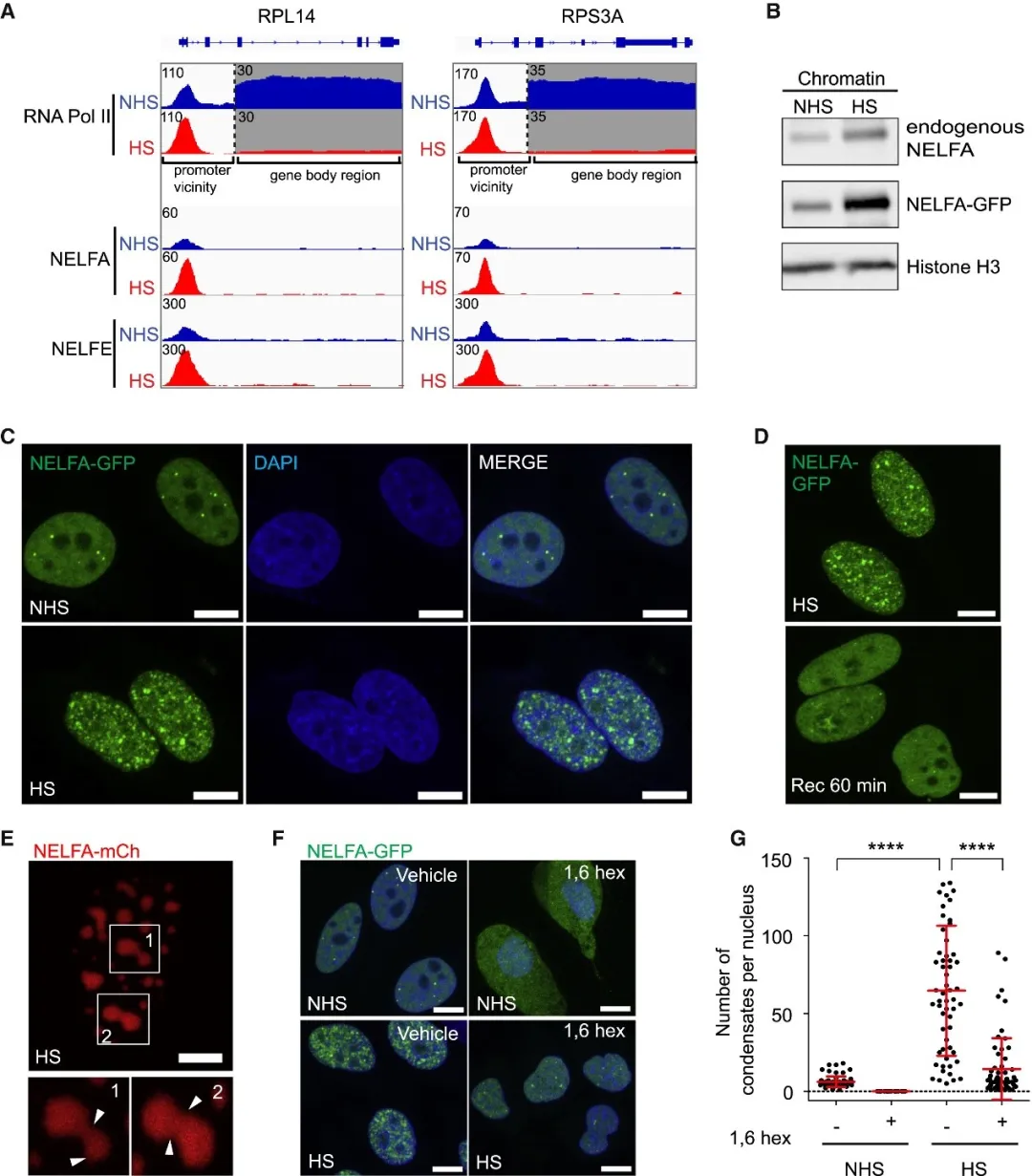
In vitro experiments provide direct evidence for the liquid-liquid phase separation ability of NELF. The recombinant NELF complex can spontaneously form droplet-like structures under specific in vitro conditions, and the formation of these droplets is highly sensitive to ionic strength: with the increase of sodium chloride concentration, the ability to form droplets decreases significantly, indicating that electrostatic interactions play a key role in the phase separation process of NELF. At a sodium chloride concentration of 50 mM, the critical concentration of NELF for droplet formation is about 0.5 μM, which matches the expression level of NELF in cells under physiological conditions, suggesting that the in vitro phase separation phenomenon has physiological relevance.
The NELF droplets formed in vitro also show core characteristics of the liquid phase: droplets can fuse with each other, and FRAP experiments show that molecules in the droplets have rapid dynamic exchange ability. These results confirm that the NELF complex itself has independent phase separation ability, which can form liquid-like condensates without the assistance of other nuclear factors, providing an important basis for understanding the molecular origin of NELF nuclear condensation in vivo.
The spatiotemporal specific regulation of NELF nuclear condensation under stress conditions depends on a precise post-translational modification network, among which dephosphorylation and SUMOylation play core roles. Heat shock treatment can lead to a continuous decrease in the phosphorylation level of specific amino acid residues in the NELFA protein. It is known that these residues are phosphorylated by the CDK9 subunit of P-TEFb kinase under normal physiological conditions. In vitro experiments show that wild-type P-TEFb treatment can cause significant shrinkage of NELF droplets, while P-TEFb variants with deficient catalytic activity have no such effect, indicating that phosphorylation can inhibit the phase separation ability of NELF. Further studies have found that heat shock can promote the interaction between CDK9 and proteins such as LARP7 and HEXIM1, leading to the sequestration of CDK9, thereby reducing the phosphorylation of NELF and promoting its dephosphorylation and nuclear condensation.
NELF dephosphorylation alone is not sufficient to drive nuclear condensation, and stress-induced SUMOylation is another key regulatory factor. Heat shock treatment can cause changes in the SUMOylation level of multiple residues in the NELF complex. Treatment of cells with the SUMO-activating enzyme inhibitor ML-792 or downregulation of the SUMO-conjugating E2 enzyme UBC9 by siRNA can significantly reduce the number of NELF condensates. In addition, the depletion of ZNF451 protein also reduces the level of NELF condensation, indicating that the SUMOylation system coordinately regulates the nuclear condensation process of NELF through multiple proteins.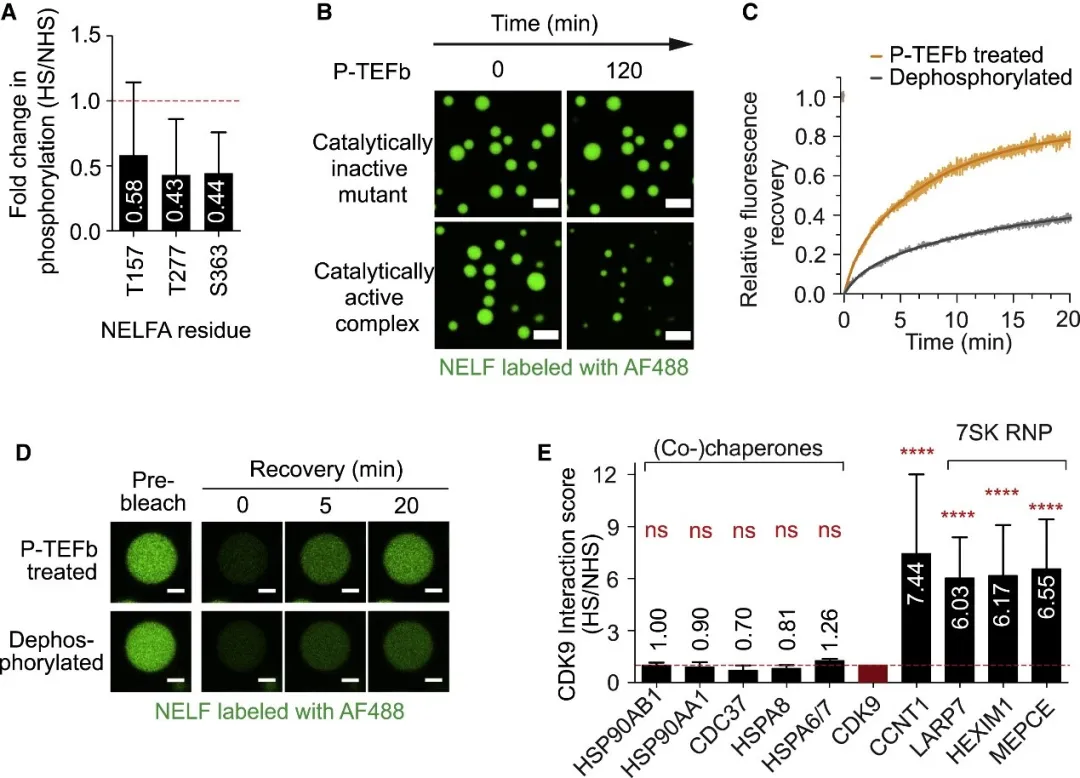
The intrinsically disordered regions (IDRs), namely "tethers", contained in NELFA and NELFE subunits are the key molecular basis for driving NELF phase separation. In vitro experiments show that neither the GFP-NELFA tether nor the GFP-NELFE tether fusion protein alone can form droplets, but when they are mixed in an equimolar ratio, droplets can be formed efficiently; the fusion protein of GFP and NELFE tether can produce phase separation even at low concentrations, and the formed droplets are sensitive to 1,6-hexanediol. The NELF complex mutant lacking NELFA and NELFE tethers has a significantly reduced ability to form droplets, confirming that these disordered regions are necessary and sufficient conditions for NELF phase separation.
The disordered regions of NELF also mediate the interaction with Pol II. The C-terminal disordered domain (CTD) of Pol II is highly enriched in NELF droplets, among which the distal non-repetitive sequence has a higher enrichment degree, and the S5-phosphorylated CTD peptide is the most enriched in NELF droplets, indicating that NELF condensates can form heterotypic interactions with the CTD of Pol II in a specific modification state through disordered regions, which provides a structural basis for NELF to inhibit Pol II elongation.
The IDR of NELFA is a key element driving NELF nuclear condensation, transcriptional downregulation, and stress survival in cells. The NELFA mutant lacking IDR (NELFA-ΔIDR) can normally target the nucleus, but fails to form condensates under heat shock conditions, and its binding ability at the promoters of transcriptionally downregulated genes is significantly reduced, resulting in the failure of normal downregulation of growth and biosynthesis-related genes. After fusing NELFA-ΔIDR with the IDRs of FUS or EWSR1, condensates can be formed even under non-stress conditions, which can significantly reduce transcriptional activity and improve cell survival rate under heat shock conditions. These results confirm that NELF nuclear condensation effectively drives transcriptional downregulation by enhancing its recruitment to promoters, which is an important survival strategy for cells to cope with stress.
Stress-induced NELF nuclear condensation is a new mechanism of cellular transcriptional regulation. Its formation is precisely regulated by post-translational modifications such as phosphorylation and SUMOylation, and the intrinsically disordered region of NELFA is the structural basis for driving phase separation. NELF enhances its binding to promoters through nuclear condensation, inhibits Pol II elongation, and realizes transcriptional downregulation under stress conditions, providing a guarantee for cell survival. This discovery not only reveals the important role of nuclear condensation in transcriptional regulation, but also provides a new perspective for understanding the molecular network of cellular stress responses, and provides potential molecular targets for the study of stress-related diseases. Future research needs to further explore the interaction between NELF nuclear condensation and other nuclear condensates, as well as the differences in NELF regulatory mechanisms under different stress types, to improve the understanding of cellular stress survival strategies.












 Business license (three certificates in one)