Prostate cancer (PCa) is a common malignant tumor of the urinary system in men worldwide, with a marked increase in incidence over the past decade. Statistics show that approximately 134,000 new cases of prostate cancer are diagnosed in China each year, and most patients are in the advanced stage at the time of diagnosis. During the disease progression, most PCa cases will develop into castration-resistant prostate cancer (CRPC), and some will further deteriorate into metastatic castration-resistant prostate cancer (mCRPC). As the terminal stage of the disease, mCRPC is the main cause of death in patients. The discovery of prostate-specific membrane antigen (PSMA) has provided a key target for the diagnosis and treatment of prostate cancer.
Ⅰ.Molecular Structure and Biological Characteristics of PSMA
PSMA is a transmembrane glycoprotein expressed in prostate tumor epithelial cells, consisting of intracellular, transmembrane, and extracellular domains. It exhibits significant tissue-specific expression: its expression is extremely low in normal prostate tissue, while in prostate cancer tissue, it is increased by 100-1000 times, especially in poorly differentiated, metastatic, and castration-resistant prostate cancer. Studies have shown that the mRNA expression level of PSMA in poorly differentiated prostate cancer lesions can be nearly 1000 times higher than that in normal tissue. In addition, PSMA is only expressed at low physiological levels in normal tissues such as the small intestine, salivary glands, and lacrimal glands, which causes little interference with targeted therapy, making it an ideal target for diagnosis and treatment.
Ⅱ.Research Progress in PSMA-Targeted Therapeutic Strategies
2.1 Radioligand Therapy (RLT)Radioligand therapy works by combining radiolabeled ligands with target antigens, releasing particles to induce tumor cell death. PSMA-617, a highly specific ligand, can be conjugated with β-emitters (e.g., 177Lu) or α-emitters (e.g., 225Ac). Among them, 177Lu-PSMA-RLT, the most widely studied RLT agent for prostate cancer, was approved by the FDA in 2021 for the treatment of mCRPC. It is mainly used in mCRPC patients with positive positron emission tomography/computed tomography (PET/CT) results after failure of drug therapy. Clinical data from the international phase III VISION study show that 177Lu-PSMA-RLT can extend tumor progression time from 3.4 months to 8.7 months, overall survival from 11.3 months to 15.3 months, and increase the pain relief rate by more than 3 times in terms of quality of life. Real-world data also indicate that some patients experience over 90% reduction in prostate-specific antigen (PSA) levels and significant shrinkage of bone metastases.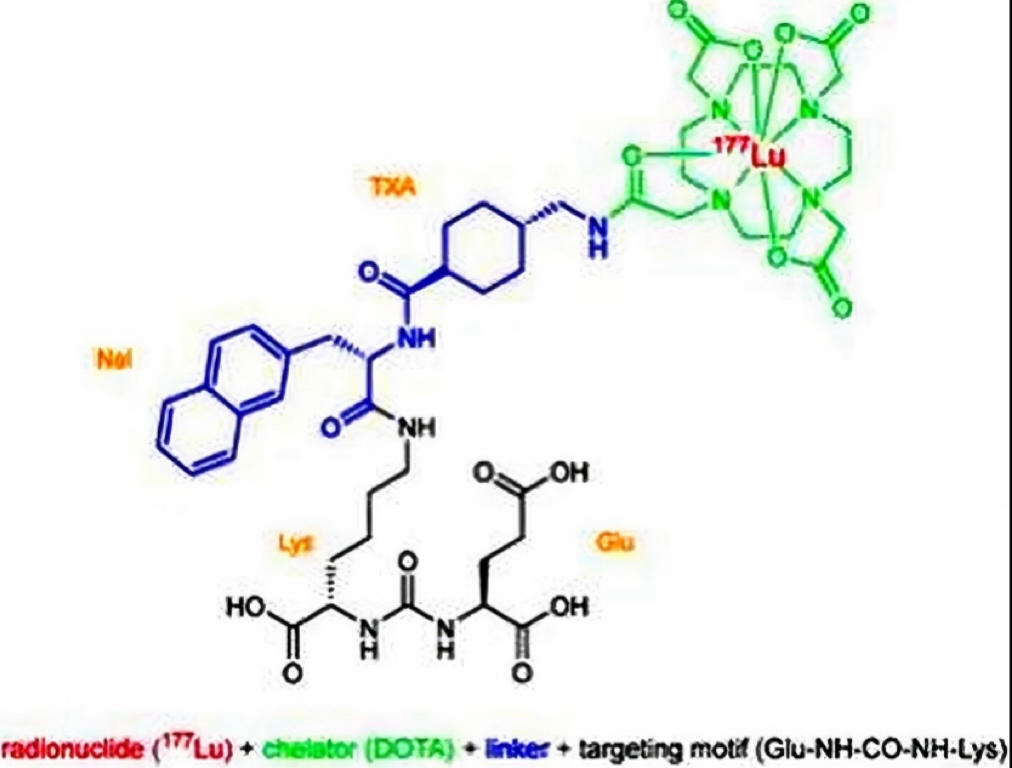
177Lu PSMA-RLT Structure Diagram
2.2 Antibody-Drug Conjugates (ADCs)
ADCs are formed by linking antibodies with cytotoxic drugs via various chemical bonds, representing a major breakthrough in cancer therapy. Compared with traditional cytotoxic drugs, ADCs avoid systemic administration and reduce toxicity to non-target organs. In PSMA-targeted ADC therapy, after the antibody specifically binds to PSMA, the ADC enters tumor cells through PSMA-mediated internalization. The linker is then degraded under the action of intracellular low pH or lysosomal proteases, releasing the drug to kill tumor cells.
Common cytotoxic drugs used include microtubule disruptors such as maytansinoid-1 (DM1) and monomethyl auristatin E (MMAE), which block microtubule function, disrupt mitosis, and ultimately induce apoptosis; and tesirine (SG3249), a pyrrolobenzodiazepine (PBD) dimer that forms highly cytotoxic DNA interstrand cross-links, causing cell cycle arrest in the G2 phase and eventual apoptosis. Several PSMA-targeted ADCs based on monoclonal antibodies have entered clinical trials, including MLN2704 (composed of humanized antibody J591 linked to DM1), PSMA-MMAE (delivering MMAE to PSMA-positive cells via a fully human IgG1 monoclonal antibody), and MEDI3726 (combining humanized antibody J591 with SG3249). Preclinical studies have shown that PSMA-MMAE can inhibit 70%-80% of PSMA-positive tumor cell lines, demonstrating good targeting and activity.
Ⅲ.Immunocell Therapy
3.1 CAR-T Cell Therapy
Chimeric antigen receptor T (CAR-T) cell therapy modifies T cells with genes encoding receptors (CARs) that specifically recognize tumor antigens via genetic engineering. When CARs bind to antigens, T cells are activated to release cytotoxins (e.g., perforin and granzyme), inducing tumor cell apoptosis. PSMA is considered a reliable target for CAR-T cell therapy in PCa treatment.
The development of PSMA-targeted CAR-T cells has gone through two generations: the first generation, constructed based on monoclonal antibody 3D8, achieved basic recognition and killing of PSMA-positive tumor cells; the second generation, with the insertion of the CD28 signaling domain, secretes more cytokines and proliferates more vigorously in PSMA-positive tumors, thereby inhibiting tumor growth more effectively. Studies comparing the two generations in animal models have shown that the second generation has deeper and wider infiltration in tumor tissues and a more significant inhibitory effect on tumor growth. Recent studies have also found that CAR-modified NK-92 cells can specifically recognize and effectively kill PSMA-positive cells, significantly inhibiting tumor growth and improving the survival rate of mice in experiments.
3.2 Bispecific T Cell Engager (BITE) Immunotherapy
Bispecific T cell engagers (BITEs) are antibody fragments containing two different single-chain variable fragment (scFv) domains, designed to bind tumor-associated antigens and CD3 on T cells, activating the patient's own T cells to eliminate tumor cells without genetic modification or in vitro expansion/manipulation of T cells.
Among PSMA-targeted BITEs, the first-generation agents such as AMG 212 and BAY 2010112 showed clinical activity in phase I studies but required continuous intravenous infusion due to their short half-life. The next-generation PSMA-targeted BITE, AMG 160, has an extended half-life, allowing longer dosing intervals. Preliminary results from phase I studies showed that 34% of patients achieved a PSA50 response (≥50% reduction in PSA levels), indicating its promising application prospects.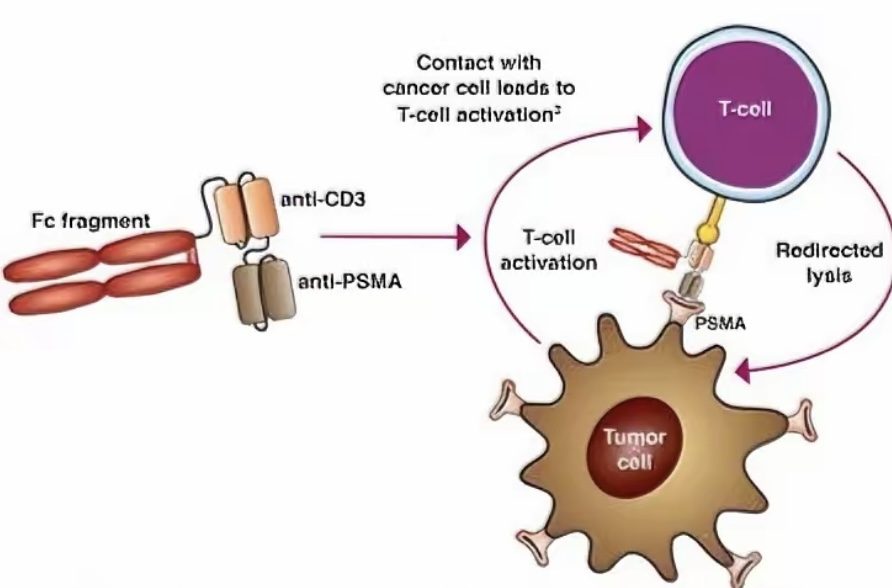
PSMA targeted bispecific T cell redirection therapy
Ⅳ. Other Novel Therapeutic Strategies
In addition to the above methods, PSMA-based targeted therapies include photodynamic therapy (PDT), image-guided surgery, and ultrasound-mediated nanobubble destruction (UMND). In PDT, PSMA inhibitors are conjugated with the photosensitizer pyropheophorbide-a. In vitro studies have confirmed that this conjugate specifically binds to LNCaP cells (PSMA-positive), and after irradiation with a specific wavelength of light, induces apoptosis in a time- and dose-dependent manner by generating highly reactive singlet oxygen, which oxidizes adjacent biomolecules (e.g., amino acids, fatty acids, or nucleic acids) to produce toxic photochemical products.
Image-guided surgery, including PSMA-targeted radio-guided surgery (RGS), fluorescence-guided surgery (FGS), and their combination, improves the precision of surgical resection. For example, the 68Ga-P3 nuclide/fluorescence dual-modal probe developed by the team of Peking University First Hospital enables precise preoperative staging and localization via PET/CT imaging and provides real-time intraoperative navigation via fluorescence imaging, significantly enhancing surgical accuracy. UMND uses targeted nanobubbles as carriers for drugs or genes, which are destroyed under ultrasound irradiation to release the loaded drugs or genes, thereby enhancing the targeting and efficacy of treatment.
In summary, as a specific marker for prostate cancer, PSMA has significant value in disease diagnosis and targeted therapy. With the in-depth research and clinical translation of various PSMA-targeted strategies, it is expected to provide more efficient and safe treatment options for patients with advanced prostate cancer, especially mCRPC, promoting the development of precision medicine in this field.












 Business license (three certificates in one)