1. Core Requirements of Organoid Culture and the Importance of R-spondin
In recent years, organoid technology has made significant progress, and organoids derived from normal and tumor tissues (such as intestine, liver, breast, brain, skin, etc.) have been successfully constructed. Although there are commonalities in the construction methods of organoids from different tissue sources, the optimization of medium components and culture conditions is still the key to the success of culture. Organoids in in vitro environments often struggle to achieve normal expansion and functional maintenance due to the lack of endogenous stem cell signaling. Therefore, the exogenous addition of specific growth factors and stem cell factors has become a core part of the culture system. Among numerous regulatory factors, the R-spondin family of cytokines has been proven to be a key factor in maintaining the self-renewal and phenotypic stability of organoids, and it is indispensable in the culture of various organoids.
2. Molecular Characteristics and Domain Composition of the R-spondin Family
The R-spondin family includes four members, R-spondin 1-4, which encode four evolutionarily conserved small secreted proteins. The sequence and domain similarity among family members reaches 40%-60%, with R-spondin 1, 2, and 3 being the most intensively studied. All members of the R-spondin family have highly conserved structural features, including four main functional regions: a signal peptide sequence at the N-terminus, which is responsible for guiding protein secretion; two adjacent furin-like domains, which are the core regions for exerting biological functions; a thrombospondin type 1 domain (TSP1); and a region rich in basic amino acids at the C-terminus. This structural layout provides a structural basis for its participation in the regulation of various signaling pathways.
In terms of chromosomal localization, the encoding genes of each member of the human R-spondin family are distributed on different chromosomes, further indicating the specificity and diversity of their functions. The high conservation of protein structure suggests that this family plays an important biological role in the evolutionary process, while the subtle differences in domains may endow each member with unique regulatory characteristics.
3. Signaling Pathway Regulation Mechanisms of the R-spondin Family
(1) R-spondin 1: A Potent Enhancer of the Canonical Wnt Signaling Pathway
R-spondin 1 plays a key role in organ development, epithelial stem cell maintenance, and tumorigenesis regulation by activating the Wnt-β-catenin signaling pathway. Its two adjacent furin-like domains are decisive for activating the canonical Wnt signaling pathway. Experiments have confirmed that the loss of any one furin-like domain will cause it to lose the ability to activate the Wnt/β-catenin pathway.
In canonical Wnt signal transduction, after Wnt ligands bind to frizzled receptors (Fzd), they induce the phosphorylation of low-density lipoprotein receptor-related proteins 5/6 (LRP5/6), thereby initiating downstream signal cascades. However, E3 ubiquitin ligases RNF43 (ring finger protein 43) and ZNRF3 (zinc and ring finger 3) on the cell membrane can bind to Fzd and mediate its ubiquitination and degradation, thus negatively regulating Wnt signal transduction. R-spondin 1 specifically binds to G protein-coupled receptors 4/5 (Lgr4/5) through its furin-like region. The formed complex can bridge the extracellular regions of RNF43 and ZNRF3, inhibiting their ubiquitination and degradation of Fzd, allowing Fzd receptors on the cell membrane to stably exist, and ultimately achieving the continuous enhancement of Wnt signals. This regulatory mechanism provides key signal support for the continuous growth and phenotypic maintenance of organoids.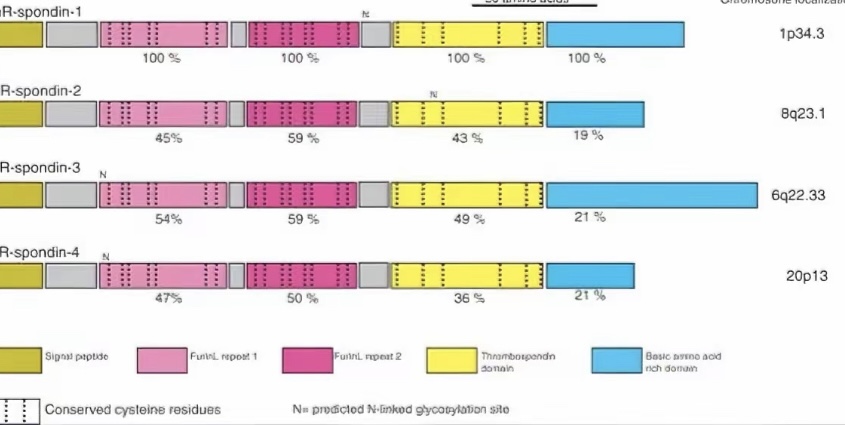
(2) R-spondin 2: An Independent Activator of Wnt Signaling and Inhibitor of BMP Signaling
R-spondin 2 also has the function of enhancing the Wnt-β-catenin signaling pathway, and its unique feature is that it can directly activate Wnt signals independently of Wnt ligands, thereby promoting the differentiation of chondrocytes and osteoblasts. In terms of regulatory mechanism, R-spondin 2 acts independently of LRP5/6 by inhibiting the activity of RNF43 and ZNRF3, playing an important role in limb development.
In addition, as a bifunctional ligand, R-spondin 2 can also bind to BMP receptors through its TSP1 domain, bridging RNF43 and ZNRF3 to form a ternary complex. After internalization, this complex is degraded, thereby reducing the number of functional BMP receptors on the cell surface and effectively inhibiting the BMP signaling pathway. This dual regulatory ability makes it of special significance in the balance of tissue differentiation.
(3) R-spondin 3: A Regulator of Angiogenesis and a Multi-pathway Activator
R-spondin 3 has a similar enhancing effect on the Wnt-β-catenin signaling pathway to other family members. At the same time, it is also a key regulatory protein for angiogenesis and vascular development, which can promote endothelial cell proliferation, migration, and the formation of new blood vessels. In addition to Wnt signaling, R-spondin 3 can also activate the Gai1/3-Akt-mTOR signaling pathway, which is crucial for angiogenesis, and participates in the regulation of vascular homeostasis through multi-pathway synergy.
Similar to R-spondin 2, R-spondin 3 is also a bifunctional ligand, which can bind to BMP receptors through its TSP1 domain, mediate the internalization and degradation of the RNF43/ZNRF3 complex, thereby inhibiting BMP signal transduction. This characteristic gives it potential roles in tissue regeneration and tumor microenvironment regulation.
4. Application of the R-spondin Family in Organoid Culture
Organoids have become important models for studying tissue homeostasis, cancer occurrence, regenerative medicine, and drug development due to their advantages such as high genetic stability, ease of gene editing, short construction cycle, and ability to simulate the in vivo microenvironment. In organoid culture, the addition of members of the R-spondin family is key to maintaining the success of the culture system: R-spondin 1, as an activator of the canonical Wnt signaling pathway, is an essential component of the medium for various organoids such as stomach, intestine, liver, prostate, and kidney, and can support the long-term sustainable culture of organoids; in breast organoid culture, in addition to R-spondin 1, R-spondin 3 is often added in combination to optimize the culture effect.
At present, with the help of reasonable R-spondin regulation strategies, in vitro cultured organoids can achieve continuous growth for several weeks without frequent passage, which provides a stable and reliable experimental platform for in-depth research on the development mechanism of tissues and organs, disease model construction, and personalized drug screening. With the deepening of research, the application of the R-spondin family in organoid technology will be further expanded, providing more powerful support for life science research and clinical transformation.












 Business license (three certificates in one)