The Sonic Hedgehog (SHH) signaling pathway, a key regulatory network in embryonic development, is closely associated with the occurrence of various malignant tumors. Among these, SHH-subtype medulloblastoma (MBSHH) is a typical representative driven by abnormal activation of this pathway. In recent years, the development of targeted drugs against the SHH pathway has opened new avenues for the treatment of MBSHH. In particular, clinical research on the SMO inhibitor Vismodegib has revealed the potential of precision therapy guided by molecular subtyping. This article systematically elaborates on the molecular mechanism of the SHH signaling pathway, its abnormal characteristics in MBSHH, and the progress and challenges of targeted therapy in clinical research.
The SHH signaling pathway regulates cell proliferation, differentiation, and tissue polarity through a rigorous molecular cascade, and its precise physiological functions depend on the coordination of various components.
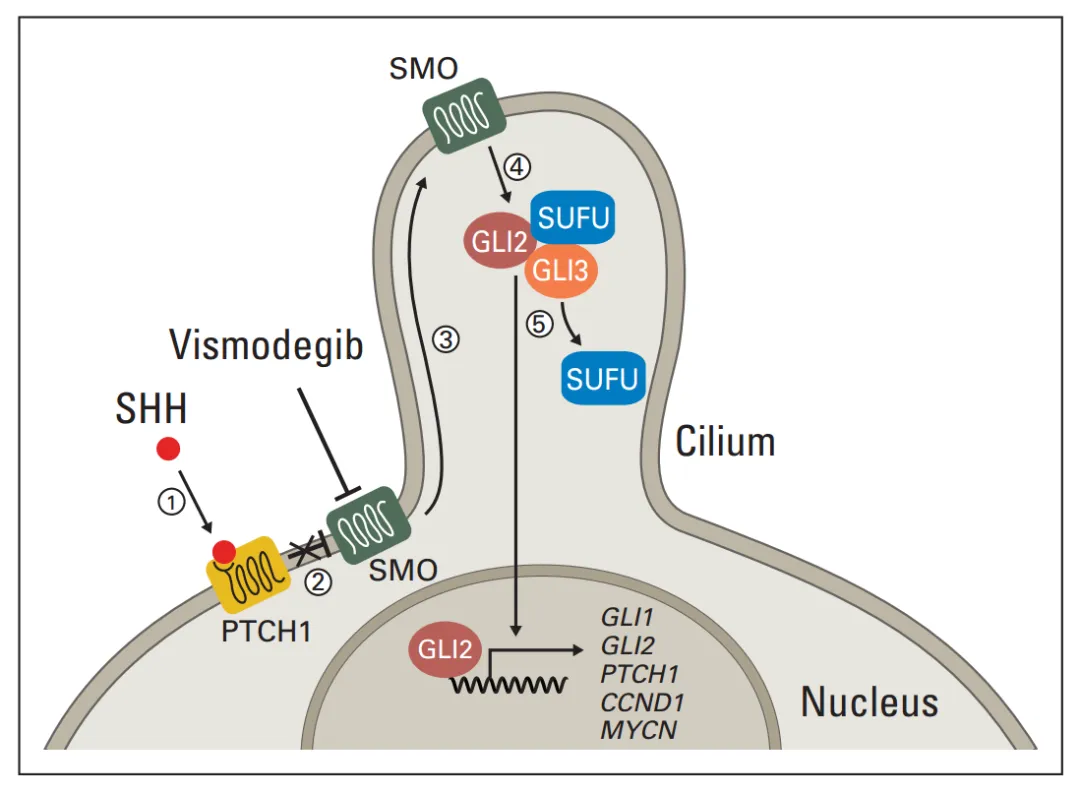
The activation of the SHH pathway follows a hierarchical regulatory model of "ligand-receptor-effector". The secreted protein SHH binds to the transmembrane receptor PTCH1 (Patched 1) on the cell membrane, relieving the inhibition of the downstream signal molecule SMO (Smoothened) by PTCH1. SMO translocates from the cytoplasm to the primary ciliary membrane, activates downstream signal complexes through conformational changes, and releases the 束缚 of SUFU (Suppressor of Fused) on GLI family transcription factors (GLI1, GLI2). Free GLI enters the nucleus and initiates the expression of target genes (such as PTCH1, GLI1, MYCN), forming a negative feedback regulatory loop to maintain the dynamic balance of pathway activity.
During embryonic development, the SHH pathway is involved in the morphogenesis of the nervous and skeletal systems, playing a crucial role especially in cerebellar development. In adulthood, the pathway is mostly in a quiescent state, and its abnormal activation may induce tumors.
SHH-subtype medulloblastoma is one of the main subtypes of medulloblastoma, accounting for approximately 30% of all cases. It predominantly affects infants (<3 years old) and adolescents (>16 years old), and its molecular characteristics are closely related to genetic abnormalities in the SHH pathway. Approximately 50% of MBSHH cases have inactivating mutations (somatic or germline) in PTCH1, leading to the release of inhibition on SMO. SUFU mutations (about 10%) directly activate the pathway by impairing the inhibition of GLI. Activating mutations in SMO (such as D473H) can mimic the ligand-bound state and continuously transmit signals. Amplifications of GLI1/GLI2 or MYCN (about 15%) can bypass upstream regulation and directly drive the expression of target genes, resulting in the malignant proliferation of tumor cells.
These genetic abnormalities collectively lead to the sustained activation of the SHH pathway, making it a core driver of the occurrence and development of MBSHH.
SHH signal pathway diagram. ① SHH binds to transmembrane protein PTCH1; ② Release the inhibition of SMO; ③ SMO is located on the cilia of cells; ④ SMO relieves the inhibition of GLI by SUFU; ⑤ GLI enters the nucleus and activates downstream target genes.
Vismodegib, the first approved selective SMO inhibitor, blocks the conformational activation of SMO by competitively binding to its transmembrane domain, thereby inhibiting downstream signals of the SHH pathway. Clinical studies (PBTC-025B and PBTC-032) on recurrent MBSHH have provided key evidence for its efficacy and safety.
Both studies were based on the dosage regimen determined by a phase I clinical trial (PBTC-025): 150mg/day for patients with a body surface area of 0.67-1.32m², and 300mg/day for those with a body surface area of 1.33-2.5m². They included patients with recurrent or refractory medulloblastoma. PBTC-025B enrolled 31 patients, with 20 confirmed as MBSHH and 9 as non-SHH subtypes through molecular subtyping. PBTC-032 included only 9 MBSHH patients (previous studies showed no response in non-SHH subtypes).
For efficacy evaluation, the objective response rate (ORR) was defined as complete response (CR) or partial response (PR) lasting ≥8 weeks. PBTC-025B adopted the RECIST criteria (PR: tumor reduction ≥30%), while PBTC-032 used stricter criteria (PR: tumor reduction ≥50%). Molecular biological analysis detected copy number variations of genes such as PTCH1, GLI2, and MYCN using formalin-fixed paraffin-embedded (FFPE) samples, combined with immunohistochemistry (IHC) to analyze p53 expression, and performed whole-exome sequencing on tumor tissues from 8 patients.
The results showed that Vismodegib has certain therapeutic value for recurrent MBSHH, with differences in age and molecular background. Three adult patients and one child patient achieved objective responses, while 5 adults and 3 children showed transient radiological responses (not sustained until the next evaluation). The progression-free survival (PFS) of MBSHH patients was significantly longer than that of non-SHH subtype patients (especially in the adult subgroup), indicating that efficacy is related to subtype specificity.
The drug was well-tolerated, with no treatment discontinuation due to adverse reactions. No skeletal developmental abnormalities or oral mucositis (common adverse reactions in the treatment of adult basal cell carcinoma) were observed in child patients. These results confirm that Vismodegib can prolong the disease control time in patients with recurrent MBSHH with controllable safety.
Analysis of genetic characteristics revealed predictors of Vismodegib efficacy, providing a basis for precision therapy. Patients with PTCH1 deletion had significantly longer PFS, suggesting that tumors with upstream pathway abnormalities (upstream of SMO) are more sensitive to SMO inhibitors. Diffuse positive p53 (indicating TP53 mutation) was associated with shorter PFS; 4 out of 6 p53-positive patients had concurrent GLI2 or MYCN amplification, which may drive tumors through SMO-independent pathways. Patients with SUFU mutations or GLI2 amplification (4 out of 8 sequenced cases) showed no objective responses, indicating that downstream pathway abnormalities can lead to drug resistance.
Two drug-resistant patients had concurrent PI3K pathway mutations, suggesting that cross-activation of the SHH and PI3K pathways may exacerbate drug resistance. These findings indicate that the molecular subtype of MBSHH is a key factor in predicting the efficacy of Vismodegib, and patients with upstream mutations are more likely to benefit.
Although Vismodegib has brought breakthroughs in MBSHH treatment, its clinical application still faces many challenges, promoting the optimization and innovation of targeted strategies.
Clinical studies have shown that the duration of response in most patients is short (median approximately 6 months). The main mechanisms of drug resistance include: primary resistance (abnormalities in downstream molecules such as GLI2 amplification and SUFU mutations lead to pathway activation independent of SMO); acquired resistance (secondary mutations in SMO or pathway remodeling such as activation of the IL6/STAT3 pathway can bypass SMO inhibition); and tumor microenvironment (SHH ligands secreted by tumor-associated fibroblasts may maintain pathway activity and weaken drug effects).
Countermeasures include: developing new-generation SMO inhibitors (such as Sonidegib) to overcome mutation-induced resistance; combining GLI inhibitors (such as GANT61) to directly target downstream effectors; and dual-target inhibition (such as SHH + PI3K) to block synergistic pathways.
Studies have confirmed that comprehensive genetic testing (such as for PTCH1, SUFU, GLI2, TP53) is the premise for screening beneficial populations. For patients with PTCH1 or SMO mutations, SMO inhibitors remain the first choice; for patients with SUFU mutations or GLI amplification, downstream targeting or combination therapy should be considered; patients with germline mutations (such as Gorlin syndrome-related MBSHH) require long-term monitoring to prevent multiple primary tumors.
Combining liquid biopsy technology to dynamically monitor the mutation profile in circulating tumor DNA (ctDNA) can real-time evaluate efficacy and drug resistance, guiding treatment adjustments.
The treatment of pediatric MBSHH faces special challenges. In terms of age-related differences, the objective response rate in children was lower than that in adults in the study, which may be related to more frequent downstream mutations (such as SUFU germline mutations). Regarding long-term safety, SMO inhibitors may affect skeletal development in children, requiring a balance between efficacy and growth and development needs. In the exploration of combination therapy, the synergistic effect with chemotherapy (such as carboplatin) or radiotherapy is being evaluated in clinical trials to improve the depth and duration of response.
Abnormal activation of the SHH signaling pathway is the core mechanism of MBSHH occurrence. Clinical research on the SMO inhibitor Vismodegib has confirmed the feasibility of targeting this pathway, showing clear efficacy especially in adult patients with upstream mutations. The discovery of molecular markers provides a basis for accurately screening beneficial populations, and the analysis of drug resistance mechanisms has promoted the development of combination therapy strategies. In the future, with a deeper understanding of the SHH pathway regulatory network, combined with multi-omics detection and the development of new targeted drugs, it is expected to further improve the treatment effect of MBSHH and bring long-term survival benefits to patients.













 Business license (three certificates in one)