The Siglec family (sialic acid-binding immunoglobulin-like lectins), a group of transmembrane proteins expressed on immune cells, participates in immune regulation by recognizing sialic acid-modified glycans. Among them, Siglec-15 has become a focus of medical research due to its roles in regulating bone metabolism, tumor immunosuppression, and infectious responses. This article systematically elaborates on its molecular characteristics, signaling mechanisms, and physiological/pathological functions, and analyzes its potential as a new target for cancer immunotherapy.
The structure and signaling mode of Siglec-15 determine its functional diversity.
Siglec-15 is a type I transmembrane protein composed of three parts: the extracellular region contains one V-set domain (recognizing sialic acid ligands) and one C2-set domain (maintaining conformation). The V-set domain specifically binds to tumor-associated sialyl-Tn antigens; the transmembrane region contains a lysine residue (Lys274), which binds to the aspartic acid residue (Asp50) of the adapter protein DAP12 through ionic bonds; the intracellular region has no signaling motifs and relies on the immunoreceptor tyrosine-based activation motif (ITAM) of DAP12 to recruit and activate SYK kinase.
Unlike most Siglec members that transmit inhibitory signals through SHP-1, Siglec-15 mediates activating signals through the DAP12-SYK pathway. This unique mode enables it to participate in cell activation and regulate T-cell functions, reflecting bidirectional functionality.
The function of Siglec-15 depends on the coordination of ligand binding and signal transmission: its V-set domain preferentially recognizes glycans with α2,6- or α2,3-linked sialic acids, especially showing high affinity for sialyl-Tn antigens overexpressed on tumor cells. After ligand binding, conformational changes activate ITAM phosphorylation of DAP12, initiating SYK-mediated pathways such as PI3K-AKT and MAPK, thereby regulating cytokine secretion and cell differentiation. In different cell types, its signal output is specific: for example, promoting differentiation in osteoclasts and inducing immunosuppression in tumor-associated macrophages.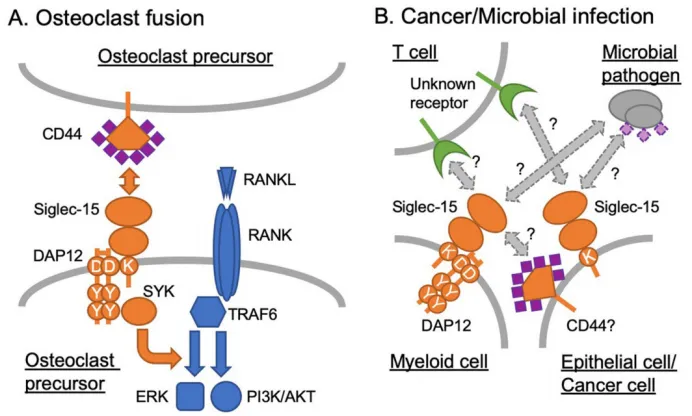
Siglec-15与配体互作及下游信号通路
Siglec-15 maintains bone homeostasis by regulating osteoclast differentiation and is a potential target for bone metabolic diseases.
Osteoclasts, key cells responsible for bone resorption, rely on the RANK-NF-κB pathway and auxiliary signals for differentiation. Studies have shown that Siglec-15 is a core regulator of osteoclast maturation: RANKL stimulation activates the NFAT2 transcription factor, which directly upregulates SIGLEC15 expression, forming a positive regulatory loop; Siglec-15 binds to DAP12 to activate SYK, promoting NFATc1 nuclear translocation, and accelerates precursor cell fusion by recognizing sialic acid ligands on stromal cells.
Experimental evidence indicates that anti-Siglec-15 antibodies significantly inhibit osteoclast differentiation of RAW264.7 cells and primary bone marrow macrophages; Siglec-15 knockout mice exhibit increased bone mass and reduced urinary deoxypyridinoline levels, confirming its necessity for bone resorption. This suggests that it can serve as a therapeutic target for diseases such as osteoporosis and bone metastasis, restoring bone metabolic balance by blocking its function.
Siglec-15 promotes immune evasion by inhibiting T-cell responses in the tumor microenvironment, holding significant therapeutic value.
Clinical studies have shown abnormal expression of Siglec-15 in various solid tumors: it is mainly expressed on tumor-associated macrophages (TAMs), upregulated by M-CSF induction, and can also be expressed in some tumor cells (e.g., non-small cell lung cancer). Its immunosuppressive mechanisms include two aspects: Siglec-15 on TAMs recognizes tumor sialyl-Tn antigens, activates the DAP12-SYK pathway to promote TGF-β secretion, and induces tumor metastasis; it directly binds to receptors on T cells, inhibiting T-cell proliferation and cytokine secretion, thereby impairing cytotoxic functions.
Clinical data indicate that Siglec-15 expression is negatively correlated with PD-L1, remaining highly expressed in PD-L1-negative tumors, suggesting its potential as a supplementary target for patients resistant to PD-1/PD-L1 inhibitors.
Preclinical studies have confirmed the potential of Siglec-15-targeted therapy: in mouse melanoma models, Siglec-15 knockout enhances T-cell infiltration and prolongs survival; anti-Siglec-15 monoclonal antibodies reverse T-cell suppression, slow tumor growth, and show synergistic effects when combined with PD-1 inhibitors. Its advantages include limited expression in normal tissues (mainly in bone marrow and osteoclasts), reducing the risk of systemic adverse reactions, and achieving tumor-specific regulation through glycan recognition.
Currently, Siglec-15 monoclonal antibodies have entered early clinical trials to evaluate their safety and efficacy in solid tumors, opening a new path for cancer immunotherapy.
Siglec-15 participates in infectious processes by regulating immune responses, and genetic polymorphisms affect infection susceptibility.
Studies on Candida albicans infection show that the Phe273Leu polymorphism of SIGLEC15 (adjacent to Lys274) is a risk factor for infection. Individuals carrying this variant exhibit abnormal increases in T-cell cytokine secretion, possibly due to impaired interaction with DAP12 and disrupted SYK signaling, leading to immune imbalance. Epidemiological studies have found that SIGLEC15 variants are associated with susceptibility to pulmonary tuberculosis, 推测 ing that it may participate in granuloma formation by promoting macrophage fusion or reduce pathogen clearance by inhibiting T-cell activity, with specific mechanisms to be further verified.
As a multifunctional immune regulatory molecule, Siglec-15 plays a key role in bone metabolism, tumor immunity, and infectious responses. Its potential as a tumor immune checkpoint has been confirmed, providing a new therapeutic option for resistant patients; its regulatory role in bone diseases also shows targeting value. Future research should clarify its interaction mechanism with T-cell receptors, explore tissue-specific regulatory rules, and promote the clinical transformation of targeted drugs, aiming to achieve breakthroughs in the treatment of multiple diseases.













 Business license (three certificates in one)