Siglec-2 (also known as CD22), a highly conserved member of the sialic acid-binding immunoglobulin-like lectin (Siglec) family, is mainly expressed on the surface of B lymphocytes. It participates in the precise regulation of B cell activation, proliferation, and tolerance by recognizing sialic acid-modified glycan structures. Its unique immunomodulatory functions make it a key regulatory molecule in diseases such as autoimmune diseases and B cell malignancies, while also providing an important target for targeted therapy. This article systematically elaborates on the molecular characteristics of Siglec-2, its mechanism of action in immune regulation, and research progress in disease treatment.
As a classic member of the Siglec family, the structural characteristics and classification of Siglec-2 reflect the conservation and specificity of its functions.
Siglec-2 is a type I transmembrane glycoprotein belonging to the highly conserved subgroup of the Siglec family (together with Siglec-1, 4, and 15). Its structure includes three core functional regions. The extracellular region consists of 7 immunoglobulin-like domains, among which the first N-terminal V-set domain contains a sialic acid recognition site, which can specifically bind to α2,6-linked sialic acid residues (such as sialylation modifications on the B cell surface glycoprotein CD45). The subsequent 6 C2-set domains are responsible for maintaining protein conformation and cell-cell interactions. The transmembrane region contains a positively charged lysine residue, which can interact with the Igα/Igβ chains in the B cell receptor (BCR) complex and participate in the regulation of signal transduction. The intracellular region contains 3 immunoreceptor tyrosine-based inhibitory motifs (ITIMs) and 1 immunoreceptor tyrosine-based switch motif (ITSM). When phosphorylated by Src family kinases, it can recruit tyrosine phosphatases SHP-1, SHP-2, and SHIP-1, and transmit inhibitory signals by dephosphorylating downstream molecules.
This structure gives it the typical characteristics of an inhibitory Siglec, i.e., through ITIM-mediated negative feedback regulation, it avoids excessive activation of immune cells.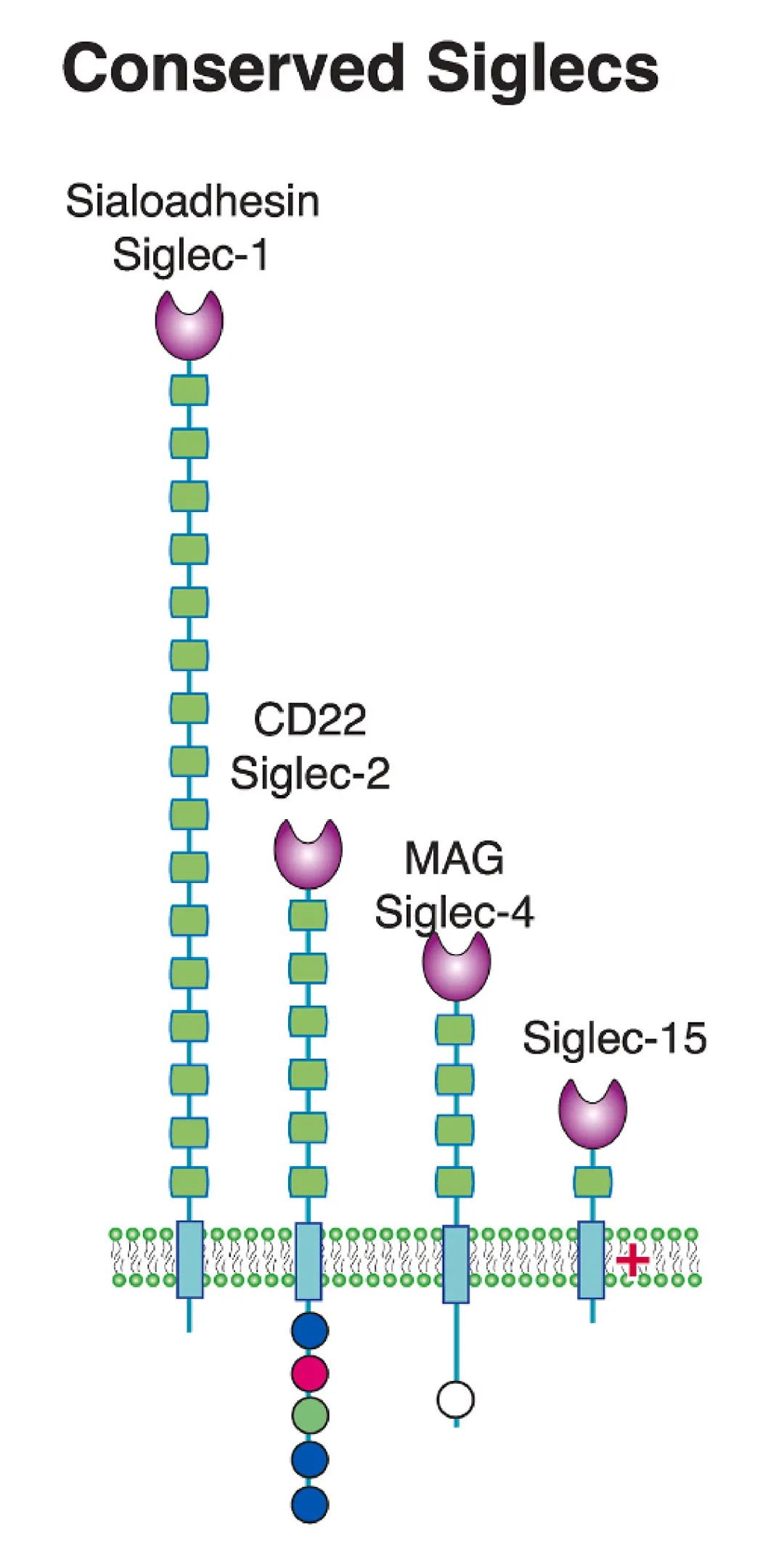
The expression of Siglec-2 has strict cell specificity. It begins to be expressed in the early stages of B cell development (pre-B cells), is continuously highly expressed in immature B cells, mature B cells, and memory B cells, while its expression is significantly downregulated in plasma cells. This expression pattern is closely related to the activation state of B cells. Low-level expression is found in a few T cell subsets (such as regulatory T cells) and dendritic cells, but their functions are not yet clear. It is also detected in small amounts in non-immune tissues such as salivary glands and kidneys, presumably participating in the maintenance of tissue homeostasis.
This restricted expression pattern makes it a specific marker for B cell function research and targeted therapy.
Through interaction with sialic acid ligands, Siglec-2 plays a core regulatory role in B cell activation, tolerance, and antibody secretion.
BCR-mediated signal activation is the core of B cell response, and Siglec-2 inhibits excessive activation through multiple mechanisms. When BCR recognizes antigens and activates Src kinases (such as Lyn), the intracellular ITIMs of Siglec-2 are simultaneously phosphorylated, recruiting SHP-1/2, which in turn dephosphorylates key molecules downstream of BCR (such as Syk and PLCγ2), weakening calcium influx and NF-κB pathway activation, forming a "activation-inhibition" dynamic balance. The ligand-dependent regulatory mechanism is also important: self-ligands on the B cell surface (such as sialylated CD22 and CD45) can inhibit the function of Siglec-2 through "cis-binding", while when B cells come into contact with other cells (such as dendritic cells), "trans-binding" (such as recognizing sialylated ligands on the surface of dendritic cells) can enhance its inhibitory activity, avoiding abnormal activation of autoreactive B cells.
This mechanism is crucial for maintaining B cell tolerance. For example, in the central tolerance stage, immature B cells recognize self-antigen-sialic acid complexes on the surface of bone marrow stromal cells through Siglec-2, initiating the apoptotic program to eliminate autoreactive clones.
Siglec-2 participates in B cell fate determination by affecting the cell cycle and cytokine signals. After B cells are stimulated by antigens, the expression of Siglec-2 is temporarily downregulated, releasing the inhibition of proliferation signals; when the antigen is cleared, its expression is restored, terminating cell proliferation by inhibiting the PI3K-AKT pathway to avoid excessive clone expansion. In terms of differentiation regulation, during T cell-dependent B cell differentiation, Siglec-2 regulates the signal transmission of cytokines such as IL-4 and IL-5 through interaction with CD45 on the T cell surface, affecting plasma cell differentiation and class switching of IgG1 and IgE; in T cell-independent responses, it weakens antibody secretion by B1 cells by inhibiting the TLR pathway.
Studies have shown that Siglec-2-deficient mice exhibit excessive B cell activation, increased serum autoantibody levels, and abnormally enlarged germinal centers, confirming its key role in B cell homeostasis.
Abnormal functions of Siglec-2 are closely related to various B cell-related diseases, and its specific expression makes it an ideal therapeutic target.
Siglec-2 is continuously highly expressed in B cell lymphomas, leukemias, and other malignancies, becoming a marker for disease diagnosis and treatment. In chronic lymphocytic leukemia (CLL), Siglec-2 on the surface of tumor cells maintains survival signals through cis-binding with self-sialic acid ligands, and inhibits the killing effect of NK cells through trans-binding; in follicular lymphoma, high expression of Siglec-2 is associated with hyperactive BCR signals, promoting the proliferation and drug resistance of tumor cells.
In terms of targeted strategies, antibody-drug conjugates (ADCs) such as Inotuzumab ozogamicin, which deliver cytotoxic drugs (calicheamicin) to tumor cells by targeting Siglec-2, have been approved for the treatment of relapsed/refractory B cell acute lymphoblastic leukemia (B-ALL), and their efficacy depends on the endocytic properties of Siglec-2. Research on bispecific antibodies is also advancing. Bispecific antibodies targeting Siglec-2 and CD3 can recruit T cells to the tumor microenvironment and kill tumor cells through T cell-mediated cytotoxicity, which is currently in the preclinical stage.
Defects in the inhibitory function of Siglec-2 may lead to activation of autoreactive B cells, participating in the occurrence of diseases such as rheumatoid arthritis and systemic lupus erythematosus (SLE). The expression of Siglec-2 in B cells of SLE patients is downregulated, and the phosphorylation level of its ITIMs is reduced, resulting in weakened inhibitory function and increased autoantibody production; in mouse models, Siglec-2 deficiency can exacerbate lupus-like symptoms.
In terms of therapeutic exploration, enhancing its inhibitory function by activating Siglec-2 has become a potential strategy. For example, using agonistic antibodies or sialic acid mimetics of Siglec-2 can reduce autoantibody secretion and alleviate joint inflammation in mouse models, but clinical transformation still requires further research.
Siglec-2 can be exploited by pathogens to evade immune responses and also participate in the regulation of anti-infective immunity. Some viruses (such as Epstein-Barr virus) and bacteria (such as Haemophilus influenzae) can inhibit BCR signals and hinder antibody production by expressing sialylated surface proteins that bind to Siglec-2 on the B cell surface. In bacterial infections, Siglec-2 regulates the production of specific antibodies by B cells by recognizing sialic acid components in bacterial capsules, and its expression level is positively correlated with anti-infective ability, suggesting that the immunogenicity of vaccines can be enhanced by regulating Siglec-2 function.
Although significant progress has been made in the research on Siglec-2, the complexity of its functions and the challenges in clinical application still need to be explored in depth. At the molecular mechanism level, the relationship between the structure of sialic acid glycans recognized by Siglec-2 (such as glycan length and linkage mode) and functions has not been fully clarified, especially how ligands on different cell surfaces (cis/trans) regulate its signal output; at the same time, the synergistic mechanism of Siglec-2 with immune checkpoint molecules such as PD-1 and CTLA-4 in B cells, and the interaction network with T cells and macrophages in the tumor microenvironment still need to be analyzed.
In the optimization of clinical transformation, treatment safety is a key issue. Existing ADC drugs may cause damage to normal B cells, leading to immune deficiency, and more tumor-specific targeting strategies (such as dual-target antibodies) need to be developed. The potential of combination therapy is great. The combination of Siglec-2 targeted therapy with BCR inhibitors and immune checkpoint inhibitors may enhance anti-tumor efficacy. Currently, relevant clinical trials are underway (such as NCT04855366 evaluating the synergistic effect of Inotuzumab and CAR-T cell therapy).
As a B cell-specific inhibitory receptor, Siglec-2 plays an irreplaceable role in maintaining immune homeostasis by precisely regulating B cell activation and tolerance. Its specific expression and functional abnormalities in B cell malignancies make it an important breakthrough for targeted therapy, and existing drugs have shown significant efficacy in clinical practice. Future research needs to further reveal its regulatory network in complex microenvironments, optimize targeting strategies, and promote its clinical application in autoimmune diseases, infectious diseases, and other fields, providing new theoretical basis and therapeutic methods for the treatment of immune-related diseases.













 Business license (three certificates in one)

