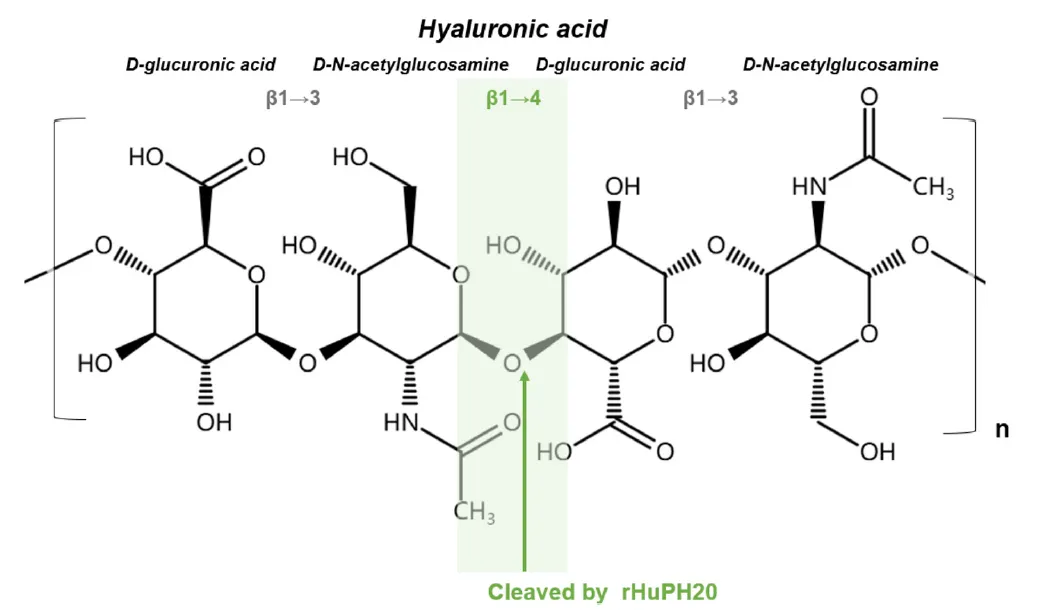
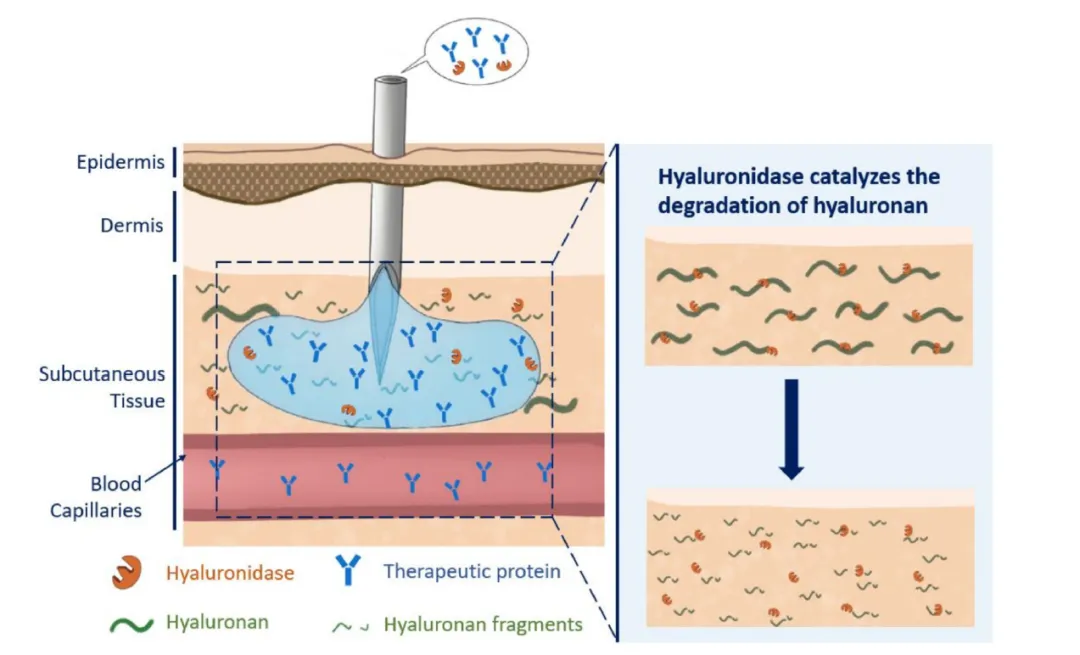
Hyaluronidase (HAase) is a type of glycosidase that specifically degrades hyaluronic acid (HA) and some glycosaminoglycans. It breaks down large substrates into small molecular fragments by cleaving β -1,4-glycosidic bonds (Figure 1). This characteristic makes it a key tool in the field of biomedicine: as a drug adjuvant, it can disrupt the extracellular matrix HA structure, enhance the tissue permeability of co injected drugs, and accelerate absorption; In clinical practice, it is used for anti adhesion in ophthalmic surgery, relieving complications of HA filling in plastic surgery, and can also be used as an anti-tumor adjuvant to increase subcutaneous injection drug dosage and enhance efficacy (Figure 2).
Since its commercialization in the 1950s, the development of hyaluronidase has always relied on innovations in downstream purification processes. From early animal tissue extraction to current recombinant protein production, process upgrades have directly driven improvements in product purity, safety, and scalability, forming the core support for its wide application.
Figure 1. Hyaluronidase rHuPH20 cleaves β 1-4 glycosidic bonds
Figure 2. Hyaluronidase, as a drug excipient for subcutaneous injection, can catalyze the degradation of hyaluronic acid in the extracellular matrix, allowing for large volume subcutaneous injection and increasing the dispersion and absorption of co administered proteins
Early hyaluronidase was mainly extracted from the testes of cattle and sheep, as these raw materials have high HAase content and stable activity. Purification centered on two-step affinity chromatography: the first step used Blue Sepharose Fast Flow resin to remove most impurity proteins and nucleic acids through hydrophobic interactions and nucleic acid affinity; the second step employed Capto Lentil Lectin resin, which specifically binds to the glycosyl groups of HAase to enrich the target protein.
SDS-PAGE and Western blot verification showed that this process could isolate active HAase (e.g., bovine samples exhibited a single target band after elution with Capto Lentil Lectin). However, it had significant drawbacks: low product purity, with residual animal-derived proteases, immunoglobulins, and other impurities that easily trigger human allergies; raw material supply was affected by breeding cycles and diseases, making large-scale production difficult; animal tissues might carry pathogens, posing potential biosafety risks. These issues drove the shift of technology toward recombinant proteins.
Recombinant human PH20 (rHuPH20) is currently the most widely used hyaluronidase. Naturally present in human sperm, it maintains activity in both neutral and acidic environments, has a short half-life (approximately 2–3 hours), and is safe for intravenous injection, making it an ideal adjuvant for subcutaneous injection of high-concentration drugs. Its mainstream expression system is Chinese Hamster Ovary (CHO) cells, and downstream purification is based on multi-step chromatography combination. Through the combined use of ion exchange, hydrophobic, and glycosyl affinity chromatography, the product purity can exceed 90%, specific activity reaches over 100,000 USP Units/mg, host cell protein (HCP) residue is <1%, and endotoxin is <0.5 EU/mg, meeting clinical standards.
To simplify the process, His-tag technology became crucial: with a molecular weight of only 0.8 kDa (much smaller than the GST tag at 26 kDa), the His-tag has minimal impact on the structure and activity of rHuPH20. rHuPH20 with a His-tag can be purified via Immobilized Metal Ion Affinity Chromatography (IMAC) using a HisTrap HP prepacked column—binding with a 35 mM imidazole buffer and eluting with 200 mM imidazole to efficiently capture the target protein. The combination of "anion exchange chromatography (Q Sepharose column, 0–100% NaCl linear elution) + His-tag affinity chromatography" can even purify high-purity rHuPH20 suitable for protein crystal structure analysis.
To meet commercial needs, Cytiva Protein Select resin demonstrates significant advantages: through a self-cleaving tag mechanism, it completes both rHuPH20 capture and tag removal in a single step without additional enzyme digestion; it has a protein binding capacity of 20 g/L, remains stable after 50 regeneration cycles, and can seamlessly transition from laboratory-scale trials to industrial production. Compatible with various expression systems (bacteria, mammals, etc.), it provides an efficient solution for large-scale production.
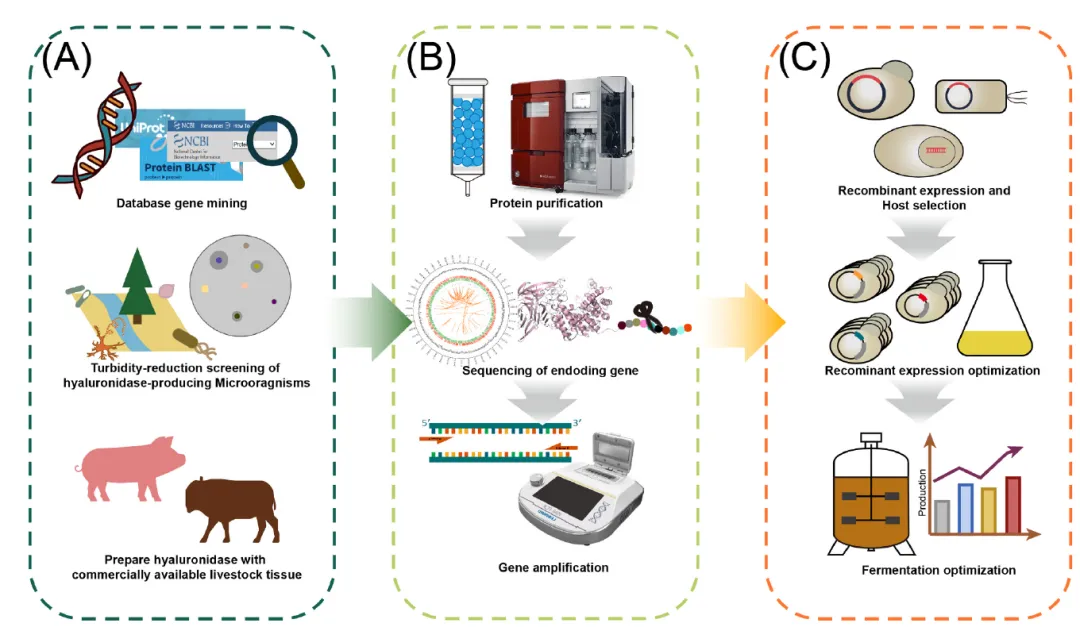
Figure 3. Recombinant hyaluronidase acquisition process (A) Mining new hyaluronidase from natural resources or databases; (B) Decoding the sequence of a novel hyaluronidase; (C) Realize high-level production of recombinant hyaluronidase
To ensure product safety and efficacy, three key attributes must be strictly controlled:
Purity and Activity: Verify purity using SDS-PAGE and HPLC; determine specific activity via the USP substrate method to ensure stable activity.
Impurity Removal: Detect HCP residues by ELISA, endotoxins by the limulus amebocyte lysate (LAL) test, and host cell DNA by PCR to avoid adverse reactions.
Structural Integrity: Analyze secondary structure using circular dichroism (CD); verify molecular weight and glycosylation modifications via mass spectrometry to ensure consistency with natural proteins.
The purification process of hyaluronidase has achieved a leap from "animal extraction" to "recombinant production". Through the application of multi-step chromatography, tag technology, and new resins, it has addressed the purity and safety issues of traditional processes. In the future, with the development of continuous chromatography and high-throughput screening technologies, the process will further advance toward high efficiency and low cost, laying a more solid technical foundation for the wide application of hyaluronidase in medicine, cosmetology, and other fields.












 Business license (three certificates in one)