As a core force in tumor immunotherapy, PD-L1-targeting antibodies restore the ability of T cells to kill tumor cells by blocking the immunosuppressive binding between PD-L1 and PD-1. Currently, they have become the standard treatment for 16 specific cancer types and tissue-agnostic indications. Based on the review in Nature Reviews Drug Discovery and global clinical trial data from IQVIA, this article systematically sorts out the latest developments in the clinical development of PD-L1 antibodies, analyzing innovations in combination therapies, changes in trial design, and differences in regional recruitment, so as to provide key references for understanding the development context of this field.
Since the first survey in September 2017, the U.S. FDA has added 23 new approvals for PD-L1 monoclonal antibodies (mAbs) and PD-1/PD-L1 combination therapies. Globally, with the advancement of PD-L1-targeted drug research and development, combined with the launch of 4 new PD-1 antibodies (which together with PD-L1 antibodies form a targeted pathway drug matrix), the total number of approved PD-L1-related antibody drugs has now reached 9. These drugs cover multiple cancer types such as melanoma, non-small cell lung cancer (NSCLC), renal cell carcinoma (RCC), and endometrial carcinoma, marking the transition of PD-L1-targeted therapy from "early exploration" to the stage of "broad clinical application".
Since 2006, a total of 3,362 PD-L1-related clinical trials have been initiated worldwide, including PD-L1 mAb monotherapy, combination of PD-L1 and PD-1 antibodies, and combination of PD-L1 antibodies with other therapies. As of September 2019, 2,975 trials were still in active progress, planning to enroll more than 500,000 patients. Compared with the same period in 2017, 1,469 new active trials were added, covering almost all cancer types and treatment stages (from advanced second-line therapy to first-line adjuvant therapy), fully demonstrating the rapid development momentum of the PD-L1-targeted field.
Currently, 76% of active PD-L1-related clinical trials are exploring the potential of combining PD-L1 antibodies with other therapies, including tumor immunotherapies (e.g., CTLA-4 antibodies), targeted therapies (e.g., VEGF inhibitors), chemotherapy, or radiotherapy. This transition stems from the limitations of PD-L1 mAb monotherapy: some patients have primary resistance due to factors such as strong immunosuppression in the tumor microenvironment and low PD-L1 expression levels. In contrast, combination therapies can break the immunosuppressive microenvironment through multi-mechanism synergy and improve the treatment response rate.
The PD-L1-related combination regimens approved by the FDA in recent years have provided important directions for the development of this field. Firstly, the combination of PD-L1 antibodies with targeted therapies, such as avelumab combined with axitinib, which was approved for the treatment of RCC. This combination improves the disorder of tumor blood vessels through VEGF pathway inhibition, thereby enhancing the infiltration of immune cells mediated by PD-L1 antibodies. Secondly, the triple combination regimen of PD-L1 antibodies, targeted therapies, and chemotherapy, such as atezolizumab combined with bevacizumab and chemotherapy, which was approved for the treatment of NSCLC. Through the triple mechanisms of "immune activation + vascular regulation + tumor killing", it significantly improves the objective response rate and survival of patients with advanced cancer.
The number of combined targets for PD-L1 antibody combination therapies has reached 295, with 136 new targets added in two years. Among them, the core targets that synergize with PD-L1 focus on three categories: combination with chemotherapy (235 new trials), which enhances the T cell activation effect of PD-L1 antibodies by leveraging the ability of chemotherapy to release tumor antigens; combination with CTLA-4 antibodies (186 new trials), which synergistically relieves the dual inhibition of T cells through dual immune checkpoint blockade; and combination with VEGF-targeted drugs (114 new trials), which has now obtained 4 FDA approvals and is one of the most mature strategies in PD-L1 antibody combinations .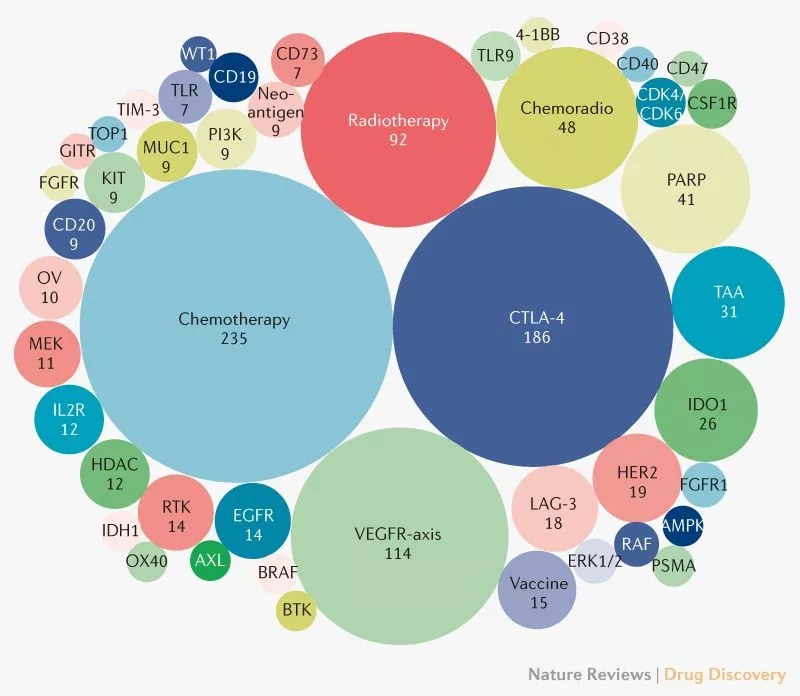
Between 2014 and 2019, the average planned enrollment per PD-L1-related clinical trial decreased from 429 patients to 129 patients, a drop of 65%. The core reason is that early PD-L1 antibody clinical trials mostly focused on "mainstream cancer types" such as melanoma and NSCLC, which have a large patient base. As PD-L1 treatment regimens for these cancer types gradually mature, new trials have shifted more to rare cancers such as cholangiocarcinoma and neuroendocrine tumors. The total number of patients with such rare cancers is small, which objectively limits the enrollment scale of individual trials and promotes the transition of trial design to "small and precise".
Among the major global clinical trial sites, the recruitment rate of PD-L1 antibody trials in the United States is the lowest. This is presumably because PD-L1-targeted drugs have been widely used as standard treatments, leading to a continuous shrinkage of the potential trial patient pool (patients who have not received PD-L1 treatment). In contrast, the recruitment rate of PD-L1 antibody monotherapy trials in China is approximately 6 times that of the United States, and the recruitment rate of combination therapy trials is about 4 times that of the United States. China has more than 4 million new cancer cases each year, and most patients have not received PD-L1-targeted treatment, resulting in a sufficient number of patients who meet the enrollment criteria, making China a core region for global PD-L1 clinical trial recruitment.
The development of domestically developed PD-L1-related combination therapies in China (such as combination regimens based on domestic PD-1/PD-L1 antibodies) and supporting clinical trials has progressed rapidly. For example, the clinical development of drugs such as sintilimab and toripalimab only took 26-45 months, with rapid recruitment capacity being a key support. With China's accession to the ICH, the clinical trial data of PD-L1 antibodies in China has gained the potential for global mutual recognition, which is expected to support the registration of drugs in other ICH member countries and provide important data and patient resource support for global PD-L1-targeted therapy research and development (Figure 3, reflecting the implementation of PD-L1 antibody clinical trials in different regions).
The current clinical development of PD-L1 antibodies needs to address two core issues. Firstly, there is a lack of specific biomarkers for PD-L1 combination therapies, making it difficult to accurately screen patients who can truly benefit from the treatment, leading to "invalid enrollment" in some trials. Secondly, most patients will develop drug resistance or experience recurrence after receiving PD-L1 antibody treatment. It is urgent to analyze the resistance mechanisms (such as downregulation of PD-L1 expression and immune desertification of the tumor microenvironment) and develop innovative combination regimens to combat resistance (such as combining PD-L1 antibodies with new immune agonists). In addition, the large patient resources in emerging markets are expected to accelerate the verification of new biomarkers and therapies, promoting the development of PD-L1-targeted therapy towards a "more precise and longer-lasting" direction, and ultimately providing better treatment options for cancer patients worldwide.












 Business license (three certificates in one)