




TSLP: The "Key Player" in Immune Regulation – How Much Do You Know?


In the fields of immunology and disease treatment, thymic stromal lymphopoietin (TSLP) is emerging as a rising star. As a pleiotropic cytokine belonging to the short-chain four-α-helix bundle type I IL-2 family, TSLP not only plays a key role in allergic and autoimmune diseases but also demonstrates unique regulatory functions in complex conditions such as cancer and metabolic syndrome.
- Recent Advances
- Reference
In the fields of immunology and disease treatment, thymic stromal lymphopoietin (TSLP) is emerging as a rising star. As a pleiotropic cytokine belonging to the short-chain four-α-helix bundle type I IL-2 family, TSLP not only plays a key role in allergic and autoimmune diseases but also demonstrates unique regulatory functions in complex conditions such as cancer and metabolic syndrome. Its dual isoform structure, multi-cell type mechanism of action, and broad impact across the disease spectrum make it a hot target for current drug development.
I. Biological Characteristics of TSLP: Dual Dimensions from Structure to Function
TSLP exists in two forms: a long isoform (lfTSLP, 159 amino acids) and a short isoform (sfTSLP, 63 amino acids). The long isoform is induced by Toll-like receptor (TLR2/3/6) ligands, pro-inflammatory cytokines (IFN-γ, TNF-α), or viral stimulation, and is closely associated with allergic diseases, chronic inflammation, and cancer; the short isoform is stably expressed in multiple tissues and participates in maintaining immune homeostasis. For example, in asthma patients, respiratory viruses activate bronchial epithelial cells via TLR3, significantly upregulating lfTSLP expression, while the synthesis of sfTSLP can partially counteract its pro-inflammatory effects.
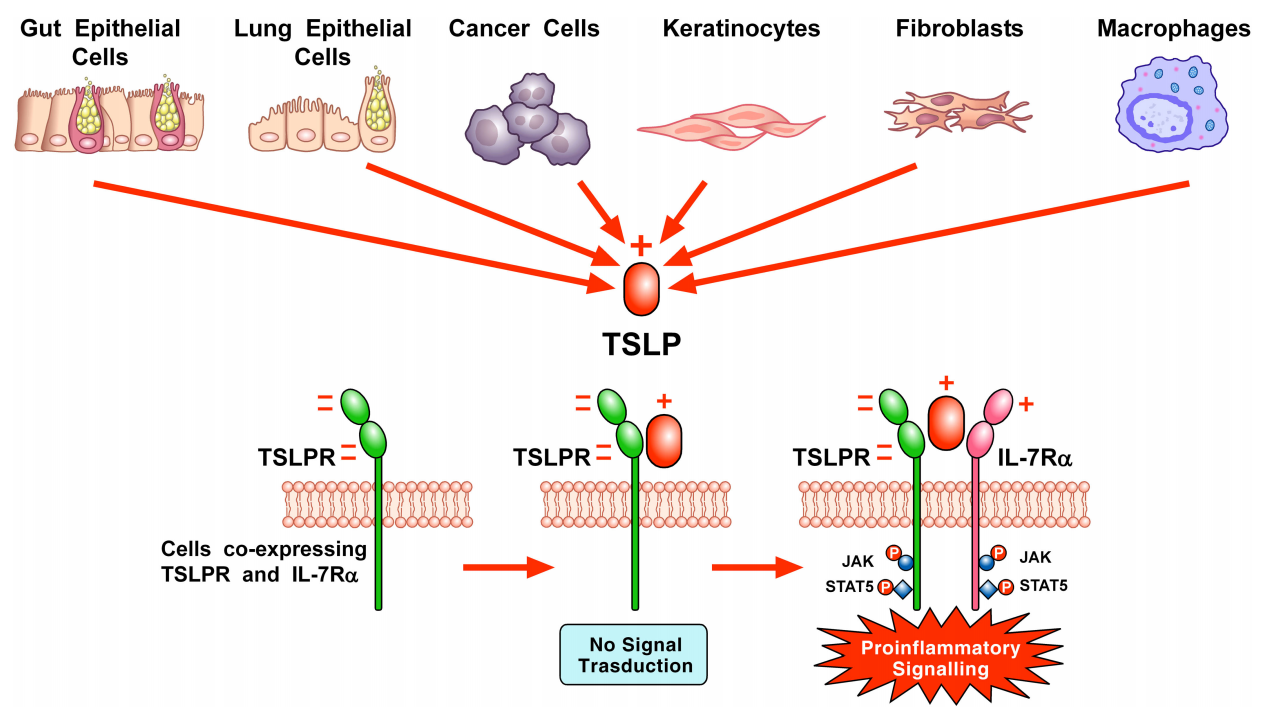
The TSLP receptor complex consists of TSLPR (thymic stromal lymphopoietin receptor) and IL-7Rα. When TSLP binds to TSLPR, the addition of IL-7Rα forms a ternary complex, activating the JAK1/JAK2-STAT5 signaling pathway and driving the production of pro-inflammatory cytokines such as IL-4, IL-5, and IL-13. This mechanism makes TSLP the "master switch" of type 2 inflammatory responses – in asthma, it can directly promote dendritic cell (DC) maturation and induce the differentiation of naïve T cells into Th2 cells; in atopic dermatitis (AD), TSLP released by keratinocytes activates the receptor complex on sensory neurons, directly triggering intense itching.
II. Clinical Translation: Cross-Domain Breakthroughs from Asthma to Cancer
1. Asthma Treatment: The First Phenotype-Agnostic Biologic
The central role of TSLP in asthma has been validated by the world's first anti-TSLP monoclonal antibody, Tezepelumab (Tezspire). This drug significantly reduces the risk of asthma exacerbations by blocking the formation of the TSLPR-TSLP-IL-7Rα ternary complex. Unlike traditional biologics (such as anti-IgE, anti-IL-5) that only target specific phenotypes (e.g., eosinophilia), Tezepelumab is suitable for a broad range of severe asthma patients, regardless of their phenotype or biomarker status. In 2023, its global sales reached $567 million, and it is projected to exceed $2 billion by 2026.
2. Atopic Dermatitis: A Novel Target for the Itch Mechanism
TSLP expression in lesional skin of AD patients is more than 10 times higher than in normal skin. TSLP not only drives the Th2 immune response by activating DCs but also directly stimulates nerve endings to produce itching. Currently, Tezepelumab is undergoing Phase III clinical trials for moderate-to-severe AD (NCT02525094), with preliminary data showing significant improvement in patients' Dermatology Life Quality Index (DLQI) scores. Domestic companies like Biosion are also advancing their candidates, such as Bosakitug (BSI-045B), which has entered Phase II trials for AD, with a differentiated design aimed at improving drug penetration in skin tissue.
3. Cancer Therapy: The Dual Role of Promoting and Suppressing Cancer
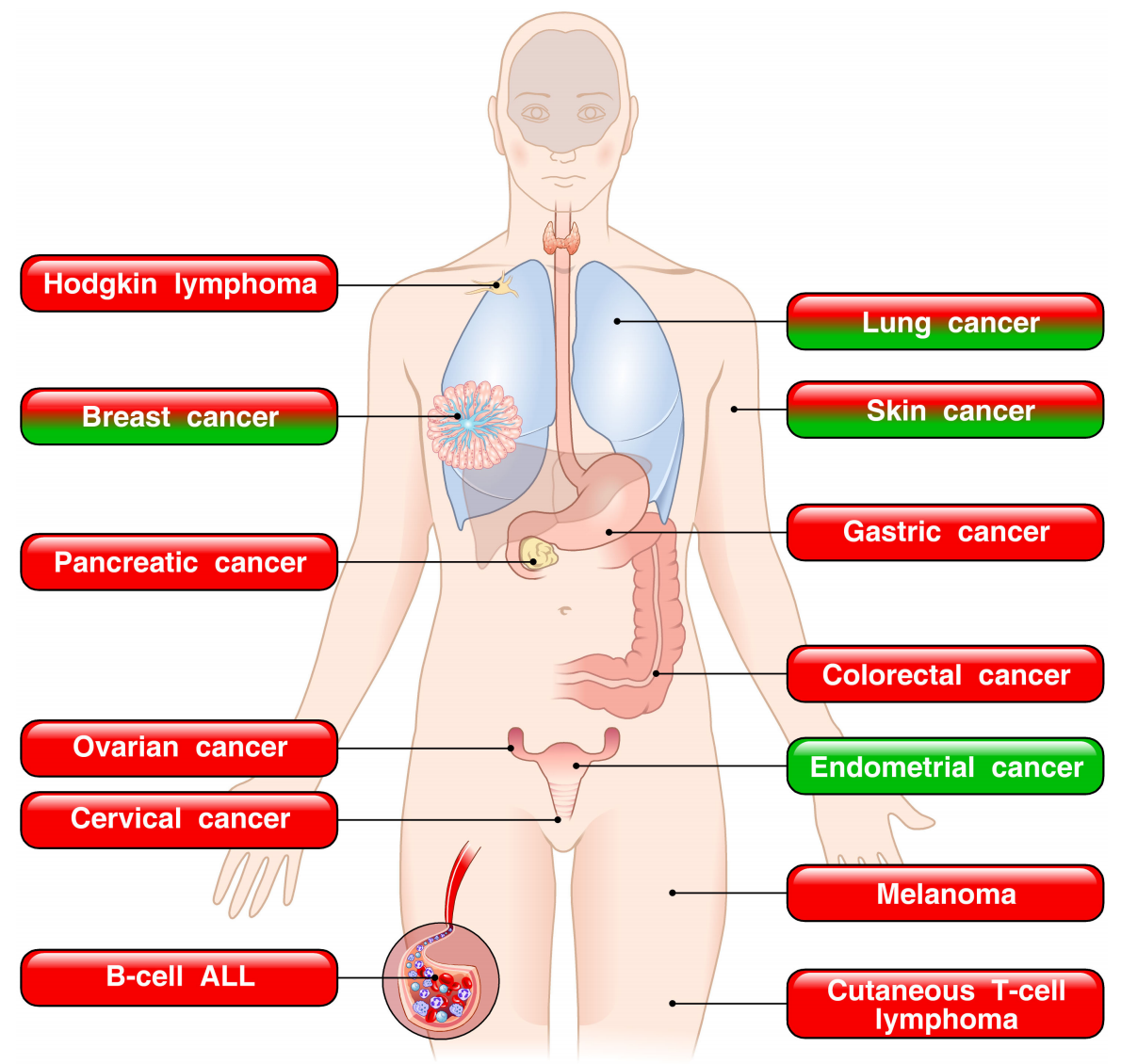
The dual role of TSLP in human tumors. Red boxes indicate tumor types where TSLP has been confirmed to promote tumor growth. Green boxes indicate tumor samples where it may have a protective effect. Mixed red/green boxes indicate that TSLP has both promoting and inhibiting effects on tumor growth in various experimental and human cancers.
The role of TSLP in cancer is controversial. For instance, in breast cancer, IL-1α secreted by tumor cells increases circulating neutrophil numbers by inducing bone marrow hematopoiesis while upregulating TSLP expression, promoting tumor cell survival; whereas in cutaneous T-cell lymphoma, TSLP can activate CD8+ T cells to directly kill tumor cells. This paradox may be related to differences in TSLP isoforms – the long isoform might promote immune escape by establishing a Th2-type tumor microenvironment, while the short isoform might inhibit tumor progression by maintaining immune homeostasis. Current research on TSLP-targeted cancer therapy is focusing on isoform-specific regulation strategies.
III. R&D Frontiers: Innovation from Single-Target to Combination Therapies
1. Next-Generation Antibody Drugs
Amgen/AstraZeneca are developing the long-acting anti-TSLP monoclonal antibody AIO-001, which has a half-life 3 times longer than Tezepelumab, allowing for dosing every 8 weeks. Domestic companies like Hengrui Pharmaceuticals are advancing TSLP target development through a license-out model; the global rights for their AIO-001, licensed to Aiolos, have brought in a $21.5 million upfront payment and over $1 billion in potential milestone payments.
2. Oral Small Molecule Inhibitors
Oral drugs targeting the TSLP signaling pathway are on the rise. For example, TAK-279 (an oral TYK2 inhibitor) in a Phase II trial for rheumatoid arthritis (RA) showed ACR20 response rates of 53.3% and 54.2% in the 15mg and 30mg groups, respectively, significantly better than the placebo group (29.2%). Such drugs can avoid the immunogenicity issues associated with injectable formulations and are particularly suitable for primary care markets.
3. Exploration of Combination Therapies
Combinations of TSLP inhibitors with JAK inhibitors and IL-4/IL-13 inhibitors are undergoing clinical trials. For instance, a Phase II trial of Tezepelumab combined with Dupilumab (anti-IL-4Rα) in severe asthma patients showed that the combination group had a 42% lower annual exacerbation rate compared to the monotherapy group, without increasing the risk of infection.
IV. Challenges and Future: TSLP Regulation in the Era of Precision Medicine
Although the TSLP target holds great promise, it still faces three major challenges:
-
Isoform-Specific Regulation: There is a need to develop detection technologies and drugs that distinguish between lfTSLP and sfTSLP to avoid immune homeostasis imbalance caused by "one-size-fits-all" inhibition.
-
Cross-Disease Mechanism Elucidation: For example, TSLP expression is downregulated in hypertensive disorders of pregnancy (such as preeclampsia), potentially disrupting maternal-fetal immune tolerance by affecting regulatory T cell (Treg) differentiation, but its specific mechanism requires further study.
-
Biomarker Development: The efficacy prediction of TSLP inhibitors still relies on empirical use; future precision medicine models need to be established based on genetic polymorphisms (such as the TSLP gene single nucleotide polymorphism rs1837253) or protein expression levels.
From asthma to cancer, from monoclonal antibodies to oral drugs, TSLP is reshaping the treatment landscape for immune-related diseases with its unique biological characteristics. As research into isoform functions, cross-disease mechanisms, and combination therapies deepens, this "versatile target" is expected to bring breakthrough treatment options to more patients.
Related Product Recommendations:
| Product Number | Product Name | Expression System |
|---|---|---|
| S0A0169 | Human TSLP Protein, His tag | HEK293 |
| UA040105 | TSLP (R127A, R130A) His Tag Protein, Human | HEK293 |
| UA010907 | TSLPR Fc Chimera Protein, Human | HEK293 |
| UA010490 | TSLPR His Tag Protein, Human | HEK293 |
Related Articles Recommendation:
➷The World's Top Three Pharma Giants Hunting IL-33: Who Will Cross the COPD Finish Line First?
This article is reviewed and published by the technical expert team of UA
Disclaimer: This article partially utilizes artificial intelligence assistance in its creation. If any content involves copyright or intellectual property issues, please let us know and we promise to verify and remove it as soon as possible.
Purchase recombinant protein, choose Nanjing UA-Bio
UA protein focuses on providing various protein reagents, raw materials, and services required for drug research and development, cell therapy, gene therapy, and basic scientific research, including drug target proteins, immune checkpoint proteins, cytokines, tool enzymes, customized protein expression, and full-length transmembrane protein development. Youai is committed to providing customers with high-quality products and professional services, and building a High-tech Biological Enterprise with International Competitiveness.

-
Remo Poto; Gianni Marone; Steven F. Ziegler; Gilda Varricchi. TSLP: contrasting roles in cancer. Frontiers in Immunology. 2025.
-
Steven F. Ziegler; David Artis. Sensing the outside world: TSLP regulates barrier immunity. Nature Immunology. 2010.






 Business license (three certificates in one)