




Immunological core mechanism: How MHC peptide complexes achieve antigen presentation and T cell immune response?


The major histocompatibility complex (MHC) was initially discovered for its role in organ transplant rejection, but with the development of immunology, we gradually realize that its more fundamental function is to participate in antigen presentation. MHC molecules can be divided into class I, class II, and class III, among which class I and class II glycoproteins form complexes on the cell surface, which can bind to antigenic peptides and present them to T cells, thereby initiating specific immune responses. This mechanism not only helps distinguish between "self" and "non self", but also plays a key role in infections, tumors, and autoimmune diseases.
- Recent Advances
- Product Information
Introduction: Why is MHC Considered the "Molecular Bridge" of Adaptive Immunity?
The major histocompatibility complex (MHC) was initially discovered for its role in organ transplant rejection. However, with advancements in immunology, we have come to recognize its more fundamental function in antigen presentation. MHC molecules can be divided into classes I, II, and III. Among them, class I and II glycoproteins form complexes on the cell surface, capable of binding antigenic peptides and presenting them to T cells, thereby initiating specific immune responses. This mechanism not only helps distinguish "self" from "non-self" but also plays a critical role in infections, tumors, and autoimmune diseases. So, how exactly does the MHC-peptide complex achieve this intricate process?
What Is the Basic Structure of the MHC-Peptide Complex?
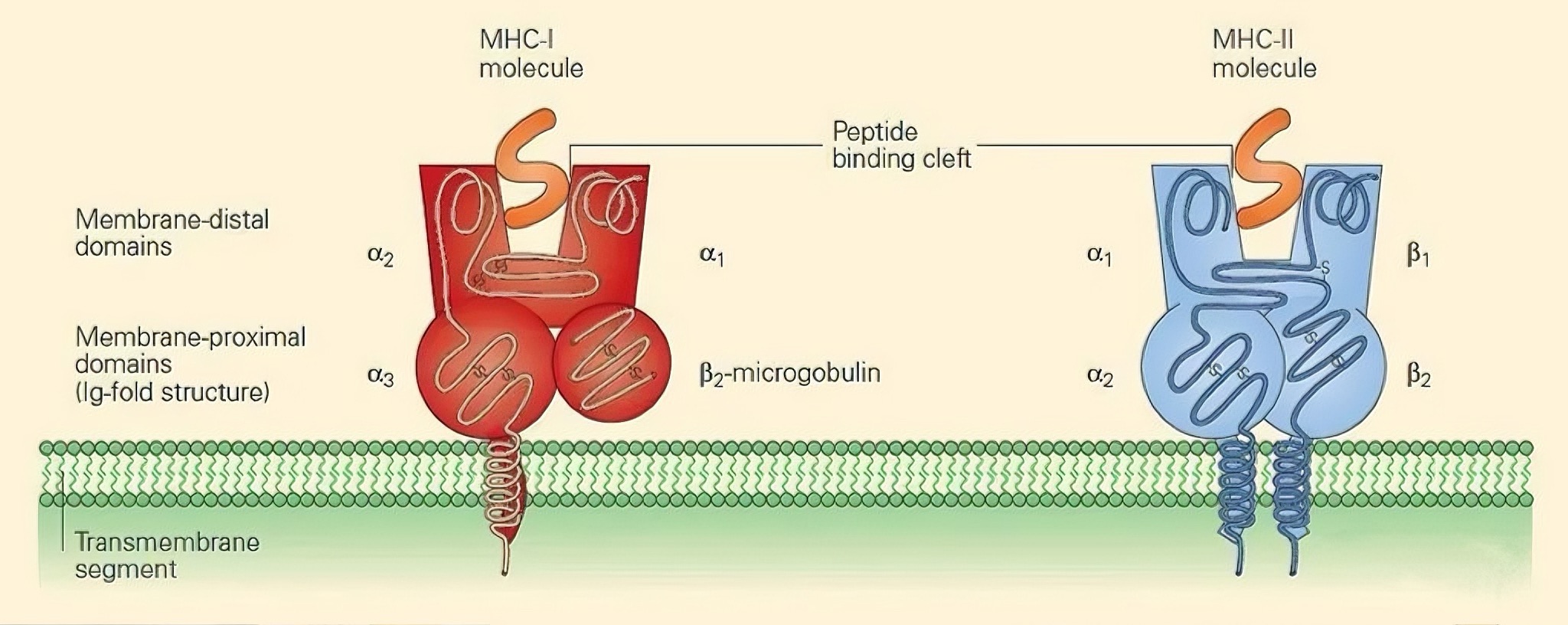
MHC molecules exhibit significant structural conservation. Their peptide-binding region forms an open "groove" structure that can accommodate peptides approximately 8–20 amino acids in length. MHC class I molecules consist of a polymorphic α chain non-covalently bound to a non-polymorphic β₂-microglobulin. Their groove is closed at both ends, making it suitable for binding shorter peptides (typically 8–10 amino acids). MHC class II molecules, on the other hand, are composed of both α and β chains, with an open-ended groove that can accommodate longer peptides (typically 13–25 amino acids). This structural difference determines the division of labor between the two classes of molecules in terms of antigen source and presentation targets.

How Do MHC Molecules Achieve Their Extreme Diversity and Peptide-Binding Specificity?
The MHC gene cluster is characterized by polygenicity and high polymorphism. The human MHC (i.e., the HLA complex) is located on the short arm of chromosome 6 and contains over 200 genes. Among them, the classical class I genes (HLA-A, B, C) and class II genes (HLA-DR, DQ, DP) exhibit extremely rich allelic variation. For example, it is currently known that the HLA-B locus has over 4,800 alleles. This diversity results in differences in the charge distribution and spatial conformation of the peptide-binding grooves of MHC molecules expressed by different individuals, enabling them to bind and present a wide variety of peptides. This significantly enhances the ability of populations to respond to pathogens.
How Do the Presentation Pathways of Endogenous and Exogenous Antigens Differ?
Depending on the source of the antigen, the formation pathways of MHC-peptide complexes are divided into endogenous and exogenous pathways:
Endogenous antigens (such as viral proteins or tumor antigens) are degraded into short peptides by proteasomes in the cytoplasm. These peptides are then transported into the endoplasmic reticulum via TAP transporters, where they bind to assembling MHC class I molecules. The complex is subsequently transported to the cell membrane via the Golgi apparatus for recognition by CD8⁺ T cells.
Exogenous antigens (such as extracellular bacteria or soluble proteins) are internalized by antigen-presenting cells (APCs) and enzymatically digested into peptides in endosomes/lysosomes. Meanwhile, MHC class II molecules bind to the invariant chain (Ii) in the endoplasmic reticulum to prevent premature peptide binding. Upon entering late endosomes, the Ii chain is degraded, leaving only a short peptide called CLIP in the groove. The HLA-DM molecule then assists in replacing CLIP with an antigenic peptide. Finally, the complex is expressed on the cell surface for recognition by CD4⁺ T cells.
Why Is MHC Restriction Key to T Cell Activation?
T cells can only recognize antigenic peptides presented by self-MHC molecules, a phenomenon known as MHC restriction. CD8⁺ T cells typically recognize endogenous peptides bound to MHC class I molecules, while CD4⁺ T cells recognize exogenous peptides bound to MHC class II molecules. This mechanism ensures the specificity of immune responses while preventing attacks on normal self-cells. MHC polymorphism further enhances the diversity of pathogen responses at the population level, enabling certain individuals to exhibit greater resistance to specific infections or diseases due to carrying particular HLA alleles.
What Is Linkage Disequilibrium, and How Does It Impact HLA Typing and Disease Research?
Linkage disequilibrium refers to the non-random co-inheritance of alleles at different MHC gene loci within a population. For example, in Northern European populations, alleles such as HLA-A01, B08, and DRB1*03 often appear together as haplotypes. This allows the prediction of alleles at other loci by detecting alleles at one gene locus in organ matching or disease association studies, improving matching efficiency and research operability. Certain autoimmune diseases (such as celiac disease with HLA-DQ2/DQ8) and infectious diseases (such as HIV control with HLA-B*57) have been found to be significantly associated with specific HLA haplotypes.
What Is the Clinical Value of MHC-Peptide Complexes?
Based on the mechanism of MHC-peptide interactions, several important clinical applications have been developed:
Vaccine Design: By predicting and screening pathogen peptides that bind with high affinity to common HLA molecules, peptide vaccines or mRNA vaccines can be constructed to enhance T cell immune responses.
Cancer Immunotherapy: Tumor-specific antigen peptides (TSAs) or tumor-associated antigens (TAAs) are used to form complexes with autologous MHC molecules. Specific T cells are expanded in vitro and then reinfused into patients (e.g., TCR-T therapy).
Diagnosis and Intervention in Autoimmune Diseases: Certain autoimmune diseases are triggered by specific HLA conformations presenting self-antigens (e.g., rheumatoid arthritis with HLA-DR4). Intervention can be achieved by blocking the formation of relevant MHC-peptide complexes.
Transplant Matching: High-resolution HLA typing can significantly reduce the risk of graft-versus-host disease (GVHD) and rejection.
Conclusion: What Is the Future Direction of MHC-Peptide Complex Research?
Although we have a deep understanding of the mechanism of MHC-mediated antigen presentation, this field still faces many challenges. These include exploring the functions of non-classical MHC molecules (such as HLA-E and G), refining the mechanism of cross-presentation by MHC class I molecules, and precisely designing MHC-peptide complexes for personalized immunotherapy. By integrating structural biology, multi-omics, and artificial intelligence methods, we hope to more comprehensively reveal the regulatory network of MHC in immune responses, providing a theoretical foundation for new vaccines and immunotherapies.
This article is reviewed and published by the technical expert team of UA
Disclaimer: This article partially utilizes artificial intelligence assistance in its creation. If any content involves copyright or intellectual property issues, please let us know and we promise to verify and remove it as soon as possible.
Purchase recombinant protein, choose Nanjing UA-Bio
UA protein focuses on providing various protein reagents, raw materials, and services required for drug research and development, cell therapy, gene therapy, and basic scientific research, including drug target proteins, immune checkpoint proteins, cytokines, tool enzymes, customized protein expression, and full-length transmembrane protein development. Youai is committed to providing customers with high-quality products and professional services, and building a High-tech Biological Enterprise with International Competitiveness.







 Business license (three certificates in one)