




Mass spectrometry grade trypsin - 'cut' to obtain good data


Mass spectrometry trypsin is a serine peptide endonuclease produced through genetic engineering technology. It can specifically cleave the carboxyl terminal peptide bonds of lysine (K) and arginine (R)
- Recent Advances
- Product Information
Product Characteristics
Mass spectrometry-grade trypsin is a serine endopeptidase produced through genetic engineering technology. It specifically cleaves peptide bonds at the carboxyl terminus of lysine (K) and arginine (R), exhibiting the following key properties:
Animal Origin-Free: Manufactured without any animal-derived raw materials, eliminating the risk of exogenous viral contamination.
High Purity and Activity: Exhibits high purity, specific activity, and low levels of host protein residues.
Batch-to-Batch Consistency: Ensures stable and reproducible quality across production lots.
Application Scenarios
Post-Translational Modification (PTM) Analysis: Under low pH conditions, recombinant trypsin suppresses non-enzymatic modifications (e.g., deamidation, disulfide bond scrambling) while efficiently cleaving proteolysis-resistant sites, enabling accurate PTM localization.
Protein Identification and Quantification: By specifically cleaving lysine (K) and arginine (R) residues, it digests complex protein samples into peptides detectable by mass spectrometry, facilitating precise protein identification via database matching.
Exosome and Single-Cell Proteomics: Exosomes, as intercellular communication carriers, require highly sensitive digestion protocols. Combining recombinant trypsin with Lys-C significantly improves peptide recovery from exosome samples, advancing liquid biopsy technologies.
Choose Excellence and Reliability
Trypsin, Mass Spectrometry Grade (Product Code: UA070130)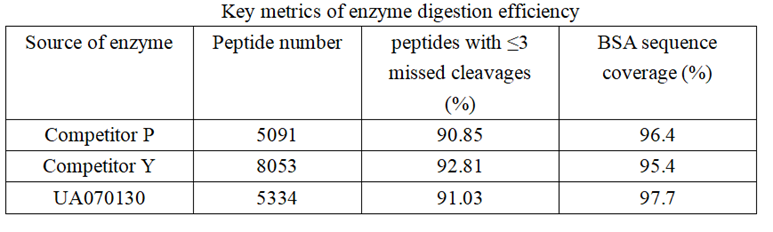
In terms of sequence coverage, UA070130 demonstrates a slight advantage, with enzyme P and enzyme Y exhibiting coverage values that are 1.3% and 2.3% lower, respectively. However, when considering peptides with no more than three missed cleavage sites, a different trend emerges. Enzyme Y yields the highest proportion, followed by enzymes UA070130 and P, which show marginally lower values. These results indicate that the three enzymes display comparable efficacy in protein digestion.
This article is reviewed and published by the technical expert team of UA
Disclaimer: This article partially utilizes artificial intelligence assistance in its creation. If any content involves copyright or intellectual property issues, please let us know and we promise to verify and remove it as soon as possible.
Purchase recombinant protein, choose Nanjing UA-Bio
UA protein focuses on providing various protein reagents, raw materials, and services required for drug research and development, cell therapy, gene therapy, and basic scientific research, including drug target proteins, immune checkpoint proteins, cytokines, tool enzymes, customized protein expression, and full-length transmembrane protein development. Youai is committed to providing customers with high-quality products and professional services, and building a High-tech Biological Enterprise with International Competitiveness.







 Business license (three certificates in one)