




Light controlled biomolecule aggregates: a new era of dynamic regulation of natural product synthesis


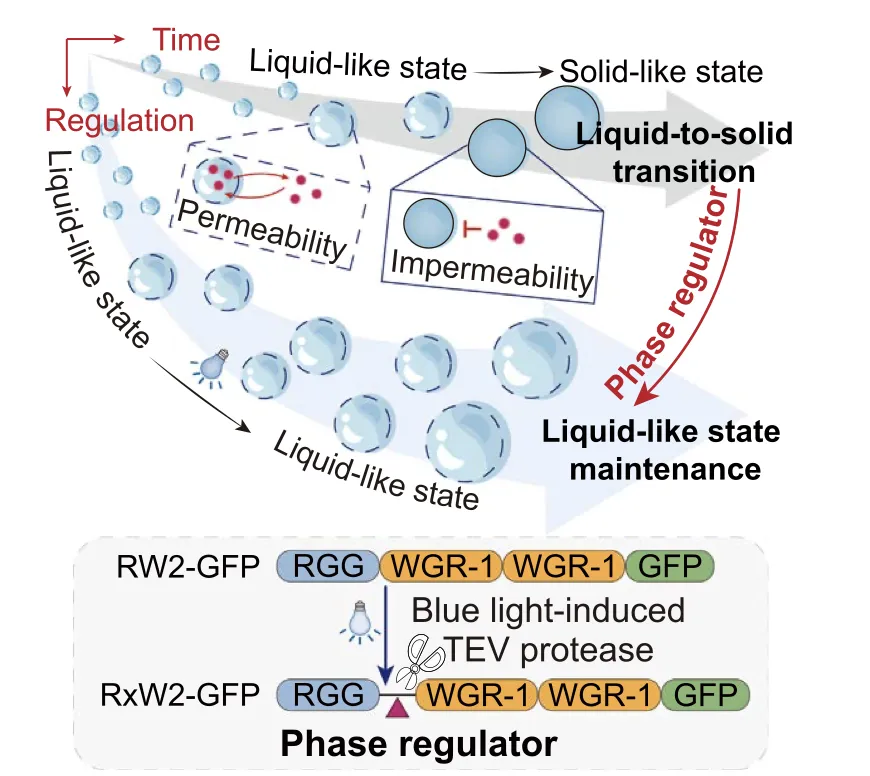
Light controlled biomolecule aggregation technology is an innovative method that precisely regulates the physical state of artificially constructed protein aggregates through a light induced protease system. This technology utilizes blue light to activate Tobacco Etch Virus Protease (TEV protease), which cleaves natural disordered protein domains (IDPs) at specific locations, thereby achieving a reversible transition of condensed matter from solid to liquid state.
- Recent Advances
What is Light-Controlled Biomolecular Condensate Technology?
Light-controlled biomolecular condensate technology is an innovative method that enables precise regulation of the physical state of artificially constructed protein condensates through a light-inducible protease system. This technology utilizes blue light to activate Tobacco Etch Virus Protease (TEV protease), which cleaves intrinsically disordered protein domains (IDPs) at specific sites, enabling reversible transitions of the condensates from a solid to a liquid state. This dynamic regulatory capability effectively addresses the issue of gradual solidification of traditional condensates during fermentation, providing a new strategy for the efficient synthesis of natural products.
How Does TEV Protease Function in This Technology?
TEV protease is a highly specific protease capable of recognizing and cleaving a particular amino acid sequence (e.g., ENLYFQ↓S). In this technology, researchers embedded TEV protease recognition sites into the artificially designed condensate protein RGG-(WGR-1)n. Blue light induces the expression of TEV protease, which cleaves the protein structure at specific time points, reducing the protein's valency and local concentration, thereby reversing the solidification process of the condensates. This cleavage restores the fluidity of the condensates, enhances the diffusion efficiency of substrates and enzymes, and ultimately significantly improves the synthesis capacity of metabolic products.
Why Is Dynamic Regulation of Condensate Phase State Necessary?
Biomolecular condensates play an important role in synthetic biology by forming membrane-less organelles through liquid-liquid phase separation (LLPS), enriching metabolic enzymes and substrates to enhance reaction efficiency. However, during prolonged fermentation, condensates often gradually transition from a liquid to a solid state, leading to several issues:
Diffusion Limitations: Solid condensates hinder the free diffusion of substrates and products, reducing reaction rates;
Loss of Enzyme Activity: Solidified structures may cause enzyme deactivation or reduced stability;
Cytotoxicity: Solid aggregates may trigger cellular stress responses, disrupting metabolic homeostasis.
Dynamic regulation of the phase state helps maintain the liquid characteristics of condensates, ensuring their efficient operation throughout the fermentation process.
How Does This Technology Enhance the Synthesis Efficiency of Natural Products?
This technology has been applied in Saccharomyces cerevisiae for the synthesis of high-value natural products such as squalene and ursolic acid. The improvement in synthesis efficiency is achieved through the following mechanisms:
Spatial Enrichment of Enzymes: Key enzymes in the synthesis pathway (e.g., ERG20 and IDI1) are recruited into the light-controlled condensates, increasing local concentration to accelerate reactions;
Dynamic Phase State Regulation: Blue light induces TEV protease expression at 24 and 48 hours of fermentation, cleaving condensate proteins to maintain fluidity;
Sustained Metabolic Promotion: Liquid condensates facilitate continuous substrate transfer and enzymatic reactions, avoiding efficiency declines due to solidification.
Experimental results showed that the yields of squalene and ursolic acid increased by 32.4% and 46.4%, respectively, demonstrating the effectiveness of this technology.
What Are the Unique Advantages of the Light-Control System?
The light-control system offers several advantages:
High Spatiotemporal Precision: Blue light irradiation enables precise control of the timing and intensity of TEV protease expression, allowing on-demand regulation;
Low Background Interference: The OptoQ-AMP system, derived from the fungal quinic acid metabolic pathway, exhibits low leakage expression in S. cerevisiae and good compatibility;
Programmability: The phase state of condensates can be flexibly adjusted by varying the timing and frequency of light exposure, adapting to different fermentation stages;
Biocompatibility: Blue light has minimal impact on cell growth and metabolism, avoiding interference with normal physiological functions.
What Are the Application Prospects of This Technology?
Light-controlled biomolecular condensate technology holds broad application potential:
Synthetic Biology: It can be used to optimize the biosynthetic pathways of various natural products (e.g., terpenoids, flavonoids), improving yield and stability;
Medical Research: It provides a new tool for studying protein aggregation mechanisms in neurodegenerative diseases, such as simulating the liquid-solid phase transition of α-synuclein or Tau protein;
Industrial Biotechnology: Integrated with smart sensing systems (e.g., substrate concentration or pH-responsive modules), it enables the construction of fully automated cell factories;
Interdisciplinary Integration: It offers new insights for the design of controllable phase-change materials in materials science and biomedical engineering.
Conclusion
Light-controlled biomolecular condensate technology achieves programmable dynamic regulation of protein condensate phase states through light-inducible precise cleavage by TEV protease, effectively addressing the bottleneck of condensate solidification during fermentation. This technology not only significantly enhances the synthesis efficiency of natural products but also provides innovative methodological support for synthetic biology and metabolic engineering. With further optimization and expanded applications, light-controlled condensate regulation strategies are expected to play an important role in various scientific and industrial fields.
This article is reviewed and published by the technical expert team of UA
Disclaimer: This article partially utilizes artificial intelligence assistance in its creation. If any content involves copyright or intellectual property issues, please let us know and we promise to verify and remove it as soon as possible.
Purchase recombinant protein, choose Nanjing UA-Bio
UA protein focuses on providing various protein reagents, raw materials, and services required for drug research and development, cell therapy, gene therapy, and basic scientific research, including drug target proteins, immune checkpoint proteins, cytokines, tool enzymes, customized protein expression, and full-length transmembrane protein development. Youai is committed to providing customers with high-quality products and professional services, and building a High-tech Biological Enterprise with International Competitiveness.







 Business license (three certificates in one)