




Assembly and dissociation mechanism of SCF ubiquitin ligase complex


The SCF complex consists of two pre assembled sub complexes: one is the CUL1-RBX1 core catalytic module, where CUL1 serves as the scaffold protein and RBX1 is responsible for recruiting E2 ubiquitin binding enzyme; The second is the SKP1 Fbp subunit, where SKP1 acts as a linker protein and the F box protein directly recognizes and binds to degradation determinants (degron) on specific substrates.
- Recent Advances
- Product Information
How is the biosynthesis of multi-subunit complexes usually carried out? What is special about the SCF complex?
The synthesis of many multi-subunit protein complexes (such as ribosomes or proteasomes) is a highly ordered, step-by-step assembly process. The interactions between subunits are strictly regulated to ensure the correct formation and function of the complex. However, the SCF (SKP1–CUL1–F box protein) E3 ubiquitin ligase exhibits strikingly dynamic behavior. As an important member of the cullin-RING ligase (CRL) superfamily, the uniqueness of SCF lies in its ability to undergo continuous and rapid assembly and disassembly, a process dependent on a key regulatory factor—CAND1. By dynamically exchanging its substrate recognition module—the F-box proteins (Fbps, with approximately 70 different variants in humans)—the SCF complex achieves specific ubiquitination of diverse substrates, thereby participating in numerous biological processes including metabolic regulation, hormone signaling, stress responses, and DNA damage repair.
What is the basic structure and function of the SCF complex?
The SCF complex consists of two pre-assembled subcomplexes: one is the CUL1–RBX1 core catalytic module, where CUL1 acts as a scaffold protein and RBX1 recruits the E2 ubiquitin-conjugating enzyme; the other is the SKP1–Fbp subunit, where SKP1 serves as an adaptor protein and the F-box protein directly recognizes and binds to specific degron motifs on substrates. When the two subcomplexes combine, SCF catalyzes the polyubiquitination of target proteins, marking them for degradation by the proteasome. The activity of SCF is also regulated by NEDD8 modification (neddylation): covalent attachment of NEDD8 to the C-terminal domain of CUL1 significantly enhances E3 ligase activity, whereas deneddylation (carried out by the CSN complex) inactivates it.
What role does CAND1 play in the dynamic regulation of SCF?
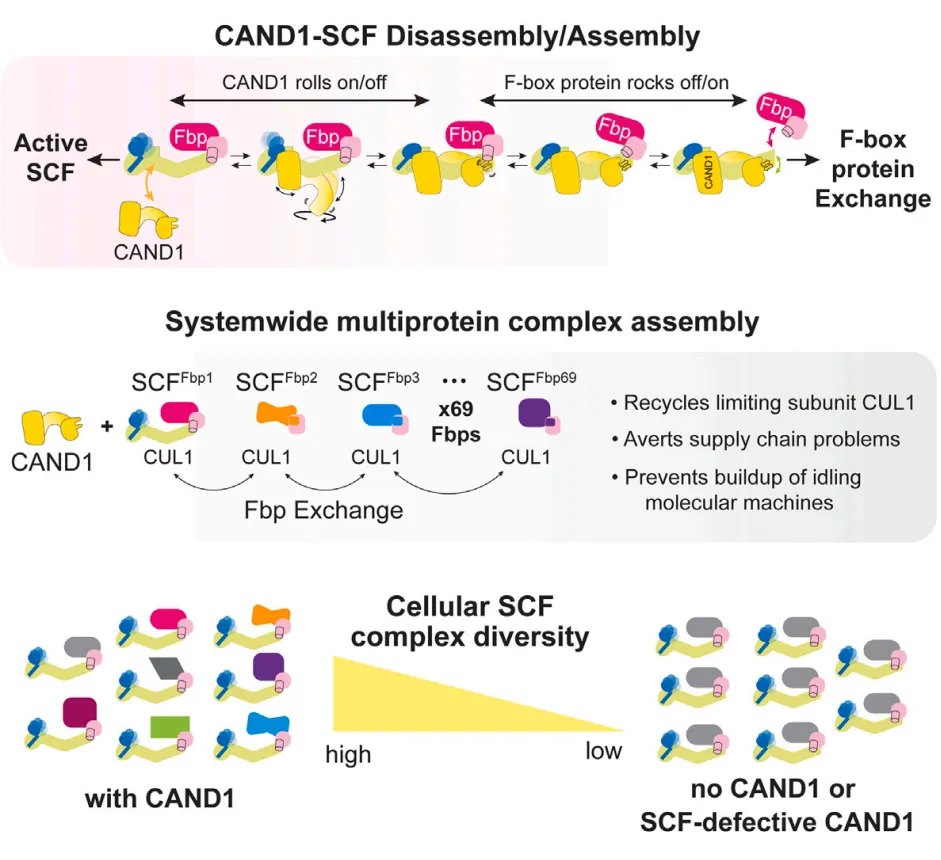
CAND1 is a core regulatory factor in the dynamic turnover of the SCF complex. In vitro, assembled SCF complexes are highly stable, and their spontaneous disassembly takes several days, which is insufficient to meet the cell's need for rapid response to signals. CAND1 recognizes and binds to the unneddylated CUL1–RBX1 complex, promoting the dissociation of the SKP1–Fbp subunit from CUL1 through allosteric regulation, thereby "recycling" the CUL1–RBX1 module for use by new F-box proteins. On the other hand, when there is an abundance of free SKP1–Fbp complexes in the cell, they can competitively displace CAND1 and bind to CUL1–RBX1 to form new, substrate-specific SCF holoenzymes. This competition-based mechanism allows the cell to flexibly and rapidly reconfigure SCF complexes according to demand, enabling it to respond to diverse physiological and stress conditions.
How does CAND1 achieve its disassembly function on SCF at the structural level?
To elucidate the mechanism by which CAND1 regulates SCF, researchers used cryo-electron microscopy (cryo-EM) to resolve the structures of CAND1 in complex with SCF under different states. Structural analysis revealed that CAND1 binds to unneddylated CUL1 through a unique "latch" mechanism: it not only envelops multiple domains of CUL1 but also disrupts the interaction interface between CUL1 and SKP1–Fbp through conformational flipping and allosteric effects, thereby promoting SCF disassembly. Notably, the binding of CAND1 blocks the catalytic active region of CUL1, ensuring the stability of SCF in its inactive state and preventing its erroneous activation. When new SKP1–Fbp complexes become available, their interaction with CUL1 induces conformational changes in CAND1, destabilizing it and causing it to dissociate from CUL1, thereby initiating a new round of SCF assembly.
How do CAND1 and CSN collaborate to maintain SCF function?
CAND1 and the deneddylation enzyme complex CSN work closely together to maintain the dynamic balance of the SCF system. CSN removes NEDD8 modifications from CUL1, inactivating SCF and transitioning it into a "disassembly-ready state," creating conditions for CAND1 binding. CAND1 then further disassembles the inactivated SCF, releasing the CUL1–RBX1 module and SKP1–Fbp subunits, enabling the recycling of each component. This synergistic mechanism effectively prevents spontaneous assembly and overaccumulation of SCF, ensuring that the cell can quickly adjust the composition of the SCF repertoire based on signal input and substrate availability, thereby precisely regulating the protein degradation process.
How does this study advance the understanding of SCF regulatory mechanisms?
This study integrates structural biology (cryo-EM), biochemical analysis, and cellular experiments to systematically reveal, for the first time, the molecular mechanism of CAND1-mediated dynamic assembly and disassembly of SCF. It not only elucidates how CAND1 induces SCF disassembly through allosteric effects but also reveals the competitive binding mechanism between SKP1–Fbp and CAND1 during the assembly of new SCF complexes. These findings deepen our understanding of how large E3 ligase complexes dynamically regulate protein degradation and provide an important theoretical and structural basis for developing strategies to intervene in SCF function (such as anticancer drugs targeting specific F-box proteins).
This article is reviewed and published by the technical expert team of UA
Disclaimer: This article partially utilizes artificial intelligence assistance in its creation. If any content involves copyright or intellectual property issues, please let us know and we promise to verify and remove it as soon as possible.
Purchase recombinant protein, choose Nanjing UA-Bio
UA protein focuses on providing various protein reagents, raw materials, and services required for drug research and development, cell therapy, gene therapy, and basic scientific research, including drug target proteins, immune checkpoint proteins, cytokines, tool enzymes, customized protein expression, and full-length transmembrane protein development. Youai is committed to providing customers with high-quality products and professional services, and building a High-tech Biological Enterprise with International Competitiveness.







 Business license (three certificates in one)