




The key role of FGF9 in the development and function of cerebellar Purkinje cells


Fibroblast growth factor 9 (FGF9), as a type of neurotrophic factor, is widely expressed in the central nervous system and is believed to play a critical role in the differentiation, survival, and maturation of neurons and glial cells. However, its specific function in cerebellar development is still unclear.
- Recent Advances
- Product Information
- Reference
1. What role do Purkinje cells play in cerebellar function, and what are the consequences of their dysfunction?
Purkinje cells are the principal neurons and the sole output neurons in the cerebellar neuronal circuit. They receive input from climbing fibers originating in the inferior olive and parallel fibers from granule cells, integrating sensory and motor information before relaying signals to the cerebellar and vestibular nuclei, thereby regulating motor coordination and influencing multiple neural functions. Studies have shown that loss or dysfunction of Purkinje cells leads to ataxia—a neurodegenerative disorder characterized primarily by loss of motor coordination. Cerebellar ataxia is often autosomal dominantly inherited, exhibits high genetic heterogeneity and clinical overlap, and has a global incidence of approximately 2.7 per 100,000 people. Despite its severe impact on patients' quality of life, the pathogenesis of this disease remains unclear, and effective treatments are lacking.
2. How is FGF9 related to nervous system development, and what are the new findings of this study?
Fibroblast growth factor 9 (FGF9), as a neurotrophic factor, is widely expressed in the central nervous system and is considered crucial for neuronal and glial cell differentiation, survival, and maturation. However, its specific role in cerebellar development remained unclear. Recently, a collaborative study by the teams of Cong Wang and Peijun Li at Wenzhou Medical University, published in iScience, employed neurobiological, molecular biological, and electrophysiological techniques to demonstrate for the first time that FGF9 plays an indispensable role in regulating the development and normal function of cerebellar Purkinje cells. This work provides important insights into the etiology of cerebellar ataxia and the development of new diagnostic and therapeutic strategies.
3. How does FGF9 deficiency affect cerebellar structure and cellular organization?
Using a mouse model with brain-specific knockout of FGF9, the study found that loss of FGF9 led to cerebellar atrophy and significantly disrupted the structure of the interpeduncular fissure in cerebellar lobules VI and VII. Further histological analysis revealed that the absence of FGF9 not only interfered with the normal formation of the Bergmann glial scaffold and the migration of granule neurons but also caused a reduction in Purkinje cell number and disorganized alignment. These structural abnormalities indicate that FGF9 is essential for maintaining cerebellar cytoarchitecture and orderly cellular distribution.
4. How does FGF9 deficiency lead to Purkinje cell death and circuit dysfunction?
To investigate the mechanisms underlying Purkinje cell loss and misalignment, researchers used electron microscopy and observed abnormal chromatin condensation and increased autophagosomes in Purkinje cells lacking FGF9, indicating spontaneous cell death. Additionally, input from climbing fibers derived from the inferior olive is crucial for maintaining spontaneous firing in Purkinje cells. This study showed that loss of FGF9 resulted in the disruption of connections between climbing fibers and Purkinje cells, leading to reduced spontaneous electrical activity, lower action potential thresholds, and ultimately, an imbalance in excitation and inhibition within the cerebellar circuit.
5. Does FGF9 affect neurotransmitter systems, and how is this related to motor abnormalities?
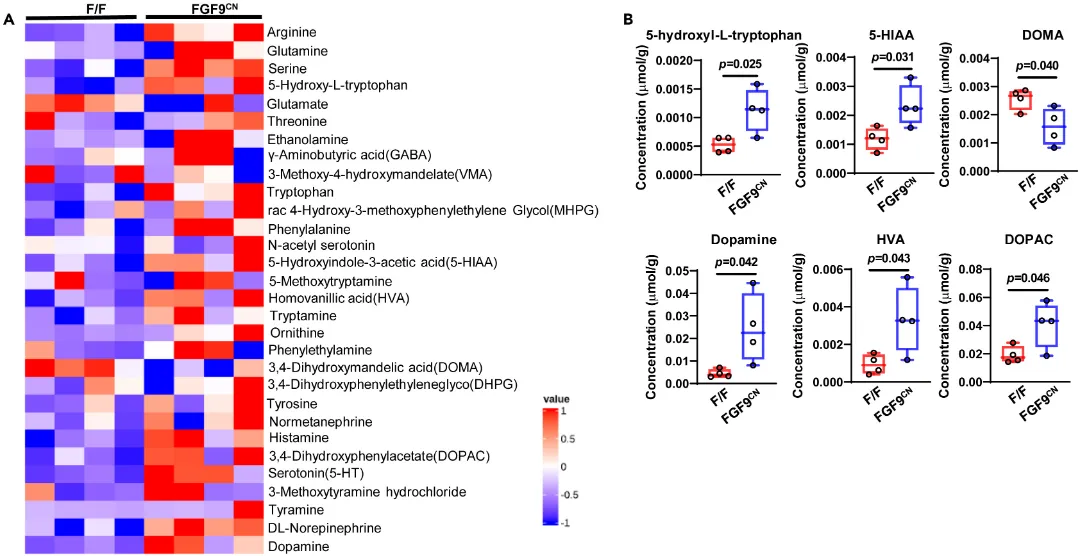
Neurotransmitter metabolomic analysis of cerebellar tissue from 3-month-old FGF9 knockout mice revealed significantly elevated levels of several monoamine neurotransmitters, such as dopamine and its metabolites. Notably, levels of homovanillic acid (HVA) and 5-hydroxyindole-3-acetic acid (5-HIAA) were markedly altered, suggesting that dopaminergic and serotonergic systems may be involved in the dysregulation of neural modulation caused by FGF9 deficiency. Abnormalities in these neurotransmitter systems could be an important biochemical basis for motor coordination impairments and other ataxic symptoms observed in the mice.
6. What are the implications of this study for ataxia treatment, and what questions remain?
This study systematically elucidates the critical role of FGF9 in cerebellar development and motor regulation by promoting Purkinje cell maturation, suppressing neuroinflammation, and ensuring proper positioning of Bergmann glia. The structural and functional abnormalities in the cerebellum resulting from FGF9 deficiency provide new molecular targets and ideas for the clinical diagnosis and treatment of cerebellar ataxia. However, the specific mechanisms through which FGF9 influences the arrangement and interaction of Purkinje cells and Bergmann glia still require further in-depth research. Future studies could focus on the downstream signaling pathways of FGF9 and its cell-specific functions to develop more effective interventions for neurodegenerative diseases.
This article is reviewed and published by the technical expert team of UA
Disclaimer: This article partially utilizes artificial intelligence assistance in its creation. If any content involves copyright or intellectual property issues, please let us know and we promise to verify and remove it as soon as possible.
Purchase recombinant protein, choose Nanjing UA-Bio
UA protein focuses on providing various protein reagents, raw materials, and services required for drug research and development, cell therapy, gene therapy, and basic scientific research, including drug target proteins, immune checkpoint proteins, cytokines, tool enzymes, customized protein expression, and full-length transmembrane protein development. Youai is committed to providing customers with high-quality products and professional services, and building a High-tech Biological Enterprise with International Competitiveness.







 Business license (three certificates in one)