




Targeting IL-13: Addressing the Challenges of Head and Neck Treatment in Atopic Dermatitis


The mechanism by which IL-13 targeted therapy affects paradoxical erythema at the molecular level is still unclear, and further basic research is needed from the perspectives of immune microenvironment and receptor regulation.
- Recent Advances
- Product Information
Q: Why is head and neck atopic dermatitis (AD) particularly difficult to treat, and what are the limitations of current therapies?
Head and neck AD lesions are located in visually sensitive areas, making them susceptible to environmental irritants such as ultraviolet light and microorganisms, resulting in a high recurrence rate and often suboptimal treatment response. Long-term use of topical corticosteroids is limited due to significant side effects, while existing biologics such as anti-IL-4Rα monoclonal antibodies, although widely used for AD, provide insufficient relief in the head and neck region and may even induce "paradoxical erythema," reducing patient compliance. There is an urgent clinical need for long-term treatment options that precisely inhibit inflammatory pathways with a favorable safety profile.
Q: What is the mechanism of action of tralokinumab, and why does its targeting of IL-13 offer unique advantages?
Tralokinumab is a fully human monoclonal antibody that binds with high affinity to IL-13, blocking its interaction with the IL-13Rα1 and IL-13Rα2 receptors, thereby inhibiting the IL-13 signaling pathway. IL-13 is a key cytokine in type II immune responses, directly involved in skin barrier disruption, itch transmission, and inflammatory cell infiltration. Compared to dual-target agents that broadly inhibit both IL-4 and IL-13, tralokinumab's high specificity for IL-13 allows for more precise modulation of the inflammatory process, reducing potential adverse effects associated with broader pathway inhibition.
Q: What clinical evidence supports the long-term efficacy of tralokinumab in head and neck AD?
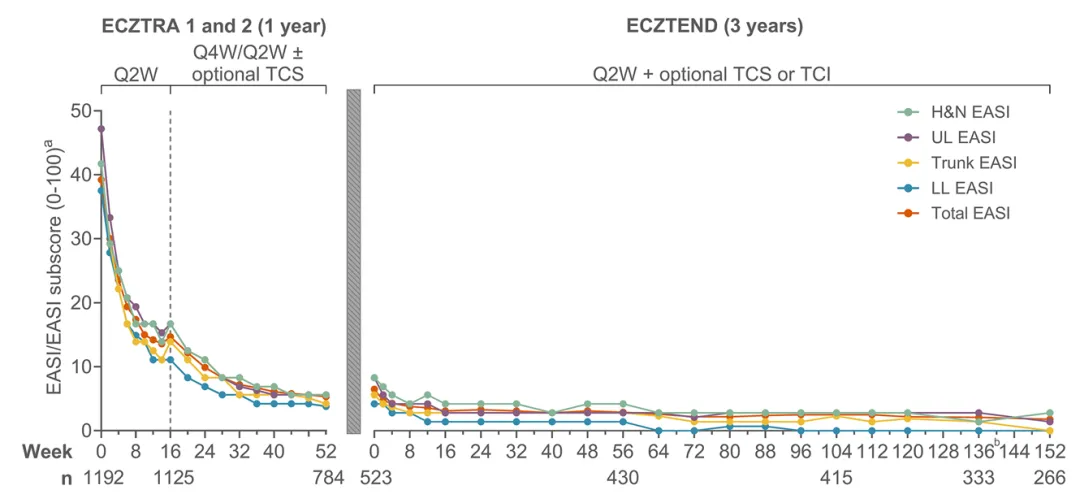
A study published in the American Journal of Clinical Dermatology pooled data from two Phase III trials (ECZTRA 1 and 2) and the extension study ECZTEND, involving over 1,100 patients with moderate-to-severe AD, more than 500 of whom completed up to 4 years of follow-up. The results showed that the median head and neck EASI score significantly decreased from 3.0 at baseline to 1.2 after 16 weeks of tralokinumab treatment, further dropping to 0.4 by week 52, and remaining at a low level of around 0.2 during the extension period. Approximately 80% of patients achieved mild or complete clearance of head and neck lesions over the four-year treatment, confirming the sustained and stable efficacy.
Q: Does the treatment genuinely improve patients' quality of life? What are the specific manifestations?
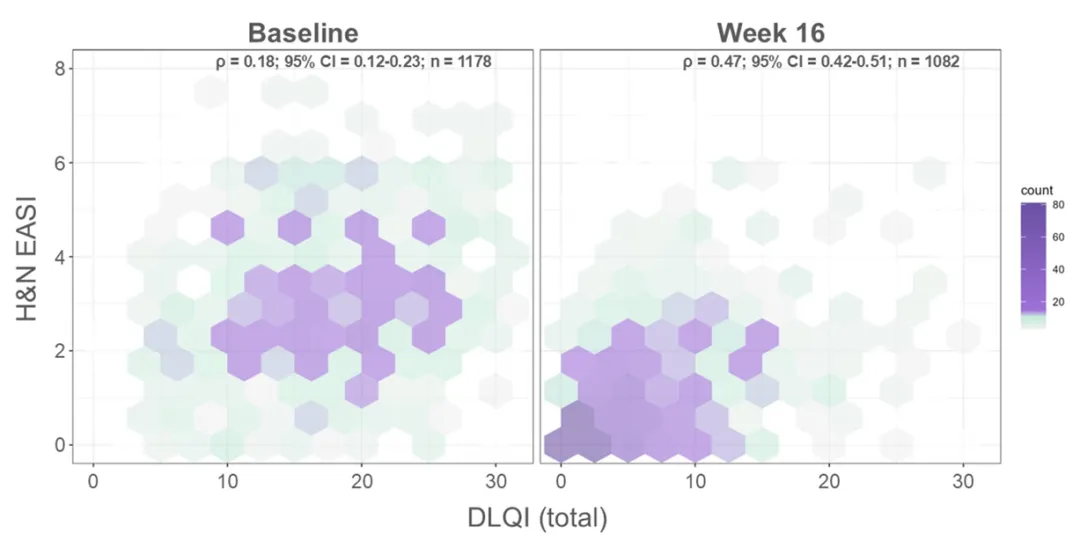
The study assessed quality of life using the Dermatology Life Quality Index (DLQI) and found a moderate correlation between the head and neck EASI score and the total DLQI score at week 16 (ρ=0.47), which was significantly higher than at baseline. The correlation was most pronounced for items related to itch and pain discomfort (DLQI Q1) and psychological embarrassment due to skin appearance (DLQI Q2). After long-term treatment, over 80% of patients reported that the impact of AD on their lives was reduced to "none or mild," indicating substantial improvement in quality of life.
Q: Does tralokinumab worsen head and neck erythema?
The study demonstrated that tralokinumab treatment did not significantly induce "paradoxical erythema" but instead markedly reduced the severity of existing erythema. At baseline, only 10% of patients had no or mild erythema in the head and neck region. After 16 weeks of treatment, this proportion increased to 42%, reaching 75% by week 152. Only about 1% of patients experienced transient and reversible worsening of erythema, most of which gradually resolved with continued treatment without requiring discontinuation.
Q: What implications does the study's conclusion have for future clinical practice?
As an IL-13-specific inhibitor, tralokinumab demonstrates superior long-term efficacy, favorable safety, and tolerability in treating refractory head and neck AD. It is particularly suitable for patients who require alternative treatments due to inadequate response to other biologics or facial erythema reactions. The established correlation between efficacy and quality of life highlights the importance of controlling head and neck lesions in the overall management of AD.
Q: What are the limitations of the current study, and what directions warrant further exploration?
The study population primarily consisted of Caucasians, and future research should include Asian and other ethnic groups to validate its applicability across diverse populations. The absence of a placebo control group in the extension phase necessitates cautious interpretation of the results. Additionally, the molecular mechanisms underlying the impact of IL-13-targeted therapy on "paradoxical erythema" remain unclear and require further basic research from the perspectives of the immune microenvironment and receptor regulation.
This article is reviewed and published by the technical expert team of UA
Disclaimer: This article partially utilizes artificial intelligence assistance in its creation. If any content involves copyright or intellectual property issues, please let us know and we promise to verify and remove it as soon as possible.
Purchase recombinant protein, choose Nanjing UA-Bio
UA protein focuses on providing various protein reagents, raw materials, and services required for drug research and development, cell therapy, gene therapy, and basic scientific research, including drug target proteins, immune checkpoint proteins, cytokines, tool enzymes, customized protein expression, and full-length transmembrane protein development. Youai is committed to providing customers with high-quality products and professional services, and building a High-tech Biological Enterprise with International Competitiveness.







 Business license (three certificates in one)