




Five core issues surrounding the application and principles of the "IdeZ" enzyme


IdeZ (IgG degrading enzyme) is a protease derived from Streptococcus pyogenes that can specifically hydrolyze immunoglobulin G (IgG).
- Recent Advances
- Product Information
1. What is the IdeZ enzyme, and what is its fundamental mechanism of action?
IdeZ (IgG degrading enzyme) is a protease derived from Streptococcus pyogenes that specifically hydrolyzes immunoglobulin G (IgG). By cleaving the hinge region of the IgG heavy chain, it disrupts the antibody’s structure and neutralizes its immune activity. Compared to the commonly used IdeS enzyme (from the same bacterium), IdeZ demonstrates superior pH stability and enzymatic efficiency, making it particularly suitable for targeted antibody processing in in vitro diagnostics and biopharmaceutical production. Its activity is independent of cofactors and remains high across a broad temperature range (4°C–37°C), offering great operational flexibility in both experimental and industrial settings.
2. What is the value of IdeZ in the preparation of antibody fragments?
During the development and production of monoclonal antibody drugs, it is often necessary to generate antigen-binding fragments (such as Fab or F(ab′)₂) for use in immunoassays, imaging probes, or minimized therapeutic formulations. Traditional enzymatic methods (e.g., using pepsin or trypsin) suffer from non-specific cleavage, harsh reaction conditions, and over-degradation. Thanks to its high substrate specificity and controllability, IdeZ can hydrolyze IgG precisely, producing homogeneous F(ab′)₂ fragments with significantly improved yield and quality—especially beneficial for high-throughput screening and large-scale production.
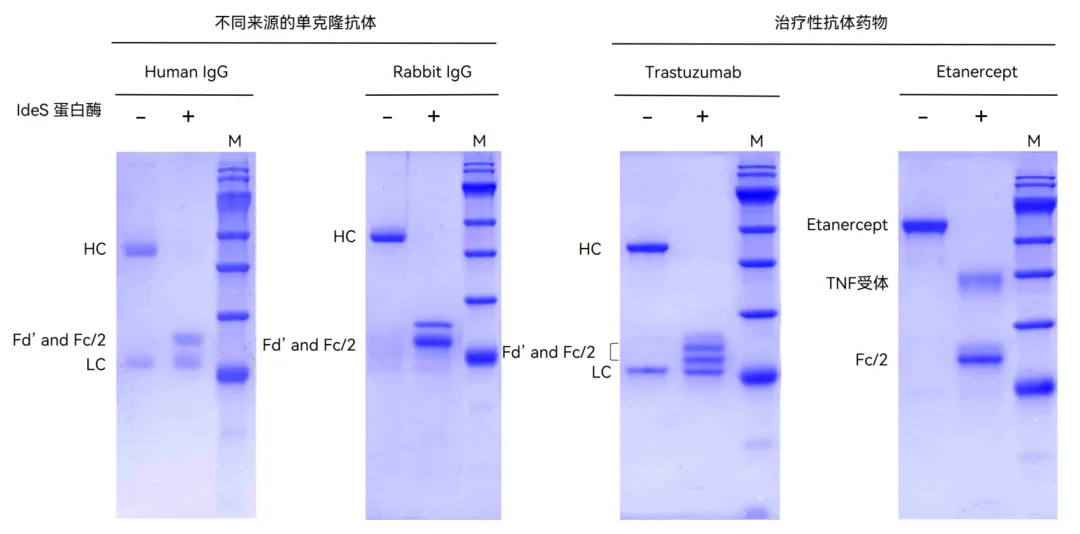
3. How does IdeZ help address antibody interference in immunoassays?
In serum- or plasma-based immunoassays (e.g., ELISA, chemiluminescence), substances such as rheumatoid factor (RF) and heterophilic antibodies (HAAA) can bind to detection antibodies, causing false-positive or artificially high results and seriously compromising diagnostic accuracy. IdeZ efficiently degrades IgG in samples, removing such interference and thereby improving assay specificity and signal-to-noise ratio. This is particularly valuable in immunoassays related to autoimmune diseases, tumor markers, and infectious diseases. Several studies have confirmed that samples pretreated with IdeZ show enhanced reliability in tests for cardiac troponin (cTnI), SARS-CoV-2 antibodies, and other markers.
4. Does IdeZ play a role in cell therapy and gene editing research?
Yes. During the preparation of cell-based products such as CAR-T and stem cell therapies, it is often necessary to remove serum-derived or secreted antibodies to avoid interference with cell function, transfection, or editing efficiency. IdeZ can be used to degrade IgG in culture systems; for example, in CRISPR-Cas9 gene editing, eliminating serum antibodies can reduce non-specific immune reactions, improve editing efficiency, and enhance cell survival. Additionally, the enzyme may be applied to clear residual therapeutic monoclonal antibodies in vivo or in vitro, supporting efficacy and safety evaluations.
5. What are the current production and technical challenges associated with IdeZ?
Although IdeZ shows broad application potential, its large-scale recombinant expression and purification remain challenging. The enzyme may form inclusion bodies or misfold in common expression systems (e.g., E. coli, yeast), requiring strategies such as codon optimization or co-expression of chaperone proteins to improve soluble yield. Furthermore, stability during storage, batch-to-batch consistency, and cost control are areas that need further optimization for industrial applications. Currently, several companies are using protein engineering techniques to develop IdeZ variants with improved thermal stability and pH adaptability.
6. What advantages does IdeZ offer over other IgG-degrading enzymes (e.g., IdeS, papain)?
Compared to traditional enzymes like papain, IdeZ exhibits higher cleavage specificity and does not non-specifically degrade other protein components. Relative to its homologous counterpart IdeS, IdeZ demonstrates better stability under certain conditions (e.g., neutral to alkaline environments) and higher cleavage efficiency, enabling lower dosing requirements and reduced downstream purification burdens. These characteristics make IdeZ particularly suitable for precision biomanufacturing and high-sensitivity diagnostics.
7. In what emerging fields might IdeZ be applied in the future?
Beyond classical applications, IdeZ shows potential in areas such as multi-omics sample preprocessing, antibody-drug conjugate (ADC) quality analysis, microbiome-related immune intervention research, and veterinary diagnostics. For example, in metagenomic or proteomic studies, using IdeZ to remove high-abundance IgG from samples can enhance the detection of low-abundance or exogenous proteins. Additionally, the enzyme may be developed as a therapeutic agent for in vivo use to clear IgG in certain autoimmune diseases, though this remains in early-stage research.
This article is reviewed and published by the technical expert team of UA
Disclaimer: This article partially utilizes artificial intelligence assistance in its creation. If any content involves copyright or intellectual property issues, please let us know and we promise to verify and remove it as soon as possible.
Purchase recombinant protein, choose Nanjing UA-Bio
UA protein focuses on providing various protein reagents, raw materials, and services required for drug research and development, cell therapy, gene therapy, and basic scientific research, including drug target proteins, immune checkpoint proteins, cytokines, tool enzymes, customized protein expression, and full-length transmembrane protein development. Youai is committed to providing customers with high-quality products and professional services, and building a High-tech Biological Enterprise with International Competitiveness.







 Business license (three certificates in one)