




Exploring IL-4R α/CD124: Key Regulators in the Immune System and Their Clinical Significance


IL-4Rα, Also known as CD124, it is the core subunit of interleukin-4 receptor (IL-4R) and belongs to the type I cytokine receptor family. It can bind to two ligands: IL-4 and IL-13.
- Recent Advances
- Product Information
Q: What is IL-4Rα (CD124), and what are its structure and functions?
IL-4Rα, also known as CD124, is the core subunit of the interleukin-4 receptor (IL-4R) and belongs to the type I cytokine receptor family. It can bind to two ligands: IL-4 and IL-13. IL-4Rα exists in two forms: the type I receptor (which dimerizes with the γc chain, primarily responding to IL-4) and the type II receptor (which binds to IL-13Rα1 and responds to both IL-4 and IL-13). These complexes activate the downstream JAK-STAT signaling pathway (mainly STAT6), regulating gene transcription and influencing the proliferation, differentiation, and function of immune cells. Widely expressed on T cells, B cells, macrophages, dendritic cells, and epithelial cells, IL-4Rα is a central mediator of Th2 immune responses.
Q: What role does IL-4Rα play in immune and inflammatory diseases?
By regulating IL-4 and IL-13 signaling, IL-4Rα is deeply involved in allergic inflammation, autoimmune diseases, and barrier immune function. Abnormal activation of IL-4Rα signaling can lead to excessive Th2 immune responses, promoting IgE class switching, mucus secretion, eosinophil accumulation, and fibrosis processes. It is closely associated with various diseases, such as atopic dermatitis (AD), asthma, chronic rhinosinusitis with nasal polyps (CRSwNP), and eosinophilic esophagitis (EoE). In atopic dermatitis, IL-4 and IL-13 directly disrupt the skin barrier, inducing itching and inflammation, while in asthma, they contribute to airway hyperresponsiveness and remodeling.
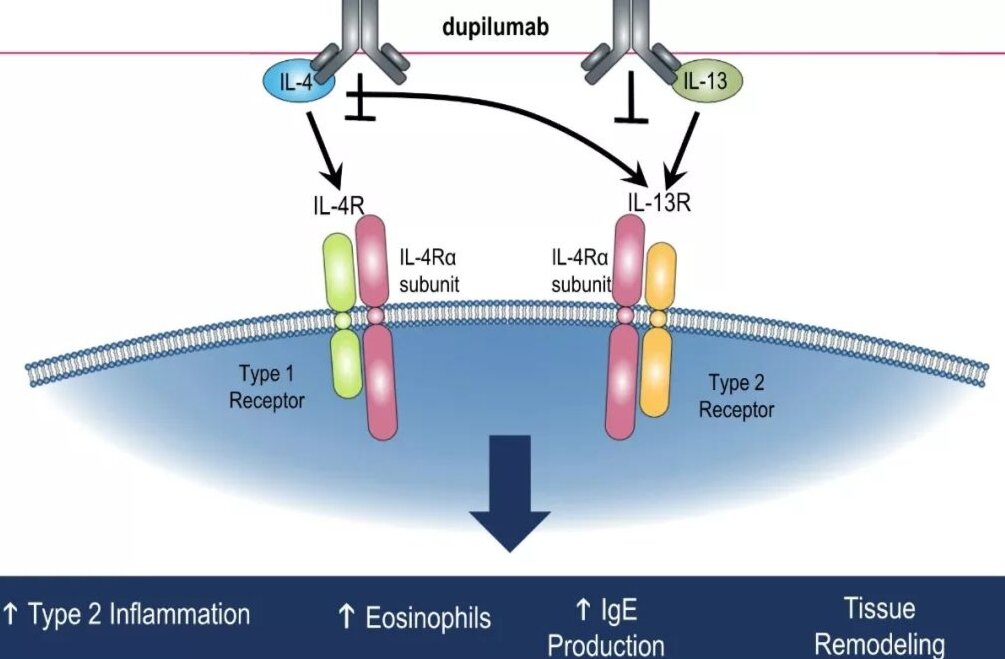
Q: What targeted drugs exist for IL-4Rα, and how do they work?
The most representative targeted drug is dupilumab, a fully human monoclonal antibody that specifically binds to IL-4Rα, thereby blocking both IL-4 and IL-13 signaling pathways. By inhibiting JAK-STAT6 phosphorylation, dupilumab effectively reduces inflammatory cytokine levels, IgE production, and epithelial abnormalities. It has been approved for the treatment of moderate-to-severe atopic dermatitis, asthma, CRSwNP, and EoE. Additionally, other investigational drugs, such as bispecific antibodies or small molecule inhibitors, are being developed to more precisely regulate this pathway or overcome resistance mechanisms.
Q: How does IL-4Rα differ from other cytokine receptors?
A distinguishing feature of IL-4Rα is its "dual ligand-dual receptor" mechanism. Unlike single-ligand receptors, it can bind with high affinity to IL-4 and also participate in IL-13 signal transduction (via the type II receptor). This cross-regulation expands its biological impact, particularly in type 2 inflammation, where it plays a central role. Moreover, since IL-4Rα is expressed on various immune and structural cells, its functions are broader and context-dependent, capable of promoting both tissue repair and pathological inflammation.
Q: What are the clinical advantages and challenges of targeting IL-4Rα?
In terms of advantages, drugs like dupilumab offer high specificity, favorable safety profiles, and efficacy across multiple diseases, providing a unified treatment strategy for various Th2-related conditions. Clinical data show significant improvements in patient symptoms, quality of life, and objective measures (such as IgE levels and lesion area). However, challenges remain: some patients exhibit insufficient response (primary or secondary resistance), possibly due to individual genetic differences, compensatory signaling from the microenvironment, or drug immunogenicity. Long-term blockade of IL-4/IL-13 may also impact anti-parasitic and anti-viral immunity, and the high cost limits accessibility.
Q: What are the current research directions regarding IL-4Rα?
Research is expanding in multiple frontiers:exploring combination therapies, such as synergizing with JAK inhibitors or IL-33/TSLP targeted drugs to enhance efficacy; developing new formulations like subcutaneous or oral administration to improve convenience;utilizing biomarkers (e.g., serum IL-13 levels, STAT phosphorylation status) to predict treatment response and enable personalized medicine;conducting in-depth mechanistic studies to elucidate the potential roles of IL-4Rα in non-Th2 contexts, such as cancer, neuroinflammation, or metabolic diseases; and applying structural biology to design more efficient or long-acting allosteric inhibitors.
Q: In which new disease areas might IL-4Rα-targeted therapies be applied in the future?
Beyond approved indications, preliminary studies suggest that IL-4Rα blockade may benefit other conditions, such as allergic bronchopulmonary aspergillosis (ABPA), prurigo nodularis, mastocytosis, and certain types of fibrosis (e.g., pulmonary or hepatic fibrosis). In tumor immunity, high IL-4Rα expression on immunosuppressive cells (e.g., M2 macrophages) suggests that blocking it could remodel the tumor microenvironment and enhance anti-tumor responses. These potential applications further validation in large-scale clinical trials.
This article is reviewed and published by the technical expert team of UA
Disclaimer: This article partially utilizes artificial intelligence assistance in its creation. If any content involves copyright or intellectual property issues, please let us know and we promise to verify and remove it as soon as possible.
Purchase recombinant protein, choose Nanjing UA-Bio
UA protein focuses on providing various protein reagents, raw materials, and services required for drug research and development, cell therapy, gene therapy, and basic scientific research, including drug target proteins, immune checkpoint proteins, cytokines, tool enzymes, customized protein expression, and full-length transmembrane protein development. Youai is committed to providing customers with high-quality products and professional services, and building a High-tech Biological Enterprise with International Competitiveness.







 Business license (three certificates in one)