




Exploration of MIF and Systemic Lupus Erythematosus: Mechanisms, Regulation, and Therapeutic Potential


Macrophage Migration Inhibition Factor (MIF) is a multifunctional cytokine that has long been considered a key regulatory molecule in both innate and adaptive immune responses.
- Recent Advances
- Product Information
Q: What is Macrophage Migration Inhibitory Factor (MIF), and what role does it play in the immune system?
Macrophage Migration Inhibitory Factor (MIF) is a pleiotropic cytokine long recognized as a key regulator in both innate and adaptive immune responses. Initially named for its ability to inhibit the random migration of macrophages, subsequent research has revealed its critical roles in inflammatory responses, cell proliferation and apoptosis, and immune cell activation. MIF promotes the release of various proinflammatory factors, such as TNF-α, IL-1β, IL-6, and interferons, and is involved in regulating phagocytosis and delayed-type hypersensitivity reactions. Due to its broad and essential immunomodulatory functions, MIF has become an important target in the study of various inflammatory and autoimmune diseases.
Q: What is the relationship between MIF and systemic lupus erythematosus (SLE)?
Systemic lupus erythematosus (SLE) is a chronic autoimmune disease that affects multiple organs and systems. Its immunological features include the overproduction of autoantibodies, deposition of immune complexes, and elevated levels of proinflammatory cytokines. Multiple clinical studies have shown that MIF expression is significantly increased in the serum and affected tissues (e.g., kidneys) of SLE patients, and its levels positively correlate with SLE disease activity indices, such as the SLEDAI score. Notably, functional polymorphisms in the MIF gene promoter region have also been linked to SLE susceptibility and clinical manifestations. These findings suggest that MIF not only serves as a biomarker for SLE disease status but may also actively participate in the pathological processes of disease initiation and progression.
Q: How does MIF influence the progression of lupus nephritis (LN), and what is the molecular mechanism?
Lupus nephritis (LN) is one of the most common and serious visceral complications of SLE, characterized by glomerular immune complex deposition, complement activation, and chronic inflammatory damage. As an upstream inflammatory regulator, MIF exacerbates the pathological progression of LN through multiple signaling pathways. Studies have found that MIF enhances the activity of the nuclear factor kappa B (NF-κB) signaling pathway and upregulates its cytoplasmic inhibitor, IκB, thereby mediating glucocorticoid resistance and limiting the effectiveness of conventional treatments. Additionally, MIF promotes the expression of various inflammatory cytokines and chemokines, recruiting inflammatory cells to the kidneys and accelerating tissue damage and fibrosis.
Q: Are there endogenous mechanisms that regulate MIF expression, and do miRNAs play a role?
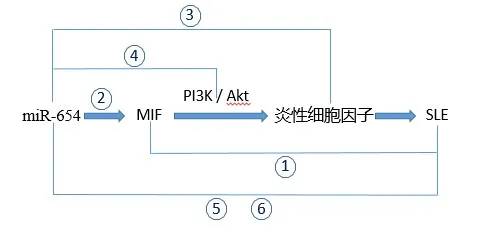
Recent studies have shown that microRNAs (miRNAs), a class of endogenous non-coding RNAs, finely regulate gene expression at the post-transcriptional level, including that of MIF. Specifically, miR-654 has been confirmed to bind to the 3' untranslated region (3' UTR) of MIF mRNA, thereby inhibiting its translation. In SLE patients, miR-654 expression is significantly reduced and negatively correlates with elevated MIF levels and disease activity, suggesting that this miRNA may play an important role in the negative feedback mechanism of MIF overexpression.
Q: How does miR-654 influence downstream inflammatory signaling by regulating MIF?
By directly targeting MIF mRNA, miR-654 reduces MIF protein expression, thereby affecting its downstream signaling pathways. Experiments have confirmed that overexpression of miR-654 significantly inhibits the phosphorylation levels of ERK and AKT—two signaling pathways central to cell proliferation, survival, and inflammatory responses. As the activation of ERK and AKT decreases, the production of various proinflammatory cytokines, including TNF-α, IL-6, and IL-1β, is also suppressed. This indicates that miR-654 not only regulates MIF itself but also broadly influences the inflammatory network by indirectly modulating the activity of key kinases.
Q: Do these findings have translational medical value? For example, can they be used to develop new treatment strategies?
Based on the above mechanisms, restoring or mimicking miR-654 function is considered a potential therapeutic strategy. Animal model studies have shown that delivering miR-654 mimics significantly reduces proteinuria levels, alleviates immune complex deposition in renal tissues, and improves glomerular pathology scores in murine lupus nephritis models. Conversely, using a miR-654 inhibitor exacerbates renal lesions and inflammatory responses. These results not only validate the critical role of the miR-654/MIF axis in LN but also provide preclinical evidence for future development of RNA-based therapies, such as miRNA replacement therapy.
Q: What challenges and future directions remain in current research on MIF/miR-654?
Although the roles of MIF and miR-654 in SLE and LN are becoming clearer, many scientific questions remain unanswered. For example, the regulatory mechanisms controlling miR-654 expression itself are still not fully understood; whether MIF is also regulated by other miRNAs or epigenetic factors; and how these molecular events specifically function in different immune cell types (e.g., T cells, B cells, macrophages). Additionally, translating miRNA-based therapeutic strategies to the clinic still faces challenges related to delivery efficiency, stability, and long-term safety. Future research will need to integrate single-cell sequencing, conditional gene knockout animal models, and innovations in drug delivery technology to further elucidate the complexity of the MIF-related network and advance its translation toward precision medicine.
This article is reviewed and published by the technical expert team of UA
Disclaimer: This article partially utilizes artificial intelligence assistance in its creation. If any content involves copyright or intellectual property issues, please let us know and we promise to verify and remove it as soon as possible.
Purchase recombinant protein, choose Nanjing UA-Bio
UA protein focuses on providing various protein reagents, raw materials, and services required for drug research and development, cell therapy, gene therapy, and basic scientific research, including drug target proteins, immune checkpoint proteins, cytokines, tool enzymes, customized protein expression, and full-length transmembrane protein development. Youai is committed to providing customers with high-quality products and professional services, and building a High-tech Biological Enterprise with International Competitiveness.







 Business license (three certificates in one)