

$1.53 Billion! Chinese ADC's Blockbuster Out-Licensing Deal – What Makes CDH17 Worth the Price?


In the field of gastrointestinal cancer treatment, a target named CDH17 (cadherin-17, also known as liver-intestine cadherin) is rapidly emerging as a "golden track" that global pharmaceutical companies are competing to develop. From bispecific antibodies to antibody-drug conjugates (ADCs) and CAR-T cell therapies, drug development targeting CDH17 is advancing along multiple technological pathways with clinical progress. The recent blockbuster collaboration between Hansoh Pharma and Roche, involving a licensing deal worth up to $1.53 billion, has further thrust this target into the global biopharmaceutical spotlight.
- Recent Advances
- Product Information
- Reference
In the field of gastrointestinal cancer treatment, a target named CDH17 (cadherin-17, also known as liver-intestine cadherin) is rapidly emerging as a "golden track" that global pharmaceutical companies are competing to develop. From bispecific antibodies to antibody-drug conjugates (ADCs) and CAR-T cell therapies, drug development targeting CDH17 is progressing along multiple technological pathways with clinical advancements. The recent blockbuster collaboration between Hansoh Pharma and Roche, involving a licensing deal worth up to $1.53 billion, has further thrust this target into the spotlight of the global biopharmaceutical industry.
CDH17: A "Precision Target" for Gastrointestinal Tumors
CDH17 is a non-classical member of the cadherin superfamily with a unique structure: it consists of seven extracellular cadherin repeats and a very short cytoplasmic domain. In normal tissues, CDH17 expression is highly confined to the basolateral membrane of intestinal epithelial cells. However, it is significantly overexpressed in gastrointestinal malignancies such as gastric cancer, colorectal cancer, pancreatic cancer, and liver cancer. Studies show that over 90% of colorectal cancer patients, 50% of gastric cancer patients, and 50% of pancreatic cancer patients exhibit abnormal CDH17 expression, and its expression level is closely associated with tumor invasion, metastasis, and poor prognosis.
This "tumor-specific expression" characteristic makes CDH17 an ideal drug target: it can precisely attack tumor cells while minimizing damage to normal tissues. Preclinical studies indicate that CDH17 drives tumor progression through mechanisms such as activating the Wnt/β-catenin signaling pathway, regulating cell adhesion and proliferation, and promoting liver metastasis, providing multiple pathways for targeted therapy.
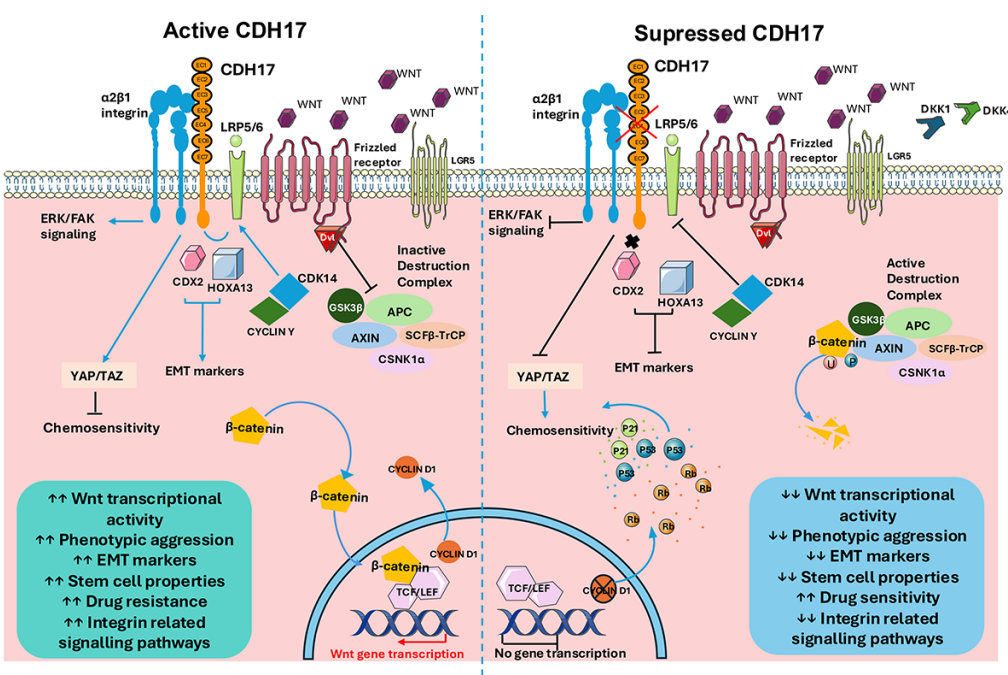
Schematic diagram of the Wnt/β-catenin pathway and CDH17-mediated tumor biology regulation
Competing Technological Pathways: Trispecific Arrows – Bispecific Antibodies, ADCs, and CAR-T
1.Bispecific Antibodies: "Precision Guidance" via T Cell Redirection
ARB202 is the world's first CDH17xCD3 bispecific antibody to enter clinical trials. Built using TriAx technology, it activates T cells to kill tumors by simultaneously binding to CDH17 on the surface of tumor cells and CD3 on T cells. Its unique design avoids systemic immune reactions caused by excessive T cell activation and has shown good safety in an Australian Phase I trial, with no dose-limiting toxicities (DLT) observed among 10 subjects. Another bispecific antibody, BI905711, induces tumor cell apoptosis by cross-linking CDH17 with the death receptor TRAILR2, achieving stable disease in 13 patients with advanced gastrointestinal cancer in a Phase Ia/Ib study.
2.ADCs: "Smart Bombs" for Toxin Delivery
ADC development is the most active area for the CDH17 target. Hansoh Pharma's HS-20110 utilizes the topoisomerase I inhibitor SHR-9265 as its payload, achieving tumor microenvironment-specific release through an optimized cleavable linker. It demonstrated over 90% tumor growth inhibition in colorectal cancer PDX models and can penetrate the stromal barrier of liver metastases. Mabwell's 7MW4911, based on the IDDC™ platform and armed with the proprietary toxin MF-6, showed significantly superior efficacy compared to traditional ADCs in multidrug-resistant models. Cynomolgus monkey toxicology studies indicated a therapeutic window exceeding 20 mg/kg. Yiling Biotech's YL217 utilizes the TMALIN® platform for tumor-specific linker cleavage, achieving 100% complete response in gastric cancer models.
3.CAR-T: The "Ultimate Weapon" for Breaking Through Solid Tumors
CHM-2101, developed by the University of Pennsylvania, is the world's first CDH17 CAR-T therapy to enter clinical trials. It employs a third-generation design (CD28 + 4-1BB costimulatory domains) and achieved complete tumor eradication in 7 cancer models. The core mechanism lies in the fact that CDH17 is hidden within tight junctions in normal cells, whereas it is exposed on the surface of tumor cells, allowing CAR-T cells to specifically recognize and kill tumors. This therapy has now received FDA approval to initiate Phase I/II trials for colorectal cancer, gastric cancer, and neuroendocrine tumors.
Capital Frenzy: The Industrial Logic Behind the $1.53 Billion Deal
On October 17, 2025, Hansoh Pharma and Roche entered a significant collaboration: Hansoh granted Roche the global rights to HS-20110 outside Greater China, involving an upfront payment of $80 million and potential milestone payments of up to $1.45 billion, totaling $1.53 billion. This figure not only sets a new record for the out-licensing of Chinese ADCs but also underscores the immense commercial value of the CDH17 target.
Deal Logic Analysis:
-
Unmet Clinical Need: Colorectal cancer is the third most common cancer globally, with 569,000 new annual cases in China alone. The five-year survival rate for advanced patients is less than 15%. Existing therapies (like chemotherapy, EGFR inhibitors, PD-1 inhibitors) have limited efficacy for metastatic patients, creating an urgent need for novel mechanism drugs.
-
Differentiated Target Advantage: CDH17 is highly expressed in MSS (microsatellite stable) colorectal cancer, a subtype (accounting for ~85% of cases) where PD-1 inhibitors are ineffective. Preclinical data for HS-20110 suggests it can cover this MSS refractory population, holding great potential for combination with chemotherapy or immunotherapy.
-
Rise of Chinese Biotech Technology: All 9 CDH17 ADCs globally that have entered the clinical stage are from Chinese companies, including, Hansoh Pharma, and KeyMed Biosciences. Chinese firms have established a globally leading advantage in target selection, molecular design (e.g., site-specific conjugation technology), and clinical development speed.
Future Outlook: Industrial Leap from "Following" to "Leading"
The explosion of the CDH17 target is no accident. Chinese pharmaceutical companies, through forward-looking of emerging targets, building integrated R&D systems across the industrial chain, and leveraging patient resource advantages to accelerate clinical trials, have shifted from "imitation" to "innovation." The heavy investments by multinational Pharma like Roche and GSK in Chinese pipelines are not only a recognition of CDH17's potential but also a vote of confidence in the upgrade of China's biopharmaceutical industry.
With the emergence of new technologies like bispecific ADCs and dual-payload ADCs, CDH17 is poised to become a pioneering target in breaking through the treatment bottleneck for solid tumors. As the Chief Medical Officer of Roche Global Product Development stated: "CDH17 ADCs represent a novel treatment paradigm that could rewrite the survival curve for advanced gastrointestinal cancers." In this global race, Chinese pharmaceutical companies are using innovation as their blade to cut a golden path onto the international stage.
UA CDH17 Target Protein - Partial Data Sharing:
CDH17/LI-cadherin His Tag Protein, Human Cat. No.: UA010825

Immobilized CDH17/LI-cadherin His Tag, Human (Cat. No. UA010825) at 2.0μg/mL (100μL/well) can bind Cadherin 17 Recombinant Rabbit mAb (SDT-736-23) (Cat. No. S0B2291) with EC50 of 1.25-1.75ng/mL.
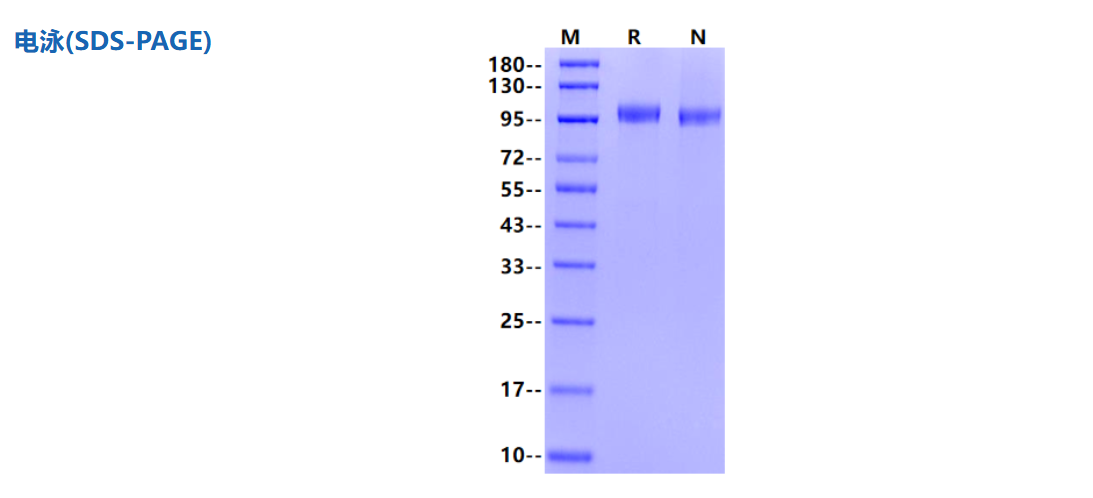
1μg (R: reducing condition, N: non-reducing condition).
CDH17/LI-cadherin His Tag Protein, Human_UA010825_优爱(UA BIOSCIENCE)官网
This article is reviewed and published by the technical expert team of UA
Disclaimer: This article partially utilizes artificial intelligence assistance in its creation. If any content involves copyright or intellectual property issues, please let us know and we promise to verify and remove it as soon as possible.
Purchase recombinant protein, choose 
UA protein focuses on providing various protein reagents, raw materials, and services required for drug research and development, cell therapy, gene therapy, and basic scientific research, including drug target proteins, immune checkpoint proteins, cytokines, tool enzymes, customized protein expression, and full-length transmembrane protein development. Nanjing Univ is committed to providing customers with high-quality products and professional services, and building a High-tech Biological Enterprise with International Competitiveness.

Bandana Shrestha; Yanping Feng; A. Lad; Anthony S. Bates; Jing Chen; et al. The Role of Cadherin 17 (CDH17) in Cancer Progression via Wnt/β-Catenin Signalling Pathway: A Systematic Review and Meta-Analysis. International Journal of Molecular Sciences.2025-10-10.






 Business license (three certificates in one)