

CD3 Protein: The Core Engine of TCE Drug Development


In the field of cancer immunotherapy, T cell engagers (TCEs) have emerged as another revolutionary pillar following immune checkpoint inhibitors.
- Recent Advances
- Product Information
- Reference
In the field of cancer immunotherapy, T Cell Engagers (TCEs) have emerged as another revolutionary pillar following immune checkpoint inhibitors. Their core lies in ingeniously utilizing the CD3 complex on T cell surfaces, transforming this fundamental immunological concept into a powerful therapeutic tool.
I. CD3: From Signaling Hub to Therapeutic Target
The CD3 complex (composed of γε, δε, and ζζ dimers) serves as the signaling module of the T cell receptor (TCR). Its intracellular immunoreceptor tyrosine-based activation motifs (ITAMs) act as the "on switch" for T cell activation. This universal activation capability, independent of T cell antigen specificity, makes it an ideal anchoring point for TCE drug design. TCE molecules employ a bispecific structure to forcibly bring T cells (via CD3) and tumor cells (via tumor-associated antigens) into proximity, forming an immune synapse, thereby bypassing MHC restriction and directly activating T cell cytotoxic functions.
II. Clinical Milestones: Evolution and Insights from Marketed Products
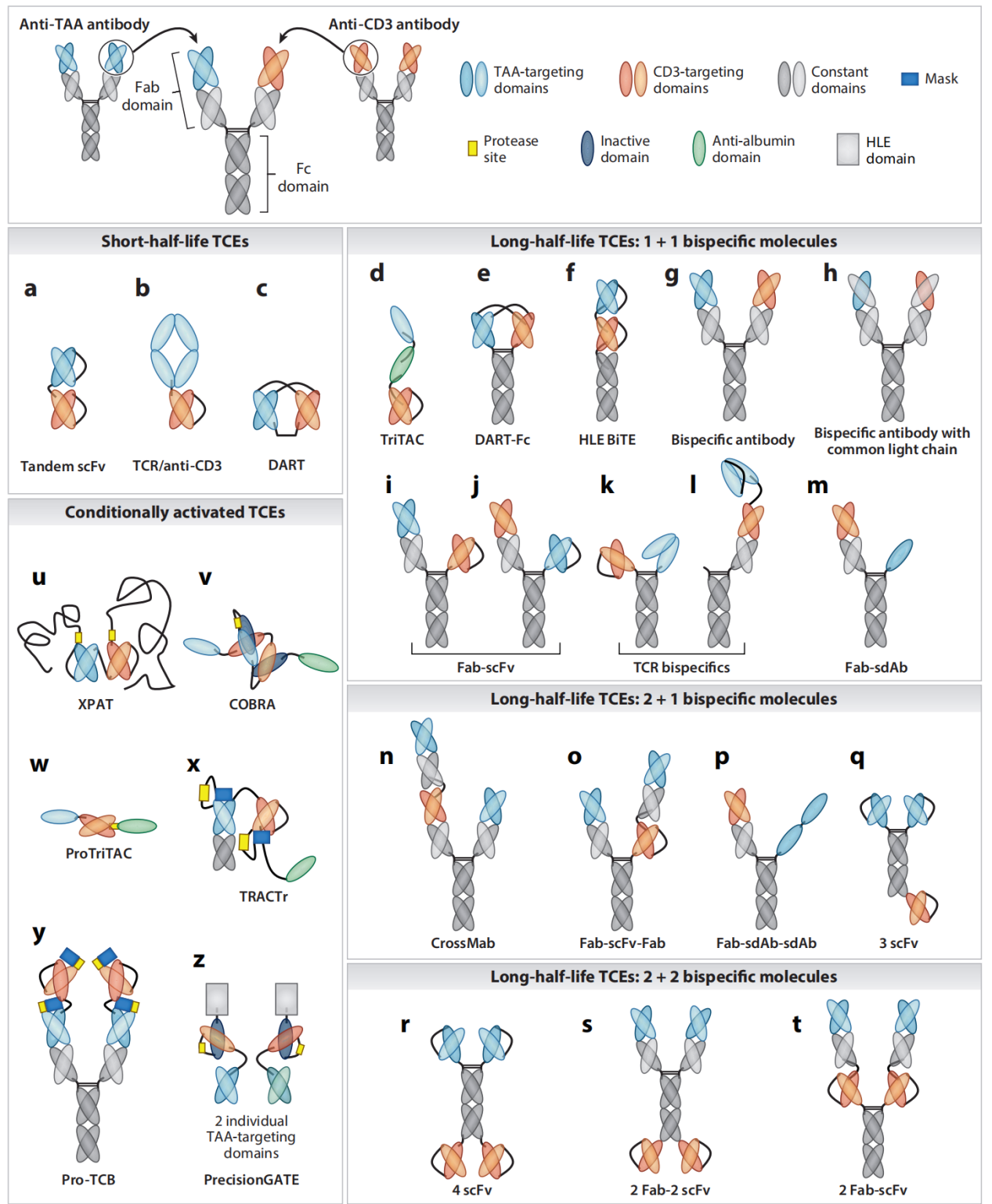
Currently, over a dozen TCE drugs have been approved globally, clearly demonstrating the trajectory of this field:
1. Pioneering Breakthroughs in Hematologic Malignancies:
Blinatumomab (Blincyto®): The first CD3 bispecific antibody (targeting CD19) for treating relapsed/refractory B-cell acute lymphoblastic leukemia. Its short half-life requires continuous intravenous infusion but proved the clinical feasibility of the TCE concept.
Next-generation hematologic TCEs: Teclistamab (targeting BCMA), Talquetamab (targeting GPRC5D), Elranatamab (targeting BCMA) have been approved for multiple myeloma. These feature subcutaneous administration, significantly improving convenience, and optimized CD3 affinity for enhanced safety.
2. Dawn in Solid Tumor Therapeutics:
Tebentafusp (Kimmtrak®): A landmark first TCE for solid tumors (and the first TCR-like bispecific immunotherapy) for HLA-A02:01-positive uveal melanoma. It targets CD3 on one end and uses a TCR domain to target gp100 peptide-HLA complexes, opening new avenues for difficult-to-treat solid tumors.
Tarlatamab (Imdelltra®): Granted FDA accelerated approval in 2024 for advanced small cell lung cancer (targeting DLL3). Its remarkable efficacy confirms TCE's immense potential in aggressive solid tumors, making it a focal point in the industry.
III. Cutting-edge Advances: Innovative Strategies Addressing Core Challenges
To overcome challenges like cytokine release syndrome, neurotoxicity, target heterogeneity, and tumor microenvironment suppression, recent research has focused on multidimensional innovations in CD3 engineering:
1. "Affinity Tuning" 2.0 and Conditional Activation:
Beyond reducing CD3 affinity, next-gen designs pursue "tumor microenvironment-selective activation." Examples include pH-sensitive or protease-activatable TCEs that fully activate only in acidic tumor microenvironments or after cleavage by tumor-specific proteases, minimizing peripheral toxicity.
Logic-gated TCEs: Development of trispecific or more complex molecules requiring simultaneous binding to two tumor antigens (e.g., EGFR and c-MET) for effective T cell activation, greatly enhancing tumor-targeting specificity for use in antigen-heterogeneous solid tumors.
2. Molecular Formats and Functional Expansions:
Bispecific-ADC conjugates: Combining TCEs with antibody-drug conjugates to redirect T cells while directly delivering cytotoxic payloads for synergistic killing.
Integrated co-stimulation: Incorporating CD28 or 4-1BB co-stimulatory domains in trispecific antibodies to provide secondary signals that promote T cell persistence and memory formation, overcoming T cell exhaustion in suppressive microenvironments.
Universal "modular" TCE platforms: Designing molecules with fixed CD3 ends whose tumor-targeting ends can be rapidly exchanged via non-covalent bonds for rapid pipeline development against different targets.
3. Beyond Oncology: Emerging Therapeutic Areas:
Fibrosis cell clearance: Preclinical studies show TCEs targeting fibroblast activation protein can effectively reverse pulmonary and hepatic fibrosis.
Targeting HIV reservoirs: Designing bispecific antibodies binding both CD3 and HIV envelope proteins to eliminate latently infected cells, achieving functional cure.
Conclusion
From hematologic to solid tumors, from cancer to fibrotic diseases, CD3-targeted TCE therapies are expanding their frontiers at an unprecedented pace. Deep understanding of CD3 biology combined with ingenious protein engineering has yielded multiple life-saving drugs. As we achieve finer decoding of T cell activation logic and advance intelligent molecular design, next-generation TCEs will become more precise, safe, and potent. CD3—this ancient "switch" on T cells—is now being programmed by human ingenuity to direct the immune system's precise and efficient revolution against the most stubborn diseases. This revolution not only redefines treatment paradigms but vividly demonstrates the extraordinary power of translating fundamental biology into clinical medicine.
Recommended Products:
| Catalog No. | Product Name |
|---|---|
| UA011360 | Biotinylated CD3E&CD3D Fc, His, Avi tag&Fc, Flag, Avi tag Protein, Human |
| UA011373 | CD3E&CD3D Heterodimer Llama Fc&Llama Fc Tag Protein, Human |
| UA010195 | CD3 delta His Tag Protein, Cynomolgus |
| UA010193 | CD3 delta His Tag Protein, Human |
| UA010173 | CD3 epsilon Fc Chimera Protein, Cynomolgus |
| UA010199 | CD3 epsilon Fc Chimera Protein, Human |
| UA010598 | CD3 gamma Fc Chimera Protein, Human |
This article is reviewed and published by the technical expert team of UA
Disclaimer: This article partially utilizes artificial intelligence assistance in its creation. If any content involves copyright or intellectual property issues, please let us know and we promise to verify and remove it as soon as possible.
Purchase recombinant protein, choose 
UA protein focuses on providing various protein reagents, raw materials, and services required for drug research and development, cell therapy, gene therapy, and basic scientific research, including drug target proteins, immune checkpoint proteins, cytokines, tool enzymes, customized protein expression, and full-length transmembrane protein development. Nanjing Univ is committed to providing customers with high-quality products and professional services, and building a High-tech Biological Enterprise with International Competitiveness.

- Tara Arvedson; Julie M. Bailis; Carolyn D. Britten; Matthias Klinger; Dirk Nagorsen; et al. Targeting Solid Tumors with Bispecific T Cell Engager Immune Therapy. Annual Review of Cancer Biology. 2021.
- Yingtang Zhou; Ming‐Guo Liu; Fei Ren; Xiangjiao Meng; Jinming Yu. The landscape of bispecific T cell engager in cancer treatment. Biomarker Research. 2021.






 Business license (three certificates in one)