




A Guide to Kinase Activity: Principle and Applications of the Kinase ADP Assay


In the microscopic world of life sciences, protein kinases play the crucial role of "molecular switches." By transferring phosphate groups from ATP to substrate proteins (phosphorylation), they precisely regulate core cellular processes including growth, division, and apoptosis. However, dysregulation of kinase function can lead to various major diseases such as cancer, inflammatory disorders, and neurodegenerative conditions.
- Recent Advances
- Product Information
In the microscopic world of life sciences, protein kinases play the critical role of "molecular switches." By transferring phosphate groups from ATP to substrate proteins (phosphorylation), they precisely regulate a series of core life activities such as cell growth, division, and apoptosis. However, when kinase function is dysregulated, it can lead to various major diseases, including cancer, inflammation, and neurodegenerative disorders. Consequently, kinases have become one of the most popular targets in modern drug development, especially in targeted therapies.
To develop drugs capable of effectively modulating kinase activity, a sensitive, reliable, and high-throughput method for detecting kinase activity is first required. The Kinase ADP Assay is one of the core technologies developed for this purpose. This article will provide an in-depth analysis of its working principle and explore its broad applications.
I. Core Concept: Starting from the "Product" to Indirectly Measure Activity
The core equation of the kinase-catalyzed reaction is:
Substrate Protein + ATP → Phosphorylated Substrate + ADP
Traditional methods might directly detect the generation of the phosphorylated substrate, but this often requires specific antibodies, which can be costly and have limited throughput. The Kinase ADP Assay takes a different approach by focusing on the other inevitable product of the reaction – ADP (Adenosine Diphosphate).
The core logic is: In the reaction system, the amount of ADP generated is proportional to the kinase activity. Higher kinase activity consumes more ATP, resulting in more ADP generated. Therefore, by precisely detecting the amount of ADP produced, one can accurately calculate back to the kinase's activity.
II. Detailed Explanation of the Principle: An Elaborate "Fluorescent Signal Relay"
Currently, the most mainstream and sensitive Kinase ADP Assays are based on Fluorescence Resonance Energy Transfer (FRET) technology. Its principle can be broken down into the following key steps:
-
Reaction Occurs:
The kinase to be tested, its specific substrate protein, and ATP are mixed in a suitable buffer system to initiate the phosphorylation reaction. After the reaction proceeds for a period, ADP proportional to the kinase activity is generated in the system. -
Detection Reagents Enter:
After the reaction, a specially designed detection reagent is added to the system. This reagent typically contains two key components:-
ADP Sensor Protein: An enzyme that specifically binds ADP.
-
Fluorescent Donor: Typically conjugated to the sensor protein.
-
Fluorescent Acceptor: A molecule that binds tightly to an ADP analog and quenches the donor's fluorescence.
-
In the absence of ADP, the donor and acceptor are in close proximity, FRET occurs, and the donor's fluorescence is absorbed (quenched) by the acceptor, resulting in little to no detectable fluorescence signal.
-
-
"Competition" and "Signal Conversion":
When the generated ADP is present in the reaction system, a "competition" begins: ADP competes with the fluorescent acceptor in the reagent for binding to the ADP sensor protein. ADP has a stronger binding affinity for the sensor protein and "displaces" the fluorescent acceptor originally bound to it. Once the fluorescent acceptor is displaced, the FRET effect is disrupted, and the fluorescent donor, when excited, can emit a strong fluorescence signal. -
Signal Readout and Quantification:
A fluorescence microplate reader is used to detect the intensity of this fluorescence signal. The fluorescence signal intensity is proportional to the concentration of ADP generated in the reaction system, which in turn is proportional to the kinase activity. By generating a standard curve, the fluorescence values can be accurately converted into units of kinase activity.
Simply summarizing this signal chain: High Kinase Activity → High ADP Generation → Competitive Binding to Sensor Protein → Fluorescent Acceptor Displaced → FRET Effect Disrupted → Strong Fluorescence Signal.
III. Introduction to the UA-Glo® Kinase ADP Assay Kit
The UA-Glo® Kinase ADP Assay is a homogeneous, ultra-sensitive detection kit based on Fluorescence Resonance Energy Transfer (FRET) technology, specifically designed for the accurate and efficient detection of protein kinase activity and the screening of kinase inhibitors.
The core principle of this kit lies in the clever detection of the direct product of the kinase reaction – ADP. When a kinase catalyzes substrate phosphorylation, it consumes ATP and generates an equivalent amount of ADP. The UA-Glo® system provides a proprietary ADP sensor reagent that specifically binds ADP and triggers a significant fluorescence signal enhancement. Simply put, the more ADP generated in the reaction (indicating higher kinase activity), the stronger the final detected fluorescence signal.
Its main technical advantages are:
-
Exceptional Universality: Since it detects the common product (ADP) of all kinase reactions, this kit does not require specific antibodies for different kinases, making it applicable to the vast majority of kinase targets. This greatly simplifies experimental procedures and reduces R&D costs.
-
High Sensitivity and Broad Dynamic Range: Utilizing an optimized FRET system, it can accurately detect very subtle changes in kinase activity. Excellent signal-to-noise ratios are achieved even at low ATP concentrations, ensuring data reliability and accuracy.
-
Convenient "Add-Mix-Detect" Homogeneous Assay Format: The entire detection process requires no separation or washing steps. Simply mix the kinase reaction system with the detection reagent, incubate, and read the fluorescence signal directly. This characteristic makes it perfectly suited for automated workstations and an ideal choice for High-Throughput Screening (HTS) of drugs.
-
Excellent Interference Resistance: The detection occurs in the far-red wavelength region, effectively avoiding interference from the intrinsic fluorescence or color of the test compounds. This significantly reduces the false-positive rate, making the screening results more reliable.
Application Areas:
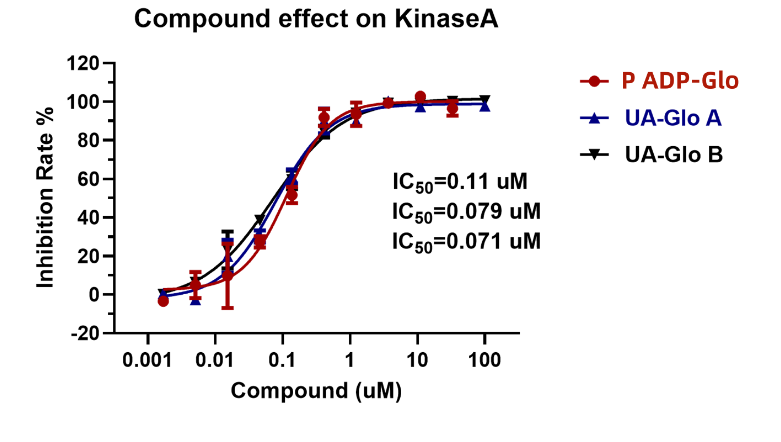
The UA-Glo® Kinase ADP Assay Kit is widely used in high-throughput screening of kinase inhibitors, studies of kinase enzyme kinetics, determination of compound half-maximal inhibitory concentration (IC50), and kinase selectivity profiling. It is an indispensable and powerful tool for pharmaceutical companies, research institutions, and biotechnology companies in kinase target research and innovative drug development.
This article is reviewed and published by the technical expert team of UA
Disclaimer: This article partially utilizes artificial intelligence assistance in its creation. If any content involves copyright or intellectual property issues, please let us know and we promise to verify and remove it as soon as possible.
Purchase recombinant protein, choose Nanjing UA-Bio
UA protein focuses on providing various protein reagents, raw materials, and services required for drug research and development, cell therapy, gene therapy, and basic scientific research, including drug target proteins, immune checkpoint proteins, cytokines, tool enzymes, customized protein expression, and full-length transmembrane protein development. Youai is committed to providing customers with high-quality products and professional services, and building a High-tech Biological Enterprise with International Competitiveness.







 Business license (three certificates in one)