




A Comprehensive Collection of Hot Target Proteins and Companion Antibodies for ADC Drugs


Currently, a total of 15 ADC drugs have been approved globally, with 7 of them available in the domestic market. These drugs are indicated for both solid tumors and hematologic malignancies. The 15 products target 11 distinct molecular targets.
- Recent Advances
- Product Information
Key Insights
Currently, a total of 15 antibody-drug conjugates (ADCs) have been approved globally, with 7 of them available in the domestic market. These drugs are indicated for both solid tumors and hematologic malignancies. The 15 products target 11 distinct molecular targets.
The cytotoxic payloads, linkers, sales, indications, and approval timelines for each drug are as follows:

According to global data, there are over 600 ADC drug candidates in the development pipeline worldwide.
In the domestic market, the most actively researched targets include HER2, EGFR, TROP2, CLDN18.2, c-Met, ST4, PSMA, CD19, Muc1, and FR-alpha, among others.
HER2 (Human Epidermal Growth Factor Receptor 2)
Location: Chromosome 17q21
Function: Transmembrane receptor-like protein with tyrosine kinase activity
Cancer Research Focus: Breast cancer (one of the most extensively studied genes in breast cancer), gastric cancer
Clinical Detection Methods: Immunohistochemistry (IHC), Fluorescence In Situ Hybridization (FISH)
UA010241 Her2 Fc Chimera, Human

Immobilized Her2 His Tag, Cynomolgus (Cat. No. UA010241) at 5μg/mL (100μL/well) can bind Anti-Human HER2(Trastuzumab) Monoclonal Antibody with EC50 of 2.00 -2.88ng/ ml.
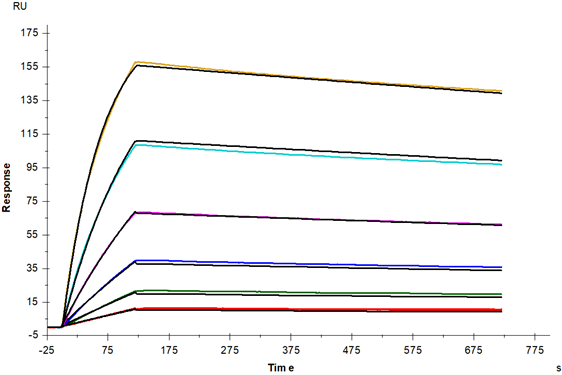
Anti-Human HER2(Trastuzumab) Monoclonal Antibody captured on Protein A Biosenor, can bind Her2 His Tag, Cynomolgus (Cat. No. UA010241) with an affinity constant of 1.54 nM as determined in SPR assay.
EGFR (Epidermal Growth Factor Receptor / ErbB1 / HER1)
Location: Chromosome 7p11.2
Function: Transmembrane receptor-like protein with tyrosine kinase activity
Cancer Research Focus: Non-small cell lung cancer (EGFR mutations are associated with drug resistance)
Drugs: First- to third-generation EGFR tyrosine kinase inhibitors (TKIs)
UA010161-EGFR His Tag, Mouse

CM5 Chip captured EGF, Human (Cat. No. UA040003), can bind EGFR His Tag, Mouse (Cat. No. UA010161) with an affinity constant of 3.00μM as determined in SPR assay.

Immobilized EGF, Human (Cat. No. UA040003) at 1.5μg/mL (100μL/well) can bind EGFR His Tag, Mouse (Cat. No. UA010161) with EC50 of 0.84-1.44μg/ ml.
TROP2 (Trophoblast Cell Surface Antigen 2 / TACSTD2 / EGP-1)
Location: Chromosome 1p32
Function: Cell surface glycoprotein that mediates multiple signaling pathways, such as calcium ion signaling and cyclin expression
Cancer Research Focus: Breast cancer, lung cancer, gastric cancer, colorectal cancer, pancreatic cancer, etc.
c-Met (Mesenchymal-Epithelial Transition Factor)
Gene Location: Long arm of human chromosome 7
Function: Member of the transmembrane receptor tyrosine kinase family; the c-Met signaling pathway plays a critical role in invasive growth during embryonic development and postnatal organ regeneration.
Cancer Research Focus: Lung cancer (c-Met mutations contribute to EGFR-TKI resistance in non-small cell lung cancer), gastric cancer, pancreatic cancer, breast cancer, etc.
PSMA (Folate Hydrolase 1 / FOLH1)
Function: Transmembrane glycoprotein
Cancer Research Focus: Prostate cancer (PSMA is a key characteristic molecule), vascular PSMA-positive tumor targeting
CD19 (Leukocyte Differentiation Antigen)
Location: Chromosome 16p11.2
Function: Cell surface transmembrane protein. Forms a complex with CD21 and CD81, contributing to the dual antigen-binding model of B cells during antigen recognition by the B cell receptor. It is involved in calcium ion transport in B cells and regulates B cell activation.
Cancer Research Focus: Leukemia, lymphoma; an important marker for the diagnosis and prognosis of immune system disorders
UA010211 FITC-Labeled CD19 Fc Chimera, Human

Immobilized Anti-CD19 Antibody, Mouse Monoclonal at 0.5μg/mL (100μL/well) can bind FITC-Labeled CD19 Fc Chimera, Human (Cat. No. UA010211) with EC50 of 11.12ng/ml.
MUC-1 (Mucin)
Location: Chromosome 1q21
Function: High-molecular-weight glycoprotein and transmembrane protein that contributes to mucus barrier formation, promotes cell proliferation (in tumors), and inhibits apoptosis (in tumors)
Cancer Research Focus: Lung cancer, pancreatic cancer, breast cancer, etc.
In addition to the above hot ADC target proteins, UA BIOSCIENCE also offers a range of first-line research targets, including B7-H3, BCMA, CD123, CD138, CD47, CD98, EpCAM, Flt-related proteins, FOLR1, GPC3, GUCY2C, and more. Click here to explore further >>>
Click on the product catalog numbers below to access detailed information on our official website.
This article is reviewed and published by the technical expert team of UA
Disclaimer: This article partially utilizes artificial intelligence assistance in its creation. If any content involves copyright or intellectual property issues, please let us know and we promise to verify and remove it as soon as possible.
Purchase recombinant protein, choose Nanjing UA-Bio
UA protein focuses on providing various protein reagents, raw materials, and services required for drug research and development, cell therapy, gene therapy, and basic scientific research, including drug target proteins, immune checkpoint proteins, cytokines, tool enzymes, customized protein expression, and full-length transmembrane protein development. Youai is committed to providing customers with high-quality products and professional services, and building a High-tech Biological Enterprise with International Competitiveness.







 Business license (three certificates in one)