




Please don't contact me, I'm culturing BMDC cells.


Within the intricate network of the human immune defense system, there exists a type of cell that plays the central role of "sentinels" and "messengers"—these are the dendritic cells. They constantly monitor the body for abnormalities, and upon detecting pathogens or cancerous cells, they can swiftly activate the entire adaptive immune system to launch a precise response.
- Recent Advances
- Product Information
- Reference
In the complex network of human immune defenses, there is a type of cell that plays the central role of "sentry" and "messenger": dendritic cells. They constantly monitor the body for abnormalities, and once pathogens or cancerous cells are detected, they can rapidly activate the entire adaptive immune system to launch a precise strike. However, obtaining dendritic cells directly from human tissues is not only difficult but also yields limited quantities, greatly restricting scientific research. Thus, scientists have found a golden key to unlock the mysteries of dendritic cells: bone marrow-derived dendritic cells.
I. What are BMDCs?
BMDCs are not isolated directly from living organisms. Instead, they are a cell model differentiated in vitro from mouse bone marrow precursor cells induced by specific cytokines in the laboratory.
Simply put, the preparation process is as follows:
-
Obtain Raw Material: Extract bone marrow cells from the femurs and tibias of mice.
-
Induce Differentiation: Culture these bone marrow cells in a dish with the key cytokine—Granulocyte-Macrophage Colony-Stimulating Factor (GM-CSF).
-
Develop and Mature: After several days of culture, these originally uncommitted bone marrow precursor cells will develop towards the dendritic cell lineage, forming a cell population with typical dendritic morphology and function.
Although there are some subtle phenotypic and functional differences between BMDCs and naturally occurring dendritic cells in vivo, they perfectly replicate the most core functional characteristics of dendritic cells, making them an indispensable tool in immunological research.
II. Protocol for Inducing and Differentiating Mouse BMDCs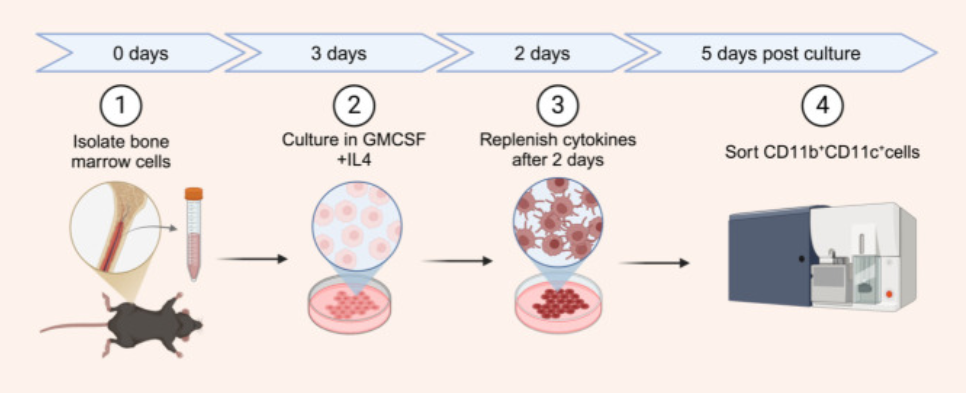
1. Acquisition of Mouse Bone Marrow Cells
1.1 Euthanize 6-8 week-old mice by cervical dislocation. Harvest the femurs and remove surrounding muscle tissue.
1.2 Disinfect the femurs by immersing in 75% ethanol for 2 minutes, then wash twice with PBS.
1.3 Use scissors to cut off both ends of the femurs. Flush the bone marrow cavity repeatedly with PBS using a syringe and needle inserted into the ends until the bone turns white.
1.4 Collect the bone marrow suspension and filter it through a 200-mesh nylon mesh.
1.5 Centrifuge the filtrate at 1200 rpm for 5 minutes, then discard the supernatant.
1.6 Add 2 ml of red blood cell lysis buffer and lyse at room temperature for 3-5 minutes.
1.7 Add 10 ml of PBS and centrifuge at 1200 rpm for 5 minutes.
1.8 Discard the supernatant, wash the pellet once with PBS, and resuspend the cells in 1640 medium supplemented with 10% FBS.
2. BMDC Induction
2.1 Adjust the cell density to 1x10^6/mL using the culture medium. Simultaneously add GM-CSF (20 ng/mL) and IL-4 (20 ng/mL). This day is designated as Day 0.
2.2 Perform a half-medium change every 2 days: remove half of the medium volume, centrifuge to collect the suspended cells, resuspend them in an equal volume of fresh medium supplemented with the corresponding concentrations of cytokines, and add it back to the dish.
2.3 On Day 6, collect both suspended and loosely adherent cells. Centrifuge at 1200 rpm for 5 minutes, discard the supernatant. Adjust the cell density to 1x10^6/mL, adding GM-CSF (20 ng/mL) and IL-4 (20 ng/mL). These are considered incompletely mature BMDCs.
2.4 Complete Maturation of BMDCs: On Day 8, add TNF-α (20 ng/mL), GM-CSF (20 ng/mL), and IL-4 (20 ng/mL). On Day 10, collect both suspended and adherent cells.
3. Detection of Incompletely Mature BMDCs
3.1 Collect cells: After cytokine intervention, discard the old medium, wash the cells once with PBS, discard the supernatant, and then gently resuspend adherent cells using PBS.
3.2 Count cells: Use a cell counter to count and calculate the total cell number. Resuspend cells at a density of 1x10^7/mL.
3.3 Block cells: Add 100 μl/well to a 96-well plate or flow cytometry tube. Add Mouse IgG (Mouse FcR Blocking Reagent) and incubate at 4°C for 30 min. Centrifuge at 300 x g for 5 min, discard supernatant.
3.4 Incubate with antibodies: Add the following antibody combinations to respective tubes, incubate at 4°C for 30 min, centrifuge at 300 x g for 5 min, discard supernatant.
* Group 1: PE anti-mouse CD11c Antibody, APC anti-mouse CD80 Antibody
* Group 2: PE anti-mouse CD11c Antibody, APC anti-mouse CD86 Antibody
3.5 Wash cells: Wash cells with PBS to remove residual antibodies, and resuspend in PBS again.
3.6 Viability staining: Add 7-AAD to each well/tube, incubate at room temperature protected from light for 5 min.
3.7 Analyze by flow cytometry.
4. Detection of Fully Mature BMDCs
4.1 Collect cells: After cytokine intervention, discard the old medium, wash the cells once with PBS, discard the supernatant, and then gently resuspend adherent cells using PBS.
4.2 Count cells: Use a cell counter to count and calculate the total cell number. Resuspend cells at a density of 1x10^7/mL.
4.3 Block cells: Add 100 μl/well to a 96-well plate or flow cytometry tube. Add Mouse IgG (Mouse FcR Blocking Reagent) and incubate at 4°C for 30 min. Centrifuge at 300 x g for 5 min, discard supernatant.
4.4 Incubate with antibodies: Add the following antibody combinations to respective tubes, incubate at 4°C for 30 min, centrifuge at 300 x g for 5 min, discard supernatant.
* Group 1: PE anti-mouse CD11c Antibody, APC anti-mouse CD80 Antibody
* Group 2: PE anti-mouse CD11c Antibody, APC anti-mouse CD86 Antibody
4.5 Wash cells: Wash cells with PBS to remove residual antibodies, and resuspend in PBS again.
4.6 Viability staining: Add 7-AAD to each well/tube, incubate at room temperature protected from light for 5 min.
4.7 Analyze by flow cytometry.
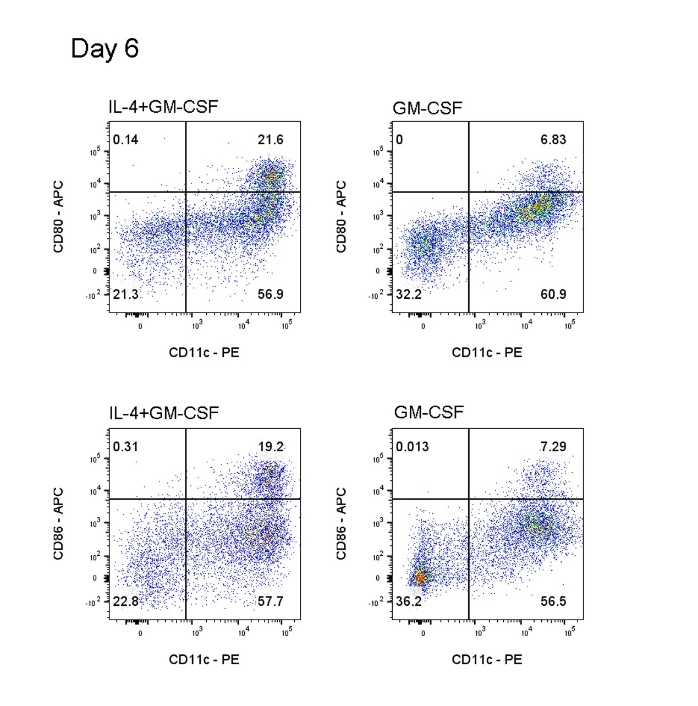
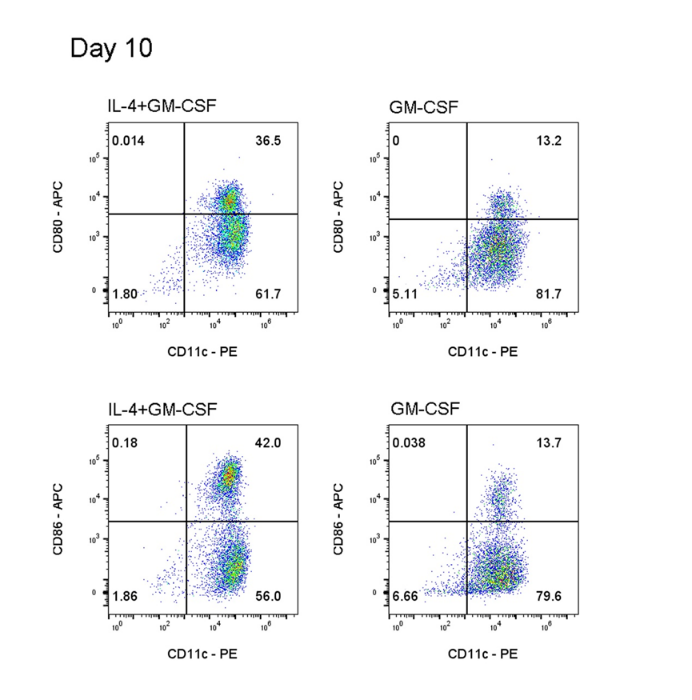
Notes:
Loosely adherent BM-derived cells were harvested and incubated with fluorescently labeled antibodies against various surface antigens.
-
About 65% of cells are induced into DCs in the GM-CSF only group on Day 6, while ~78% in the GM-CSF + IL-4 group. MHC-II+ DC cells are ~7% in the GM-CSF group, while ~20% in the GM-CSF + IL-4 group.
-
About 95% of cells are induced into DCs in the GM-CSF only group on Day 10, while ~98% in the GM-CSF + IL-4 group. MHC-II+ DC cells are ~14% in the GM-CSF group, while ~40% in the GM-CSF + IL-4 + TNF-α group.
Product Information:
| Product Name | Contents | Catalog Number |
|---|---|---|
| Mouse BMDC Induction & Differentiation Cytokine Kit | GM-CSF Protein, IL-4 Protein, TNF-α Protein | UA090008 |
III. Why are BMDCs So Important?
The establishment of the BMDC model has brought revolutionary convenience to fields such as immunology, oncology, vaccine development, and drug screening.
- Stable and Abundant Cell Source
Compared to the laborious isolation of small numbers of dendritic cells from the spleen or lymph nodes, BMDC technology allows for the easy acquisition of tens of millions of relatively uniform cells in the laboratory, enabling large-scale experiments. - An "Ideal Window" for Studying Immune Responses
Scientists can use BMDCs to visually study the "life cycle" of dendritic cells:
-
Antigen Uptake: Observe how BMDCs phagocytose and process protein antigens or pathogens.
-
Maturation and Activation: Study which signals (e.g., inflammatory cytokines, PAMPs) stimulate BMDCs to upregulate Major Histocompatibility Complex (MHC) molecules, co-stimulatory molecules, etc., thereby completing the transition from "sentry" to "messenger."
-
T Cell Activation: In co-culture experiments, directly observe how activated BMDCs effectively prime naïve T cells, initiating a specific immune response.
3. Platform for Cancer Immunotherapy R&D
In the field of cancer immunotherapy, BMDCs are the core material for preparing dendritic cell vaccines. Researchers can "train" BMDCs in vitro with tumor antigens, then infuse these "informed" BMDCs back into the body to educate T cells to precisely recognize and kill tumor cells. This strategy holds great promise for personalized cancer therapy.
4. Safety and Efficacy Evaluation of Drugs and Adjuvants
How effective are novel vaccine adjuvants or immunomodulatory drugs? BMDCs serve as an excellent "touchstone." By observing the effects of drugs on BMDC maturation and function, one can quickly predict their ability to activate or suppress immune responses in vivo, providing crucial evidence for subsequent animal studies and clinical research.
Conclusion
Bone marrow-derived dendritic cells, a bridge connecting basic research and clinical application, have significantly accelerated our understanding of the immune system due to their accessibility, stability, and functional reliability. From unraveling the fundamental principles of immune activation to driving innovative therapies toward the clinic, BMDCs, as a powerful tool for immunologists, will continue to play an irreplaceable key role in humanity's battle against infections, cancer, and autoimmune diseases.
This article is reviewed and published by the technical expert team of UA
Disclaimer: This article partially utilizes artificial intelligence assistance in its creation. If any content involves copyright or intellectual property issues, please let us know and we promise to verify and remove it as soon as possible.
Purchase recombinant protein, choose Nanjing UA-Bio
UA protein focuses on providing various protein reagents, raw materials, and services required for drug research and development, cell therapy, gene therapy, and basic scientific research, including drug target proteins, immune checkpoint proteins, cytokines, tool enzymes, customized protein expression, and full-length transmembrane protein development. Youai is committed to providing customers with high-quality products and professional services, and building a High-tech Biological Enterprise with International Competitiveness.

Sudhakar Singh; Azeez Tehseen; Mohammed Iqbal; Sharvan Sehrawat. In Vitro Bone Marrow–Derived Dendritic Cells (BMDC) Generation for Antigen Presentation Assay.BIO-PROTOCOL.2025.






 Business license (three certificates in one)