




Hitting the Pause Button on the Inflammasome——UNive's NEK7/NLRP3 Full Workflow Reagent Solutions


Aberrant activation of the NLRP3 (NOD-like receptor family, pyrin domain-containing protein 3) inflammasome has been confirmed as a key pathogenic mechanism in various human diseases, including atherosclerosis (Duewell et al., 2010), gout (Martinon et al., 2006), multiple sclerosis (Inoue et al., 2012), Alzheimer's disease (Halle et al., 2008), and several malignancies (Kolb et al., 2014; Karki et al., 2017; Sekaran et al., 2024). The NLRP3 inflammasome is a cytosolic multi-protein complex composed of the pattern recognition receptor (PRR) NLRP3, the adapter protein ASC (apoptosis-associated speck-like protein containing a CARD), and the effector pro-caspase-1. Gene mutations in NLRP3 can cause Cryopyrin-Associated Periodic Syndromes (CAPS), further underscoring the importance of in-depth research into its regulatory mechanisms.
- Recent Advances
- Product Information
Aberrant activation of the NLRP3 (NOD-like receptor family, pyrin domain-containing protein 3) inflammasome has been confirmed as a key pathogenic mechanism in various human diseases, including atherosclerosis (Duewell et al., 2010), gout (Martinon et al., 2006), multiple sclerosis (Inoue et al., 2012), Alzheimer's disease (Halle et al., 2008), and several malignancies (Kolb et al., 2014; Karki et al., 2017; Sekaran et al., 2024). The NLRP3 inflammasome is a cytosolic multi-protein complex composed of the pattern recognition receptor (PRR) NLRP3, the adaptor protein ASC (apoptosis-associated speck-like protein containing a CARD), and the effector pro-caspase-1. Gene mutations in NLRP3 can cause Cryopyrin-Associated Periodic Syndromes (CAPS), further underscoring the importance of in-depth research into its regulatory mechanisms.
NLRP3 activation follows the classic "two-step model": first, a "priming" stage mediated by NF-κB-driven transcriptional upregulation and post-translational modifications, followed by a "activation" stage induced by secondary stimuli that trigger inflammasome assembly and activation (Bauernfeind et al., 2009; O'Keefe et al., 2024). Activated caspase-1 not only cleaves pro-IL-1β and pro-IL-18 into their mature, active forms but also cleaves gasdermin D (GSDMD), inducing pyroptosis, a programmed, lytic form of cell death (Lamkanfi & Dixit, 2012).
Besides NLRP3, the inflammasome family includes other members such as NLRP1, NLRC4, PYRIN, and AIM2, each with specific agonists and activation mechanisms. For instance, NLRC4 recognizes bacterial flagellin via NAIP proteins, AIM2 senses cytosolic double-stranded DNA, and PYRIN responds to inhibition of RhoA GTPase signaling. These diverse activation modes reflect the high adaptability and specificity of the immune system to pathogenic stimuli.
Given the central role of NLRP3 in various inflammatory diseases, the development of targeted inhibitors has become a major focus in drug discovery. MCC950 (CRID3/CP-456773), as the first highly selective NLRP3 inhibitor, binds to the Walker A motif in the NLRP3 NACHT domain, blocking its ATPase activity, and has shown efficacy in CAPS models (Coll et al., 2015). Although its derivatives like Inzomelid and Somalix have entered Phase I clinical trials, potential hepatotoxicity limits their further development. Consequently, researchers are actively exploring novel-structure, diverse-mechanism NLRP3 inhibitors, including RRx-001, OLT1177, Tranilast®, and CY-09. Among them, SLC-3037 offers a novel intervention strategy by blocking the NEK7-NLRP3 interaction (Park et al., 2023).
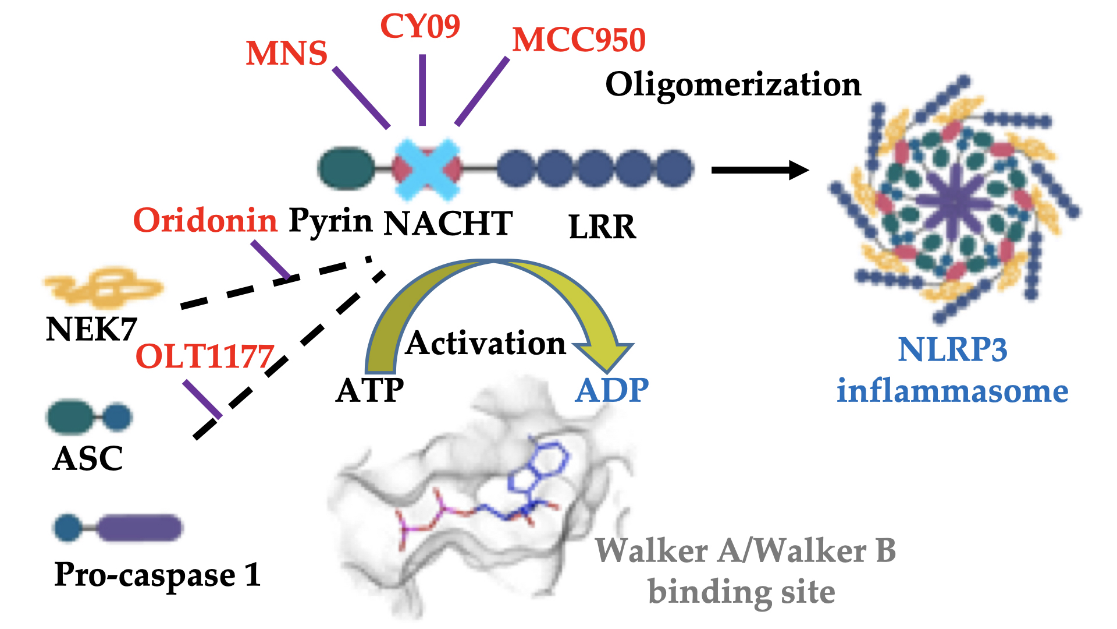
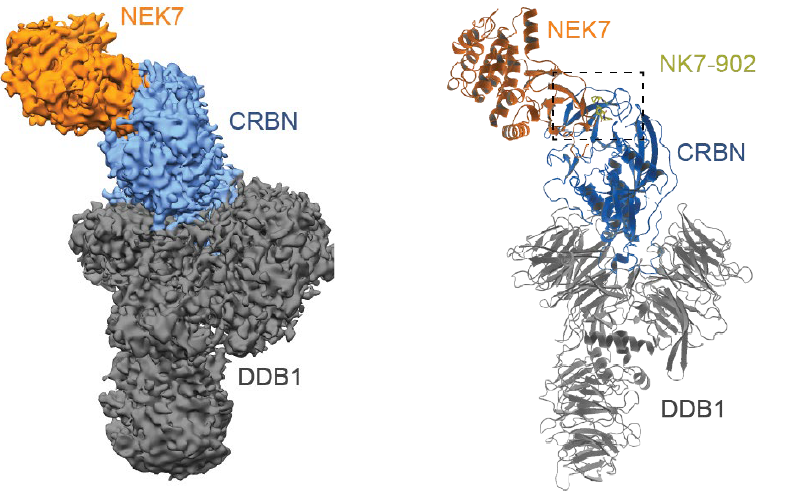
Recent studies suggest that NIMA-related kinase 7 (NEK7) may participate in the correct assembly and activation of the NLRP3 inflammasome independently of its kinase activity; therefore, reducing NEK7 protein levels could potentially block NLRP3 activation. Given that NEK7 contains a glycine β-hairpin loop degron, a structure common in many proteins targeted by CRBN molecular glue degraders, Novartis employed this strategy to degrade NEK7, thereby inhibiting the NLRP3 inflammasome. The molecule NK7-902 was identified as a CRBN molecular glue degrader of NEK7. NK7-902 potently and selectively degrades NEK7 in human primary monocytes, peripheral blood mononuclear cells (PBMCs), and whole blood. Pipeline-front molecules like MRT-8102 and CT-02 have advanced to Phase I clinical trials.
UNLWBIO bundles 'Target Protein + Functional Reagents + Detection Antibodies' in one package, covering the entire NEK7/NLRP3 drug discovery funnel. We help you compress HTS, MOA, PK/PD, and translational medicine timelines by 30% and save 50% in costs!
① Target Confirmation & Binding Assays
-
Recombinant Human CRBN/DDB1 Protein (Cat#: UA080011, DDB1/CRBN Complex, His Tag Protein, UA BIOSCIENCE)
-
Biotinylated Recombinant Human CRBN/DDB1 (Cat#: UA080262, Biotinylated CRBN/DDB1 Protein, UA BIOSCIENCE)
-
Recombinant Human NEK7 Protein (Cat#: 05-131, NEK7, Carnabio)
-
Recombinant Human NLRP3 Protein (Cat#: UA080513, NLRP3 Protein, Human, UA BIOSCIENCE)**
-
THUNDER™ TR-FRET Toolbox Protein Interaction Reagents
| Europium | Acceptor | |
|---|---|---|
| Anti His | EUHIS-1000 | FRHIS-1000 |
| Streptavidin | EUSA-1000 | FRSA-1000 |
| Anti GST | EUGST-1000 | FRGST-1000 |
② High-Throughput Cellular Screening
NEK7 Degradation & Pyroptosis Pathway Related Protein Detection
| Human | Mouse | |
|---|---|---|
| Anti-NLRP3 Rabbit Mab | S0B1123 | S0B6440 |
| Anti-NEK7 Rabbit Mab | S0B6365 | |
| Anti-ASC Rabbit Mab | S0B1370 | |
| Anti-GSDMD Rabbit Mab | S0B6191 | |
| Anti-Caspase-1 Rabbit Mab | S0B1231 | S0B6382 |
| Anti-pro Caspase-1 Rabbit Mab | S0B6378 |
-
Read "Degradation-Oligomerization-Pyroptosis" three endpoints within 3 hours, Z' > 0.8
Ready-to-Use Inflammasome Activation Model Reagents
-
LPS (UA080443) + Nigericin (abs831133) + Sytox Green Dye (abs47038985)
③ Specificity & Counterscreening
*TNF-α / IL-6 / IL-1β Detection*
-
Distinguish "NLRP3-specific IL-1β↓" from "broad-spectrum NF-κB inhibition", easily excluding pathway-toxic hits.
| OneStep ELISA | TR-FRET | |||
|---|---|---|---|---|
| Human | Mouse | Human | Mouse | |
| TNF-α | S0C3024 | S0C3023 | KIT-TNFA-500 | KIT-MTNFA-500 |
| IL-6 | S0C3004 | S0C3019 | KIT-IL6-500 | KIT-MIL6-500 |
| IL-1β | S0C3013 | S0C3029 | KIT-IL1B-500 | KIT-MIL1B-500 |
-
Caspase-1 Activity Colorimetric Assay Kit (Cat#: abs50023, Caspase 1 Activity Assay Kit, Absin)
-
Cross-validate with IL-1β release data to confirm the degrader acts on the inflammasome itself, not downstream secretion.
④ NLRP3 ATPase Activity and Inhibition
-
ADP Kinase Activity Assay Kit (Cat#: UA070101, UA-Glo® Kinase ADP Assay, UA BIOSCIENCE)
⑤ Translational Medicine & Preclinical PK/PD
-
Universal protocol for Human/Monkey/Mouse PBMC**
-
Serum IL-1β sensitivity: 2.519 pg/mL
-
OneStep Human IL-1β Assay Kit (Cat#: S0C3013, Human IL-1β OneStep ELISA Kit, STARTER)
-
OneStep Mouse IL-1β Assay Kit (Cat#: S0C3029, Mouse IL-1β OneStep ELISA Kit, STARTER)
*In Vivo Efficacy Validation – Intervention effect of NLRP3-targeting compounds on Experimental Autoimmune Encephalomyelitis (EAE)*
-
Antigen: MOG₃₅₋₅₅ Peptide (abs815889), used to induce T-cell-mediated demyelination.
-
Adjuvant: Complete Freund's Adjuvant (abs9270, containing 5 mg/mL heat-killed Mycobacterium tuberculosis), potentiates NLRP3-dependent innate immune activation.
-
Permeability Enhancer: Pertussis Toxin (abs42024902 / abs42024900), disrupts the blood-brain barrier and provides a secondary stimulus for NLRP3 inflammasome activation.
This article is reviewed and published by the technical expert team of UA
Disclaimer: This article partially utilizes artificial intelligence assistance in its creation. If any content involves copyright or intellectual property issues, please let us know and we promise to verify and remove it as soon as possible.
Purchase recombinant protein, choose Nanjing UA-Bio
UA protein focuses on providing various protein reagents, raw materials, and services required for drug research and development, cell therapy, gene therapy, and basic scientific research, including drug target proteins, immune checkpoint proteins, cytokines, tool enzymes, customized protein expression, and full-length transmembrane protein development. Youai is committed to providing customers with high-quality products and professional services, and building a High-tech Biological Enterprise with International Competitiveness.







 Business license (three certificates in one)