ROR1, full - name receptor tyrosine kinase - like orphan receptor 1, is a transmembrane protein in the ROR receptor family. In recent years, due to its high - expression characteristics in a variety of malignant tumors, ROR1 has become a research hotspot in the field of biomedicine and is considered a new drug target with broad - spectrum anti - cancer potential.
ROR1 is relatively low - expressed or not expressed in normal human tissues, but it is highly expressed in a variety of malignant tumors or tissues. For example, in chronic lymphocytic leukemia (CLL), breast cancer, ovarian cancer, melanoma, lung adenocarcinoma, etc. This characteristic of high expression in tumors and low expression in healthy cells makes ROR1 an extremely attractive target for drug development. After ROR1 binds to the ligand Wnt5a, it can mediate the signal transduction of the non - canonical Wnt signaling pathway, and then play important roles in promoting tumor growth and metastasis, inducing tumor cell drug resistance, and inhibiting cell apoptosis.
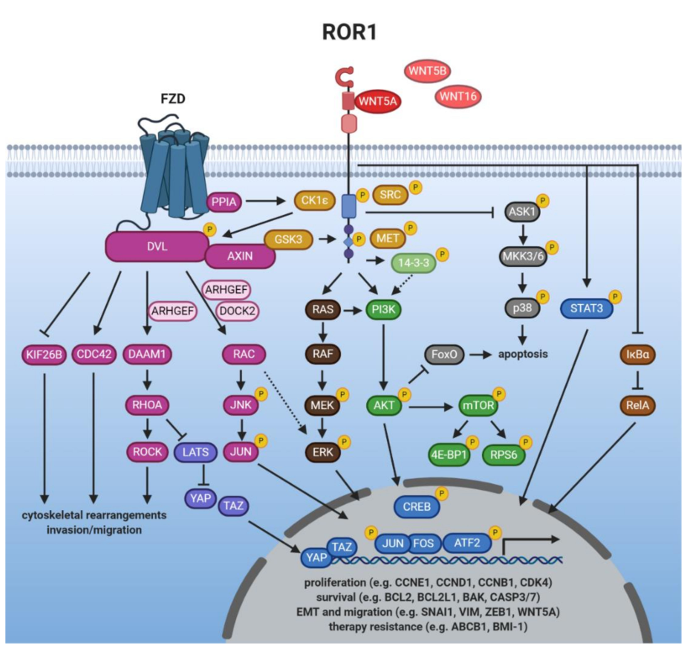
doi:10.3390/cells10010142
Currently, drug development targeting the ROR1 target mainly focuses on multiple directions such as monoclonal antibodies, bispecific antibodies, CAR - T, and ADC.
The ADC field is the most active. In 2020, both Merck & Co., Inc. and Boehringer Ingelheim invested huge amounts of money to acquire two ROR1 ADC drugs respectively. Among them, Merck & Co., Inc. acquired VelosBio at a price of up to $2.75 billion, and its core asset is a ROR1 ADC drug named zilovertamab vedotin. Just one month later, Boehringer Ingelheim also acquired NBE - Therapeutics for 1.18 billion euros, with the focus of the acquisition being to obtain a ROR1 ADC named NBE - 002 developed by the latter. In October of the same year, CSPC Ouyi Pharmaceutical Co., Ltd. successfully licensed in the ROR1 - targeted ADC drug LCB71 developed by the South Korean biopharmaceutical company LCB by paying an upfront payment of $10 million, as well as up to $353 million in milestone payments and additional tiered royalties.
The clinical progress of monoclonal antibody drugs is the fastest. For example, Cirmtuzumab developed by Oncternal Therapeutics is a humanized monoclonal antibody targeting ROR1. When Cirmtuzumab binds to ROR1 on the surface of tumor cells, it can block the activation of Wnt5a, and then induce tumor cell differentiation and inhibit the proliferation, migration, and survival of tumor cells. Currently, the clinical trial of Cirmtuzumab in combination with ibrutinib for the treatment of chronic lymphocytic leukemia (CLL) and mantle cell lymphoma (MCL) is in the phase I/II stage, and the phase I trial of combining it with docetaxel for the treatment of metastatic breast cancer is also recruiting patients.
CAR - T cell therapy has also been a research hotspot in recent years. As a new target for CAR - T cell therapy, ROR1 has shown encouraging preliminary results in a number of clinical trials. For example, a phase 1/2, single - arm, open - label, multicenter study (ONCT - 808 - 101) for patients with relapsed/refractory (R/R) aggressive B - cell malignancies showed that ROR1 CAR - T cell therapy achieved complete metabolic response (CMR) or partial response (PR) in some patients. Although adverse events such as decreased blood cell counts and pneumonia occurred in some patients, overall, ROR1 CAR - T cell therapy has shown good safety and anti - tumor activity in clinical trials.
The clinical situation of the ROR1 target:

The above data are collated from public data.
In conclusion, as a new drug target with broad - spectrum anti - cancer potential, significant progress has been made in the clinical research of ROR1. The research on various drug forms such as monoclonal antibodies, CAR - T, and ADC is in full swing, providing new possibilities for tumor treatment. With the deepening of research and technological innovation, the clinical application prospects of the ROR1 target will be broader, and it is expected to bring more effective treatment options for cancer patients.












 Business license (three certificates in one)