




The Key to Stem Cell Culture: Cytokines


Stem cells are a unique type of cells endowed with the capacity for self-renewal and differentiation, enabling them to develop into various cell types and subsequently form diverse tissues and organs within the human body. In recent years, with the advancement of stem cell research, their potential applications in the medical field have increasingly broadened. This article aims to provide a comprehensive exploration of stem cells, encompassing their classification, applications, the critical role of cytokines in their cultivation, as well as the current developmental status and future prospects.
- Recent Advances
Introduction
Stem cells are a unique type of cells endowed with the capacity for self-renewal and differentiation, enabling them to develop into various cell types and subsequently form diverse tissues and organs within the human body. In recent years, with the advancement of stem cell research, their potential applications in the medical field have increasingly broadened. This article aims to provide a comprehensive exploration of stem cells, encompassing their classification, applications, the critical role of cytokines in their cultivation, as well as the current developmental status and future prospects.
Classification of Stem Cells
Stem cells can be categorized into various types based on their origin, developmental stage, and differentiation potential. Firstly, according to the developmental stage, stem cells can be classified into embryonic stem cells (ESCs) and adult stem cells. Embryonic stem cells possess the ability to differentiate into various tissues and cell types, whereas adult stem cells primarily reside in specific tissues of the human body, such as hematopoietic stem cells, mesenchymal stem cells in bone marrow, neural stem cells, and hepatic stem cells. Secondly, based on their origin, stem cells can be divided into autologous stem cells and allogeneic stem cells. Furthermore, depending on their differentiation potential, stem cells can be classified as totipotent, pluripotent, or unipotent stem cells.
Applications of Stem Cells
The applications of stem cells in the medical field are extensive and profound. Firstly, stem cells can be utilized in the treatment of neurodegenerative diseases, such as dementia and Parkinson's disease. Through stem cell transplantation, brain function can be improved, thereby alleviating symptoms. Secondly, stem cells play a significant role in anti-aging. The reinfusion of autologous stem cells can effectively enhance and replenish the metabolism of brain or body cells, including skin cells, maintaining skin vitality. Additionally, stem cells can be employed to improve joint cell activity, promote the treatment of arthritis, and delay joint aging. Moreover, stem cells are instrumental in treating immune-related diseases by protecting immune cells or cells under immune attack, thereby improving their functionality.
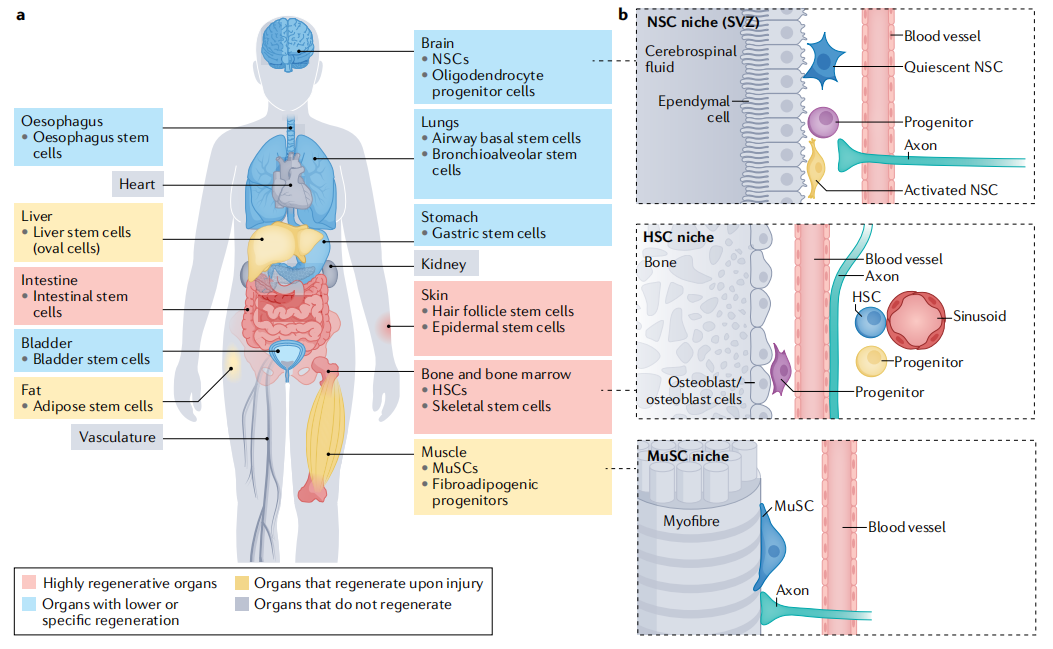
Source: Nature Reviews Molecular Cell Biology
The figure above illustrates organs containing stem cells and their niches.
a. Multiple organs in humans and other mammals contain stem cells and stem cell niches. The figure depicts highly regenerative organs with highly active stem cells; organs with limited regeneration, where stem cells are sometimes confined to specific regions; and organs capable of regeneration post-injury, where dormant stem cells are largely activated by injury. Some organs cannot regenerate and lack stem cells (or their presence is controversial).
b. Organization of adult stem cell niches in the brain, blood, and muscle. Examples of markers for adult neural stem cells (NSCs) include SOX2, nestin, glial fibrillary acidic protein (GFAP), and CD133. Examples of markers for human adult hematopoietic stem cells (HSCs) include the presence of CD34 and absence of CD38. Examples of markers for muscle stem cells (MuSCs) include PAX7, CD34, and CD56 (in humans). SVZ, subventricular zone.
The Importance of Cytokines in Stem Cell Culture
Cytokines play a pivotal role in stem cell culture. As small glycoprotein messengers that facilitate effective communication between immune cells, they regulate the proliferation and self-renewal of stem cells. For instance, stem cell factor (SCF) binds to the receptor c-kit and acts on various cells, including epithelial cells, hematopoietic cells, and vascular endothelial cells, regulating their growth, motility, and morphogenesis. Leukemia inhibitory factor (LIF) prevents apoptosis during embryonic stem cell differentiation and promotes cell proliferation. Interleukin family cytokines, such as IL-3, IL-6, and IL-33, play a positive regulatory role in stem cell mobilization and hematopoietic stem cell proliferation. These cytokines work synergistically to maintain the stable growth and differentiation of stem cells.
| Cell Type | Cytokines |
|---|---|
| MSC (Mesenchymal Stem Cells) | EGF, GM-CSF, IL-2, LIF, PDGF-BB, FGF-Basic, IL-3, IL-6, TGF-B1, PDGF-AA, VEGF |
| NSC (Neural Stem Cells) | CNTF, EGF, Galectin-1, IGF-1, Noggin, IL-3, IL-6, LIF, FGF-Basic, FGF-8, GDNF, Neuregulin, shh, BNGF, BMP-2 |
| iPSC (Induced Pluripotent Stem Cells) | EGF, FGF-Basic, IGF-1, Noggin, PDGF-BB, shh, BMP-2, GDNF |
| HSC (Hematopoietic Stem Cells) | FGF-Basic, FLT-3 Ligand, GM-CSF, G-CSF, IL-3, IL-6, IL-7, M-CSF, VEGF165, EPO, LIF, TPO, Shh, SCF |
| ESC (Embryonic Stem Cells) | FGF-4, FGF-Basic, Heregulin, IGF-1, Noggin, IL-2, EGF, EPO, FLT-3 Ligand, IL-15, IL-3, IL-6, LIF, Activin A, BAFF, BDNF, BMP-2, BMP-4, GDF-3, TGF Beta |
| UT-7 (Human Megakaryoblastic Leukemia Cells) | EPO |
Extracellular Matrix in Stem Cell Culture |
Vitronectin is a low-molecular-weight glycoprotein found in serum and the extracellular matrix (ECM) that promotes cell adhesion, spreading, and migration. Vitronectin interacts with integrins αvβ5 and αvβ1, maintaining stem cell pluripotency, normal karyotype, and differentiation capacity in vitro. It can effectively replace Matrigel in pluripotent stem cell culture, sustaining cell proliferation and normal cellular characteristics. |
| Fibronectin, when used as a substrate for pluripotent stem cell culture, promotes cell growth, enhances cell attachment rates, improves metabolic activity, supports self-renewal, and facilitates differentiation into specific cell types, such as cardiomyocytes and pancreatic islet cells, in specific culture systems. |
Future Prospects
With the deepening of stem cell research, the clinical applications of stem cell therapy are expanding rapidly. The market size for stem cell therapy in China continues to grow and is expected to further increase in the coming years. Simultaneously, stem cell technology has shown significant potential in areas such as autoimmune diseases, genetic disorders, and bone and cartilage repair, highlighting its broad application prospects. Additionally, a vast number of stem cell samples have been preserved globally, and tens of thousands of stem cell transplantations have been performed, providing robust clinical data to support the development of stem cell therapy.
Looking ahead, as stem cell technology advances and clinical experience accumulates, stem cell therapy will play an increasingly important role in various fields. Furthermore, the integration of gene editing and cell therapy technologies will further enhance the efficacy and safety of stem cell treatments. Thus, stem cell technology holds immense developmental potential and a promising market outlook.
In conclusion, stem cells, as a cell type with remarkable differentiation capabilities, offer vast prospects in the medical field. By delving into their classification, applications, the importance of cytokines in their cultivation, and their current developmental status and future prospects, we can provide stronger support for the advancement of stem cell therapy and contribute significantly to human health.
For detailed product information, please visit: https://www.ua-bio.com/cellFactor.html.
Click on the corresponding factors to view a variety of species-specific and comprehensive product data.
This article is reviewed and published by the technical expert team of UA
Disclaimer: This article partially utilizes artificial intelligence assistance in its creation. If any content involves copyright or intellectual property issues, please let us know and we promise to verify and remove it as soon as possible.
Purchase recombinant protein, choose Nanjing UA-Bio
UA protein focuses on providing various protein reagents, raw materials, and services required for drug research and development, cell therapy, gene therapy, and basic scientific research, including drug target proteins, immune checkpoint proteins, cytokines, tool enzymes, customized protein expression, and full-length transmembrane protein development. Youai is committed to providing customers with high-quality products and professional services, and building a High-tech Biological Enterprise with International Competitiveness.







 Business license (three certificates in one)