




FOLR1 (Folate Receptor Alpha): A Promising Target for Cancer Therapy with a Bright Future


FOLR1, also known as folate receptor alpha, is a glycoprotein widely expressed on the surface of human cells. It primarily facilitates the transport and metabolism of folate within cells, playing a critical role in cell growth and division. However, in various cancer cells, the expression level of FOLR1 is frequently aberrantly elevated, rendering it a potential therapeutic target for cancer treatment.
- Recent Advances
- Product Information
Introduction
In the extensive exploration of cancer treatment, scientists have consistently sought to identify targets capable of effectively inhibiting tumor growth and metastasis. In recent years, a target protein known as FOLR1 has gradually garnered attention, with its potential in cancer therapy sparking widespread interest.
FOLR1, or folate receptor alpha, is a glycoprotein widely expressed on the surface of human cells. It primarily facilitates the transport and metabolism of folate within cells, playing a critical role in cell growth and division. However, in various cancer cells, the expression level of FOLR1 is frequently aberrantly elevated, rendering it a potential therapeutic target for cancer treatment.
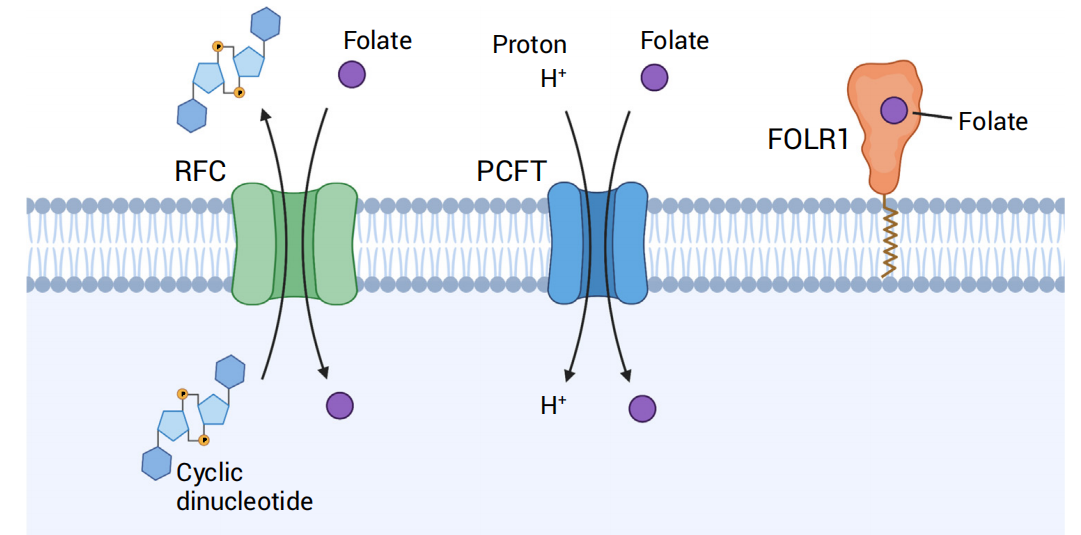
Overexpression of FOLR1 and Its Association with Cancer Progression
FOLR1 is overexpressed in many epithelial-derived cancers. The highest levels of FOLR1 overexpression are observed in cancers of the female reproductive tissues, such as ovarian and uterine cancers. Significant overexpression of FOLR1 has also been noted in brain cancers. Additionally, FOLR1 overexpression is associated with metastatic pancreatic cancer and lymphoma. Numerous studies have been conducted to determine the relationship between FOLR1 overexpression and cancer progression or reduced patient survival rates. Analyses of breast cancer, lung cancer, endometrial cancer, and ovarian cancer have evaluated the impact of FOLR1 overexpression on patient survival. It has been reported that breast cancer with high FOLR1 expression has a hazard ratio (HR) of 2.66 for disease-free survival (DFS) and 1.97 for overall survival (OS), indicating a 97% increased likelihood of patient mortality due to FOLR1 overexpression in breast cancer. The HR for DFS in endometrial cancer is 1.3. No statistically significant increase in DFS or OS was observed in ovarian or lung cancer.
However, it is important to note that the proportion of ovarian cancers expressing FOLR1 is so high that comparisons between FOLR1-expressing and non-expressing cells are less relevant. Although FOLR1 expression does not correlate with survival rates in all types of ovarian cancer, higher FOLR1 expression is observed in ovarian cancers with higher histological grades, advanced stages, increased aneuploidy, and a higher percentage of S-phase cells, all of which are markers of cancer progression and greater resistance to chemotherapy. Patients with serous ovarian cancer and higher FOLR1 expression levels exhibit increased HRs for DFS (2.45) and OS (3.60). Furthermore, in vitro inhibition of FOLR1 in ovarian cancer cells reduces cancer attributes such as cell proliferation, soft agar growth, and cell migration and invasion.
| Tissue and Cancer | Express High FOLR1 (%) | Ratio Cancer/Normal FOLR1 Protein |
|---|---|---|
| Ovary | - | - |
| Primary tumor | 72 | - |
| Serous carcinoma | 82, 100 | 22.3 |
| Endometrioid carcinoma | 22, 67, 100 | 10.2 |
| Mucinous carcinoma | 0, 22, 55 | 1.2 |
| Clear cell carcinoma | 63, 80 | - |
| Metastatic | 90, 100 | 30.1 |
| Normal | 0 | 1 |
| Uterus | - | - |
| Endometrial primary carcinoma | 20 | 9.8 |
| Endometrial metastatic | 100 | 8.6 |
| Uterine serous carcinoma | 69 | - |
| Normal | 0 | 1 |
| Brain | - | - |
| Primary carcinoma | 25 | 14.1 |
| Normal | 0 | 1 |
| Pancreas | - | - |
| Primary carcinoma | 10 | 1.5 |
| Metastatic | 100 | 3.6 |
| Pancreatic ductal adenocarcinoma | 80 | - |
| Normal | 0 | 1 |
| Lymphoma | - | - |
| Primary | 0 | 1 |
| Metastatic | 50 | 2.1 |
| Normal | - | - |
| Breast | - | - |
| Primary carcinoma | 43 | 1.9 |
| Triple-negative breast cancer (TNBC) | 67 | - |
| Metastatic TNBC | 50 | - |
| Normal | 20 | 1 |
| Lung | - | - |
| Primary carcinoma | 36 | 0.8 |
| Adenocarcinoma | 60, 72, 74 | 0.9 |
| Mesothelioma | 67 | 1 |
| Metastatic | 50 | 0.8 |
| Squamous cell carcinoma | 13, 33, 51 | - |
| Normal | 75 | 1 |
| Kidney | - | - |
| Primary carcinoma | 86 | 0.9 |
| Metastatic | 50 | 0.3 |
| Normal | 100 | 1 |
| Liver | - | - |
| Primary carcinoma | 0 | 1.3 |
| Normal | 0 | 1 |
| Prostate | - | - |
| Primary carcinoma | 0 | 1.2 |
| Normal | 0 | 1 |
| Colorectal | - | - |
| Primary carcinoma | 33 | 0.1 |
| Metastatic | 44 | 0.8 |
| Normal | 7 | 1 |
| Bladder | - | - |
| Primary carcinoma | 20 | 0.7 |
| Normal | 50 | 1 |
Source: CELLPRESS
Clinical Progress
Currently, several FOLR1-targeted drugs have entered clinical trials, yielding preliminary results.
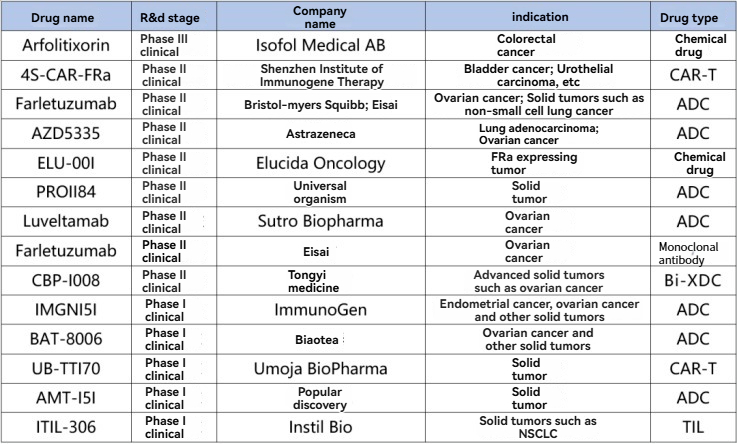
FOLR1-Targeted Drugs in Global Clinical Trials
Source: PharmaDB (incomplete statistics)
These targeted drugs primarily function by binding to FOLR1, blocking its normal activity, and thereby inhibiting cancer cell growth. Compared to traditional chemotherapy drugs, these targeted therapies exhibit higher specificity and lower side effects, offering patients a better treatment experience.
Additionally, immunotherapy targeting FOLR1 is continually evolving. By activating the patient's immune system, it enables the recognition and attack of FOLR1-expressing cancer cells, thereby achieving effective cancer control. This treatment approach offers long-term efficacy and lower recurrence rates, providing new hope for cancer patients.
Future Prospects
As a novel target in cancer therapy, FOLR1 offers new treatment options and hope for cancer patients. With the continuous advancement of scientific technology and in-depth clinical research, it is anticipated that more effective FOLR1-targeted therapies will emerge in the future, bringing improved treatment outcomes and quality of life to patients.
At the same time, it is essential to recognize that cancer treatment is a complex and prolonged process requiring multifaceted efforts and collaboration. Beyond targeted drug therapies, attention must be paid to early cancer screening and prevention, as well as improving patients' quality of life and psychological support. Only through such comprehensive approaches can we better address the global health challenge posed by cancer.
This article is reviewed and published by the technical expert team of UA
Disclaimer: This article partially utilizes artificial intelligence assistance in its creation. If any content involves copyright or intellectual property issues, please let us know and we promise to verify and remove it as soon as possible.
Purchase recombinant protein, choose Nanjing UA-Bio
UA protein focuses on providing various protein reagents, raw materials, and services required for drug research and development, cell therapy, gene therapy, and basic scientific research, including drug target proteins, immune checkpoint proteins, cytokines, tool enzymes, customized protein expression, and full-length transmembrane protein development. Youai is committed to providing customers with high-quality products and professional services, and building a High-tech Biological Enterprise with International Competitiveness.







 Business license (three certificates in one)