




The IL-6 Family: A Multifaceted Player in Immune Regulation and Disease


Within the intricate immune system of the human body, the Interleukin (IL) family assumes a pivotal role. Among its members, IL-6, as a significant constituent, is intricately involved not only in immune regulation, hematopoiesis, and inflammatory processes but also closely associated with the onset and progression of various diseases. This article delves into the biological characteristics, physiological functions, and roles of the IL-6 family in disease contexts.
- Recent Advances
- Product Information
- Reference
Introduction
Within the intricate immune system of the human body, the Interleukin (IL) family plays a pivotal role. Among its members, IL-6, as a key representative, is not only involved in immune regulation, hematopoiesis, and inflammatory processes but is also closely associated with the onset and progression of various diseases. This article will delve into the biological characteristics, physiological functions, and roles of the IL-6 family in disease contexts.
Overview of the IL-6 Family
The IL-6 family is a large group of cytokines, including IL-6, IL-11, CNTF, LIF, OSM, CT-1, CLC, NPN, IL-27, and IL-31, among others. These cytokines share structural similarities and exhibit overlapping mechanisms of action. As a representative member of this family, IL-6 has a molecular weight of 21–30 kDa and is composed of two glycoprotein chains (α and β chains). It binds to the IL-6 receptor (IL-6R) on the surface of various cells, thereby exerting a wide range of biological effects.
Biological Characteristics: IL-6 can be synthesized by multiple cell types, including activated T and B cells, monocytes/macrophages, endothelial cells, epithelial cells, and fibroblasts. The human IL-6 gene is located on chromosome 7, and its expression is regulated by various factors such as infection, inflammation, and stress.
Physiological Functions: IL-6 plays a crucial role in immune responses, acute-phase reactions, and hematopoietic regulation. It promotes B cell proliferation and differentiation, enhances macrophage phagocytic function, and stimulates hepatocytes to synthesize acute-phase proteins. Additionally, IL-6 can synergize with other cytokines, such as IL-1, to induce the release of hormones like adrenocorticotropic hormone (ACTH) and corticotropin-releasing factor (CRF).
Roles of the IL-6 Family in Diseases

The figure above illustrates how individual IL-6 cytokine family members contribute to specific physiological immune processes and highlights their relative importance in certain disease contexts.
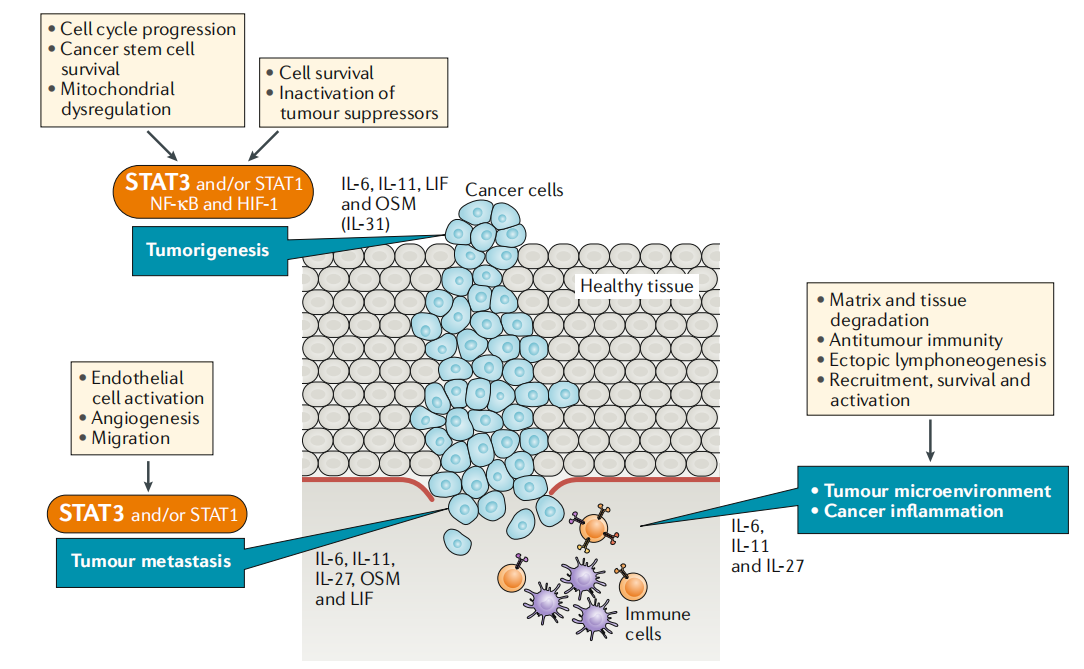
The figure outlines the cellular processes regulated by IL-6 family members, including the primary activation of signal transducer and activator of transcription 3 (STAT3) during tumorigenesis and metastasis, as well as the control of the tumor microenvironment and cancer-related inflammation. Cytokines are specifically linked to these activities. Notably, processes associated with tumor metastasis also contribute to the overall structure of the tumor microenvironment and support activities related to the development of cancer inflammation. HIF-1, hypoxia-inducible factor 1; LIF, leukemia inhibitory factor; NF-κB; OSM, oncostatin M.
Examples of IL-6 Family Members in Specific Diseases:
Role of IL-6 in Rheumatoid Arthritis (RA): IL-6 plays a critical role in the pathogenesis of RA, a chronic autoimmune disease characterized by joint inflammation and destruction. Studies have shown that IL-6 induces synovial cell proliferation and the release of inflammatory mediators, exacerbating joint inflammation. Therefore, inhibiting IL-6 signaling pathways is of great significance for RA treatment. For example, Tocilizumab, a monoclonal antibody targeting the IL-6 receptor, has been widely used in RA treatment with significant efficacy.
Role of IL-11 in Inflammatory Bowel Disease (IBD): IL-11 is a cytokine with dual pro-inflammatory and anti-inflammatory effects, playing an important role in IBD, which includes Crohn's disease and ulcerative colitis. Research indicates that IL-11 can induce the proliferation and repair of intestinal epithelial cells but may also promote the release of inflammatory mediators. Thus, the role of IL-11 in IBD is dualistic, potentially both alleviating and exacerbating inflammation.
Role of IL-27 in Anti-Tumor Immunity: IL-27, another important member of the IL-6 family, plays a significant role in anti-tumor immunity. Studies have shown that IL-27 can inhibit tumor cell proliferation and metastasis while promoting anti-tumor immune responses. For instance, in melanoma models, IL-27 activates CD8+ T cells and NK cells, thereby suppressing tumor growth and metastasis. Additionally, IL-27 can inhibit Th17 cell differentiation, reducing the production of inflammatory factors and alleviating the tumor inflammatory microenvironment.
Role of IL-31 in Atopic Dermatitis (AD): IL-31 is a pro-inflammatory cytokine that plays a crucial role in the pathogenesis of AD, a chronic inflammatory skin disease characterized by erythema, pruritus, and lichenification. Research indicates that IL-31 activates immune cells in the skin, promoting the release of inflammatory mediators and exacerbating skin inflammation. Therefore, inhibiting IL-31 signaling pathways is of great importance for AD treatment. Specific antibodies targeting IL-31 or its receptor have been developed and are undergoing clinical trials.
The IL-6 Family as Therapeutic Targets
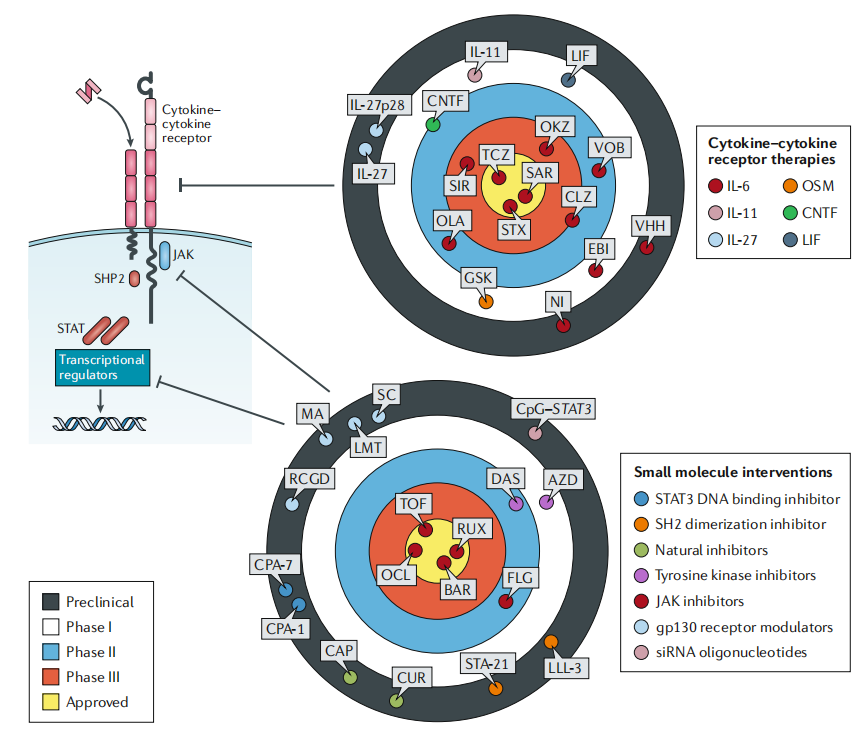
Members of the IL-6 cytokine family are drug targets for treating infections, inflammation, autoimmune diseases, and cancer. Drug categories include monoclonal antibodies and recombinant proteins targeting specific cytokines or cytokine receptors (as shown in the figure above), as well as small-molecule interventions that modulate receptor signaling activity or intracellular mechanisms related to membrane glycoprotein 130 (gp130) or Janus kinases (JAKs). The figure depicts representative cytokine-cytokine receptor complexes within the IL-6 family. Examples of these drug categories are illustrated on partitioned targets. Each target is color-coded to reflect the clinical development stage (as shown in the key at the bottom left), and the current status of individual drugs in the pipeline is indicated by the position of colored dots (corresponding to treatment types; right). Drugs with related modes of action or shared targets are colored accordingly.
AZD, AZD9150; BAR, baricitinib; CAP, capsaicin; CLZ, clazakizumab; CNTF, ciliary neurotrophic factor; CPA-1 and CPA-7, cisplatin derivatives; CpG–STAT3, CpG–STAT3 small interfering RNA; CUR, curcumin; DAS, dasatinib; EBI, EBI-031; FLG, filgotinib; GSK, GSK315234; LIF, leukemia inhibitory factor; LMT, LMT-28; MA, madindoline-A; NI, NI-1201; OCL, oclacitinib; OKZ, olokizumab; OLA, olamkicept; OSM, oncostatin M; RCGD, regulator of cartilage growth and differentiation-423; RUX, ruxolitinib; SAR, sarilumab; SC, SC144; SH2, SRC homology domain 2; SHP2, SH-PTP2; SIR, sirukumab; siRNA, small interfering RNA; STX, siltuximab; TCZ, tocilizumab; TOF, tofacitinib; VHH, VHH6; VOB, vobarilizumab.
Prospects
As a critical component of the immune system, the IL-6 family plays a complex and essential role in immune regulation, inflammation, and disease development. By further investigating the biological characteristics and physiological functions of the IL-6 family, we can gain a deeper understanding of its mechanisms in diseases, providing new insights and approaches for the diagnosis and treatment of related conditions.
This article is reviewed and published by the technical expert team of UA
Disclaimer: This article partially utilizes artificial intelligence assistance in its creation. If any content involves copyright or intellectual property issues, please let us know and we promise to verify and remove it as soon as possible.
Purchase recombinant protein, choose Nanjing UA-Bio
UA protein focuses on providing various protein reagents, raw materials, and services required for drug research and development, cell therapy, gene therapy, and basic scientific research, including drug target proteins, immune checkpoint proteins, cytokines, tool enzymes, customized protein expression, and full-length transmembrane protein development. Youai is committed to providing customers with high-quality products and professional services, and building a High-tech Biological Enterprise with International Competitiveness.

1.Ernst, M. & Putoczki, T. L. Targeting IL-11 signaling in colon cancer. Oncotarget 4, 1860–1861 (2013).
2.Hunter, C. A. & Jones, S. A. IL-6 as a keystone cytokine in health and disease. Nat. Immunol. 16, 448–457 (2015).
3.Johnson, D. E., O’Keefe, R. A. & Grandis, J. R. Targeting the IL-6/JAK/STAT3 signalling axis in cancer. Nat. Rev. Clin. Oncol. 15, 234–248 (2018).
4.Shkhyan, R. et al. Drug-induced modulation of gp130 signalling prevents articular cartilage degeneration and promotes repair. Ann. Rheum. Dis. 77, 760–769(2018).
5.Xu, S., Grande, F., Garofalo, A. & Neamati, N. Discovery of a novel orally active small-molecule gp130 inhibitor for the treatment of ovarian cancer. Mol. Cancer Ther. 12, 937–949 (2013).
6.Simon A. J. et al. Recent insights into targeting the IL-6 cytokine family in inflammatory diseases and cancer.Nature Reviews | Immunology(2018).
7.Hong, S. S. et al. A novel small-molecule inhibitor targeting the IL-6 receptor beta subunit, glycoprotein 130. J. Immunol. 195, 237–245 (2015).






 Business license (three certificates in one)